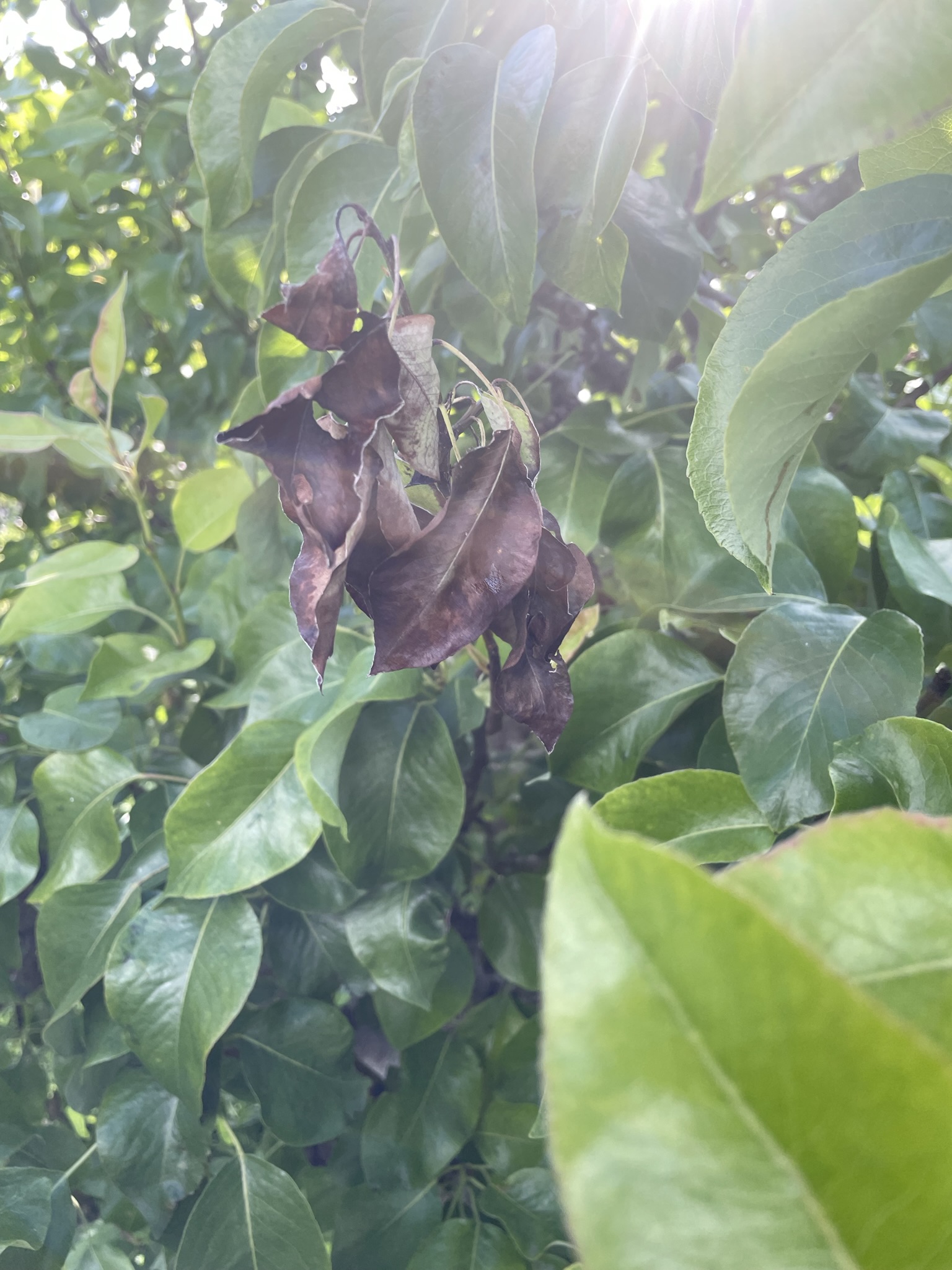
After coming out green and fresh, full of life, pear shoots can suddenly turn black and droopy. The sight is quite dramatic but can really signify anything from harmless to “quick, remove that and burn it!”. Below are two of the most frequent reasons, starting with the harmless one.
Pear shoot sawfly (Janus compressus)
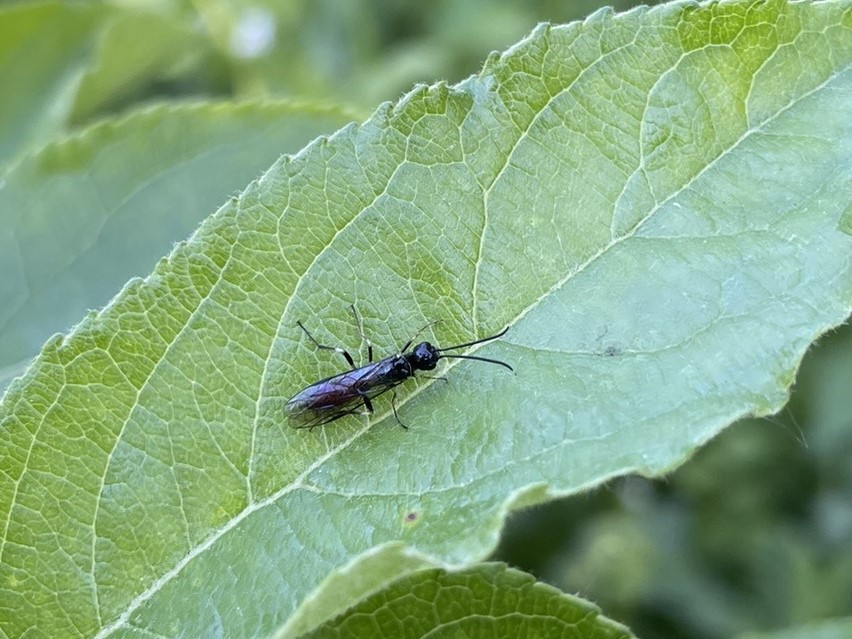
Not to be confused with the pear and cherry slugworm (Caliroa cerasi) about which a lot is to be found on the web (see ie the RHS website), this bug appears to be a more recent concern for English-speaking orchardists.
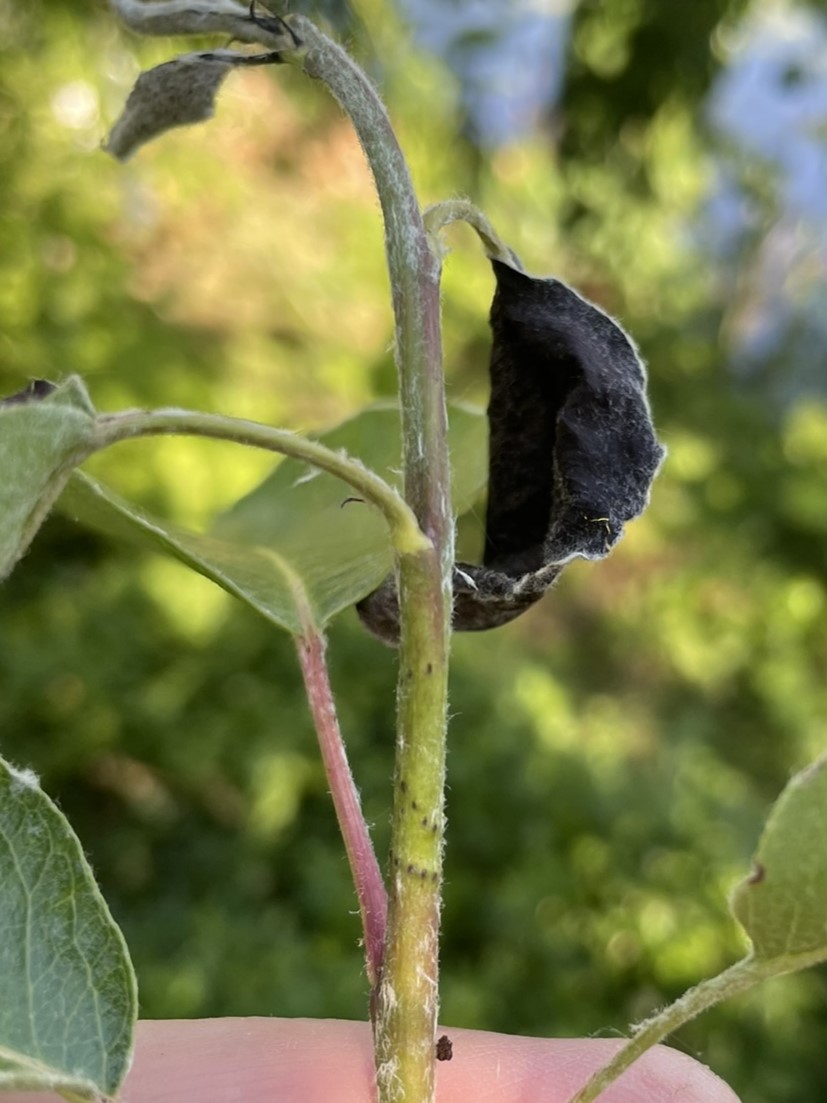
While unlikely to become a problem in a healthy, biodiverse orchard, this insect inflicts damage on the new shoots that causes them to turn black (or dark brown) and droopy to resemble a shepherd’s crook, which is also the most famous symptom of the dreaded fireblight (see below). There is however an easy tell tale sign that can put your mind at rest: at the base of the drooping and wilting shoots there is a series of spirally arranged punctures, where the female laid her egg.
An open source paper* describes the life cycle of this bug:
- Adults emerge around the end of April and fly for a long period of time, up until June.
- The female lays an egg in a shoot, or sometimes in a pear that is just about forming, which turns black and dies (also happening with fireblight).
- The egg takes about two weeks to hatch and the larva lives its life in the shoot, eating it from the inside.
- In September, it makes a hibernation chamber in situ for its winter sleep, then in March it starts pupating. The cycle starts again.
I have often wondered why, when studying horticulture, I was forced to learn spraying methods instead of the lifecycle of bugs, which is obviously the way to empower someone to develop suitable management strategies…
Fireblight (Erwinia amylovora)
I had a very unpleasant experience with this disease. In April 2022 a black bleeding lesion appeared midway through the trunk of one of my pears. I won’t lie: I did panic and removed and disposed of the little tree there and then.
Maybe I could have saved the plant. Anyway, that’s the benefit of hindsight. I spent that whole summer obsessively checking all pears and my apples for infection while researching the disease. I would terrified it would spread and destroy my beloved collection. I got my neighbours to remove a young pear tree they had got for free during the Covid lockdown, a sickly plant that was likely responsible for introducing the bacterium on site. I also stopped grafting apples on M9/26 rootstocks, in favour of the less susceptible M7.
Fireblight is so called because bad infestations can make the plant look like it’s been through a blaze. This bacterium hails from the US, so the best ID photos and management information are to be found on the websites of US universities’ agricultural extensions (ie. Cornell which provides excellent life cycle graphic, or Purdue). That information is meant for commercial growers, so they are quite liberal with their advice on chemical treatments. The RHS suggests there are no chemical treatments available (to the hobby grower), which is definitely the more sustainable approach too. Bacteria are killed with antibiotics, but we do know that extensive use of those tends to let ‘superbugs’ emerge, like MRSA.
E. amylovora is a disease of the Rosaceae family more generally, even if it affects mainly pears, apples and some ornamentals like Photinia and Pyracantha (I did briefly write about it when I first encountered the disease at Kew). There is some disagreement whether it might affect stone fruits, like plums. The reason why this disease is particularly nasty is its ability to travel inside the plant – spread systemically is the technical term for that.
The bacterium survives in inactive overwintering cankers, like the one on my little tree, which I had not spotted before. When temperatures rise, from spring onward, it awakens, multiplies and, given the right humidity, start to ooze from the cankers. Oozing is not common occurrence in cankers of pear and apple: it did make an impression on me.
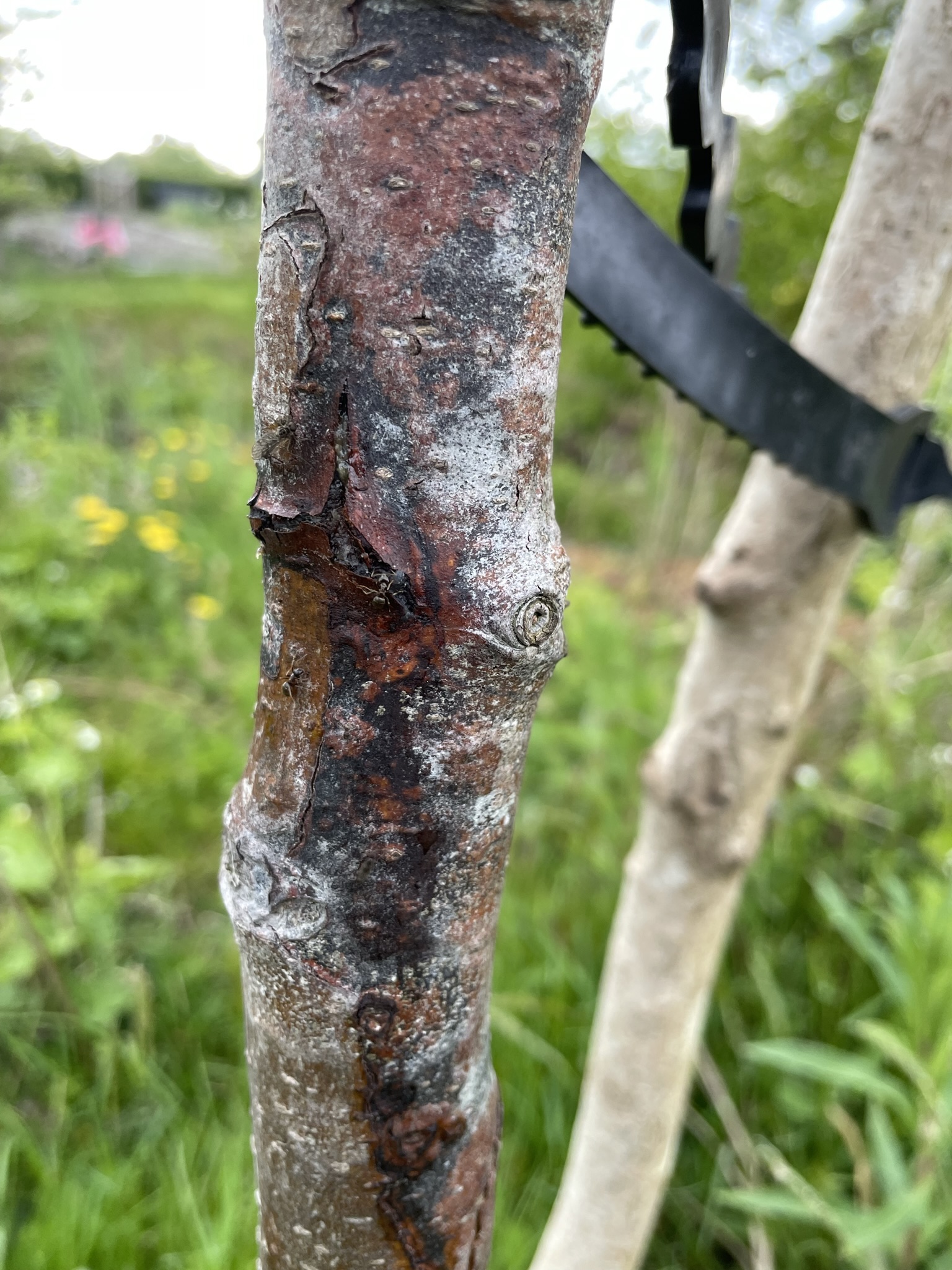
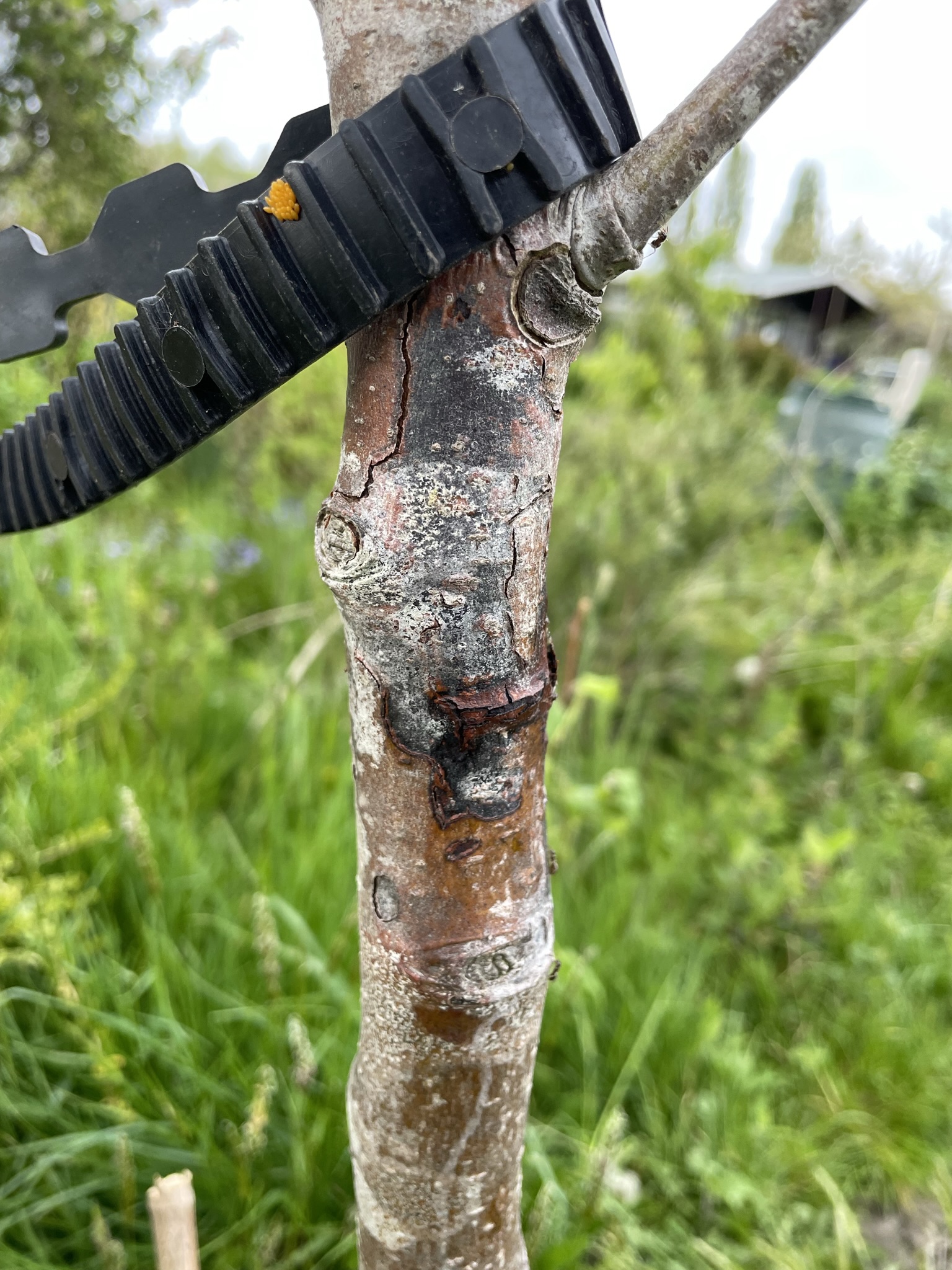
That ooze (clear/white maturing to amber) is attractive to insects, which spread it around. You can see ants in the pictures above. The disease is also spread locally by splashes, be it rain or watering (ie sprinklers).
From this early source the disease ends up in the flowers, through which it may enter young stems; in countries where the flowering seasons is quite cold, the risk is mainly associated with secondary or late flowering, aka rat tail bloom, particularly where hawthorn is also present. Natural openings in young shoots, wounds and damaged tissue (ie frost and insect damage) also provide entry points, and the cycle can continue – given the right conditions – until autumn.
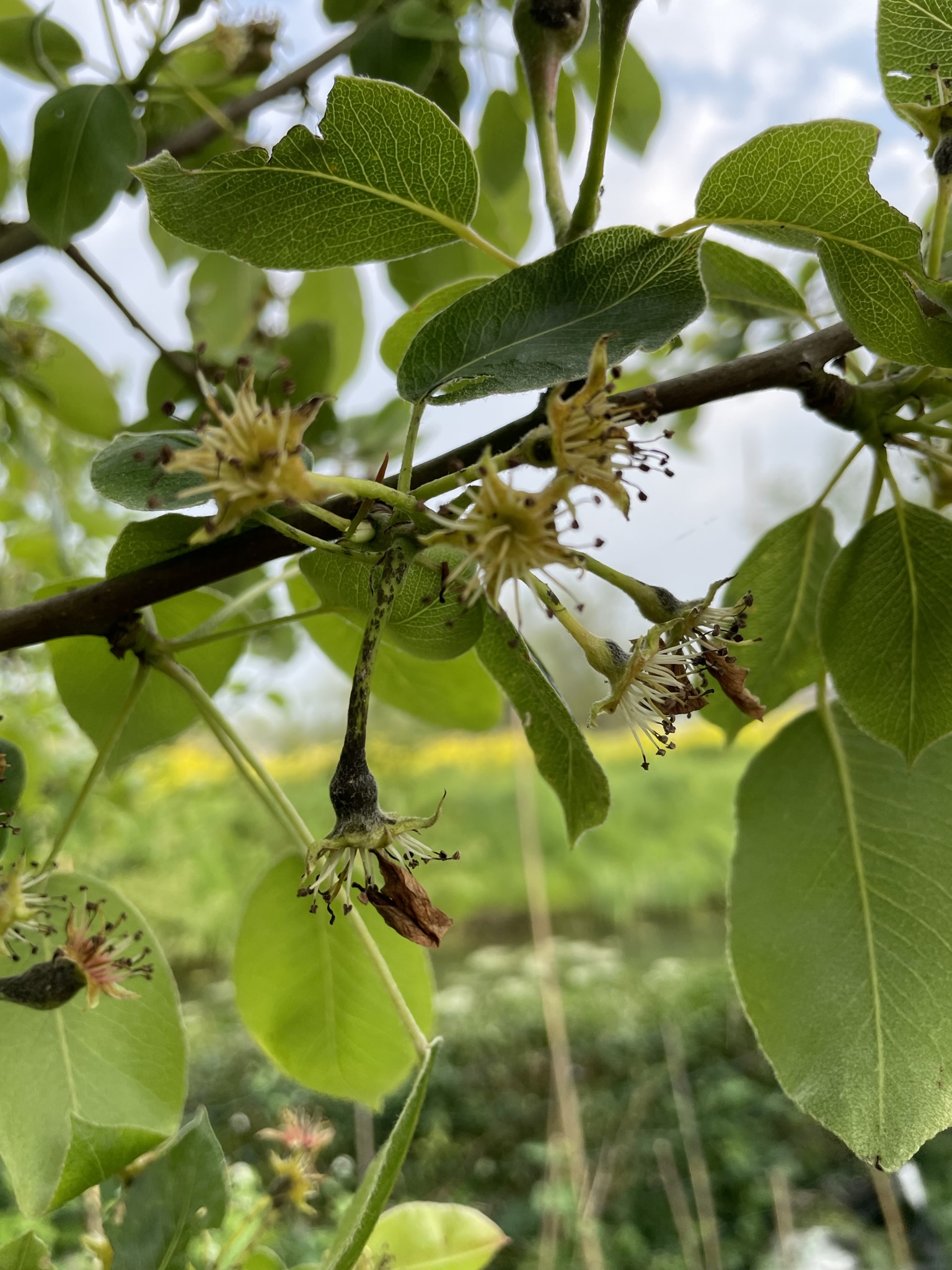
Sappy, fast growth is particularly susceptible to the disease. The advice for its cultural management is therefore to:
- prune moderately, so as not to cause too many water shoots;
- prune in the winter and dry weather when the likelihood of infection is minimal;
- feed judiciously, avoiding too much nitrogen.
Although the infection seems often to stop within the new shoots, the spread of fireblight inside a mature plant can be rather fast (and ahead of symptoms) in the right conditions. Therefore, when removing any canker on mature wood in the growing season, it is advised to do it with ample margin, ie 30-60 cm lower than the last visible symptom. As pruning wounds remain, rather unfortunately, a possible infection site until they heal, a suggestion is to leave a snag when pruning a branch, rather than properly removing it all the way down at the collar. The snag can then be cut back safely in the winter.
 M.Paola, that’s me
