One of the joys of horticulture is the continuous learning process you go through while caring for and observing your plants through the seasons, year after year.
One of the frustrations is that we seem to know rather less than we think we do about plants and the environment: it is sometimes difficult to be sure what you are looking at, and the advice you receive from all and sundry is frequently contradictory. My rule of thumb has now become: the more assertive and vocal someone is about their opinion, the more suspicious you have to be about what they say. I mean, just double (or triple) check it. After all, only science can give you a definitive answer: a lab for diseases, and entomologist for pests.
Besides, at times more than one pest, or a combination of pests, diseases and disorders can simultaneously affect a (poor!) plant, especially if it is weakened by poor growing conditions (drought, wet feet, poor soil, etc) or if – as a variety – it is particularly susceptible.
Pears have been at the centre of my attention in the last few years, what with getting more of them and having to fend off whatever enemies they seemed to be under attack from without extensive knowledge, so I’ll talk a little about them.
Spoiler alert: in most cases nothing needs doing. We just need to unlearn the involuntary reflex that pushes us to reach for the chemicals’ cabinet. In a biodiverse orchard where there are enough predators, and where plants have enough food, water, light and air, most problems sort themselves out. Sometimes judicious pruning at the right moment can help.
Pear blister mite (Eriophyes pyri)
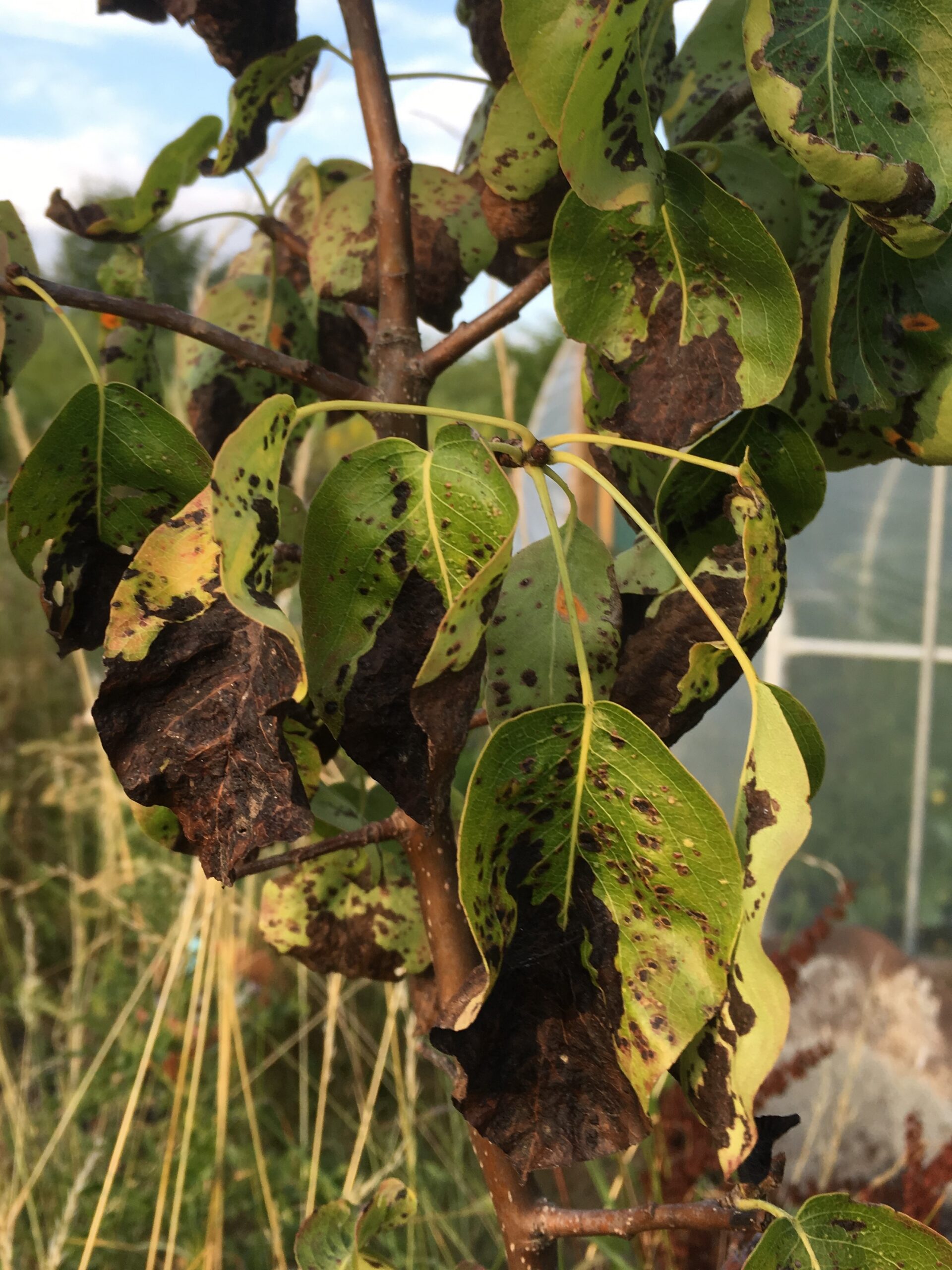
I’ll introduce you here to pear ‘Beurré Hardy’. I received it as a gift by a loved one, as a result I am quite attached to it.
The summer I was getting ready to leave the UK, it was quite badly affected by pear blister mite (Eriophyes pyri), so instead of bringing the plant with me, I propagated it from a healthy shoot in the summer, before the mites started leaving the old leaves on which they were feeding and went on to look for overwintering shelter in the bud scales (see lifecycle on RHS website).
The new plant grew quite vigorously and healthily on in its pot for a year .
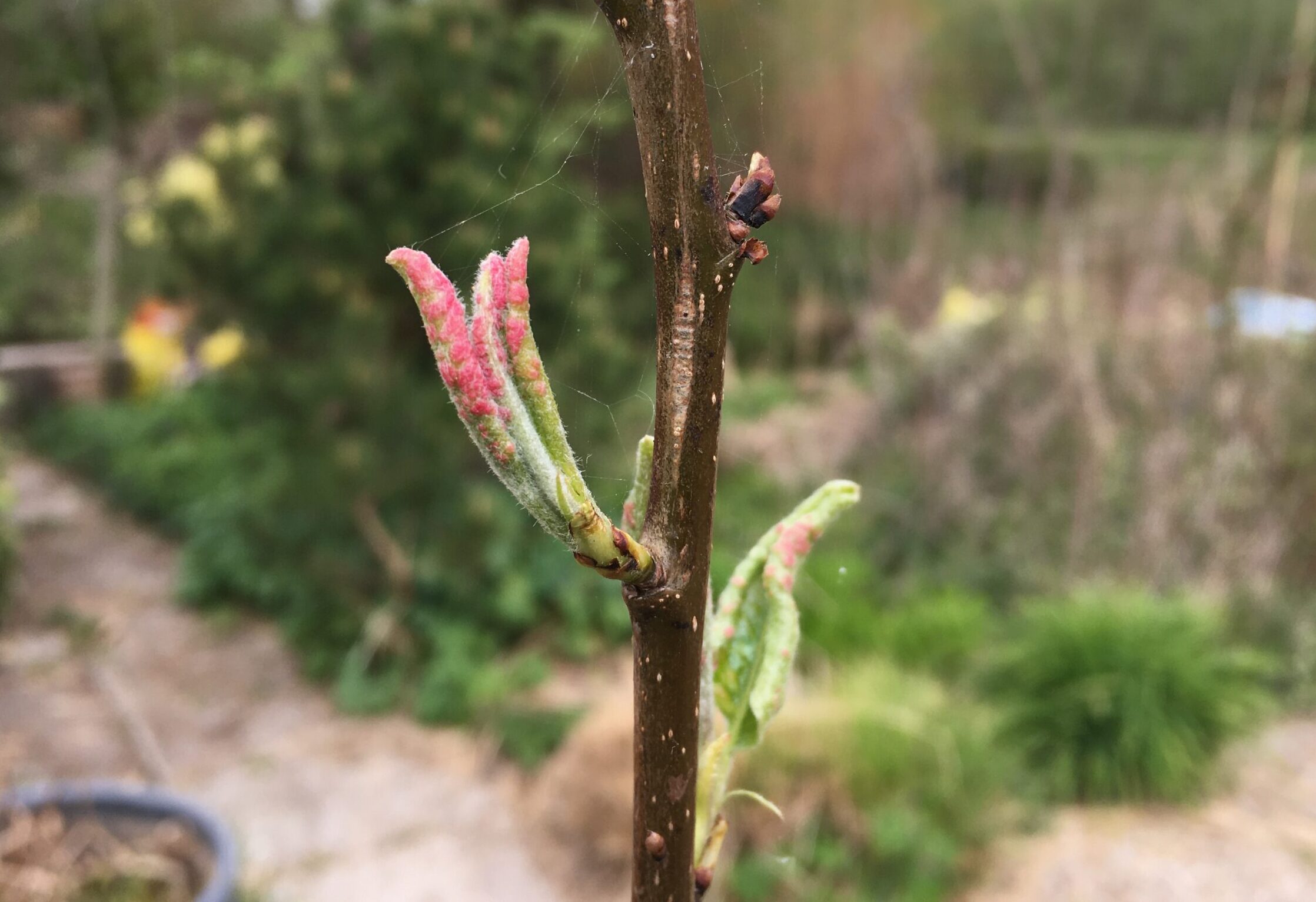
I planted it out in the winter, then all the leaves that emerged the following spring were pink with blisters and curled up. It turns out some pear cultivars are more susceptible to the mite. ‘Doyenne de Comice’ is a known one, but it does appear – from my own conversations with other owners of ‘Beurré Hardy’ trees – that this cultivar is another one.
My drastic decision was to cut the lot back to a branch as close as possible to the grafting site to get rid of all the bugs. Luckily, my little tree took it in its stride and is now thriving. It gave its first few pears last year and there are quite a few this year too. All’s well that ends well.
Pear leaf midge (Desineura piry)
While I was researching this post, however, I found out there is another pest that causes curled up, pink leaves: the pear leaf midge (Desineura piry), which, quite appropriately for the case at hand, is described as “Important on nursery or young trees during establishment”.
My new information came from a rather lovely guide to the pear ecosystem by HDC called a “Crop walkers’ guide” (2014). I suggest that you download it if you are interested in pears, as it lists quite conveniently not only pests and diseases but also the predators that deal with them. It is a bit thin on details, so I looked around further and noticed that Oregon State mentions that the curling is mostly to be noticed in the summer, so my little tree was likely not affected by the midge after all.
In any case, armed with my new knowledge, the next time I see curled leaves on pear I will try and have a closer look to investigate what the problem might be. The midge, unlike the mite, is visible to the naked eye.
More detail pictures of both E. pyri and D. pyri are available on another great resource, the Plant Parasites of Europe website.
 M.Paola, that’s me
