Orto di Casa Cecconi

My first allotment, and then one thing leading to another…

  • Thoughts triggered by reading…

    Reading instead of practising because of other commitments and the weather, corn odyssey

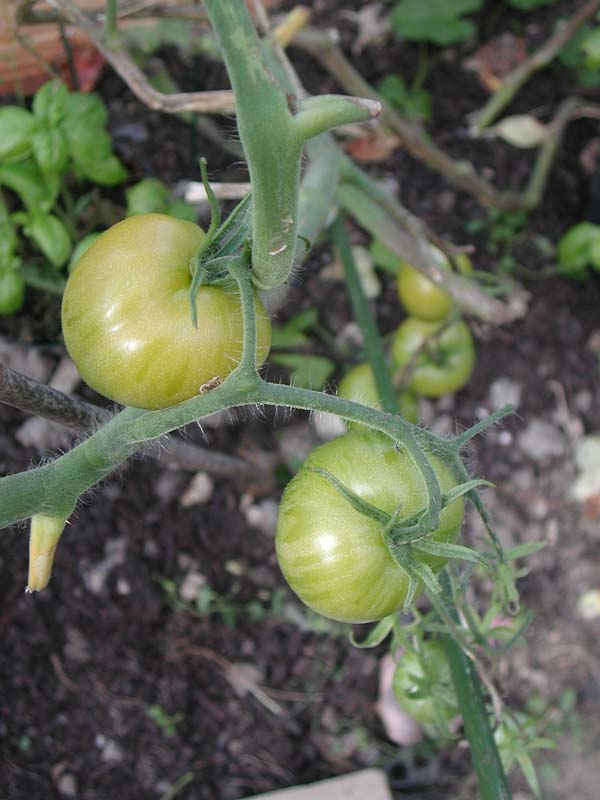
    The tomatoes were quite tasty, look forward to pick the others – this weekend I did not manage to go to the allotment: too much to do at home and miserable weather. Not a day goes by – however – that I do not at least think of the allotment: yesterday while I was out shopping I got some ericaceous compost for the blueberry bush I planted before going back to work.

    I am quite happy that we had some proper rain, this week: I will be on the lookout for seedlings of spinach and corn salad when I drop in after work one of these coming evenings, time and weather permitting.

    Too much to do, time permitting… this year I have spent most of the time “fire-fighting” as they say, trying to catch up on things I had to do. Even taking some time off work, I did not manage to do everything I planned!

    So I am still catching up, on pretty much everything, including reading my favourite “Magazine” (The Time’s). Yesterday I was browsing last week’s issue, and – unlike the usual – I read the gardening article. “Vegging out” by Alice Miles, it was.

    On the one hand, it was good to read that I am not the only newbie with problems labelling in a decent way. I mentioned my labels at the foot of the French beans that have been lost in the intricacy of the growth on wobbly sticks. Also, my potatoes are officially unnamed. I did label them. However, I used the labels that came on the net bag: with sun, rain and slimy creatures sliding over them, the writing got wiped out completely, so I was left with white tags!
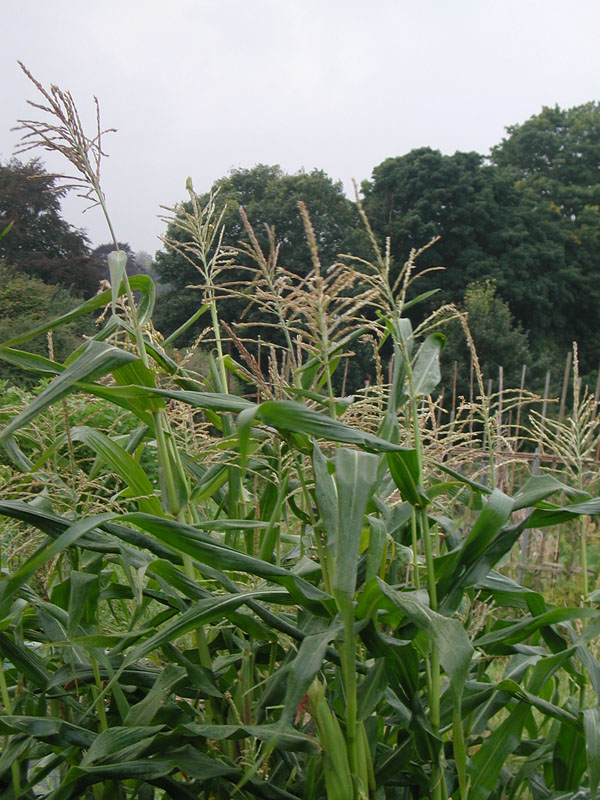
    On the other hand, it was not that good to read that corn might go bad: that possibility had not really occurred to me – the plants being so beautiful and the cobs seemingly not ready. A couple of weeks ago I had unfolded the layers of skin on a cob whose tassel had gone brown, as per instructions I found somewhere. I should have tried and squeezed a grain with my nail to see if any whitish juice came out of it. But my corn is supposed to be black (Black Aztec corn, Zea Mais), and what I saw were very tiny, light yellow grains, so I folded it back. I will be feeling a bit restless now until I manage to pick a couple of cobs and try them.
  • Acting on sudden impulse…

    Crop updates

    I was sitting half-asleep on the train tonight when my stop came: I almost jumped up and looked out, it was still relatively light. My watch said it was ten to seven so I suddenly decided I would just drop in at the allotment. With my laptop on my shoulders, the city suit and all, I almost run there. And it was fifteen great minutes before it got too dark.

    It rained quite a lot today in central London, so I was sure the ground would be wet, but I was disappointed: not a lot of rain seems to have reached here, certainly not the allotment.

    The wind (that does not make a good companion to the dry weather) has damaged the corn; on the positive side, though, it seems that the cobs are swelling a bit, which I take as a good sign.

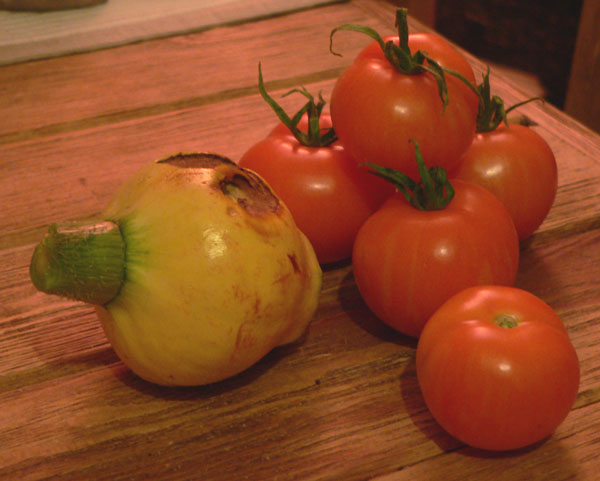
    Five tomatoes have ripened and I picked them: they look really appealing and smell delicious, even though the photo (with the light of this time of the day) does them but limited justice.

    The yellow fruit that is with them is the pumpkin I photographed a while ago: she did not make it, so I picked her to avoid any more waste of energy by the plant. Several leaves on the runners have also wilted, which might seem a bit depressing if you do not consider that – underneath – I found the biggest pumpkin so far: some 30 cm in diameter. I had not realised it was there, it grew bottom up! Looks healthy, so the count has gone up to four.

    The courgette plants are producing several little flowers but no real courgette: it looks like they are wearing out.

    Florence fennel is also growing, for the rest, no news. But what a nice wind-down I had tonight!

  • Back to work…

    Crop updates, Garden Organic and Heritage Seed Library

    Another gorgeous weekend and I have digged the last 5 pounds of potatoes and planted green manure in most empty beds. And had to water seedlings, curiously enough after this summer’s weather.

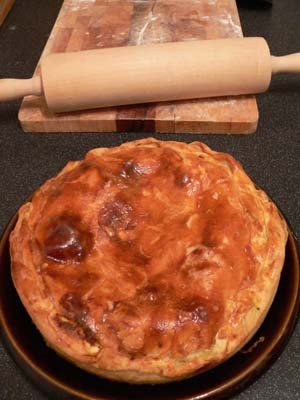
    Unlike the corn, tomatoes in the greenhouse are almost ripe, I have cooked a second torta pasqualina for ourselves and the neighbours, and put dried herbs in jars, which – with a bit of decoration – will make nice Christmas presents.

    I am back to work and with the shorter days I cannot be at the allotment during the week… to compensate for the “loss” and at the same time to celebrate my being back on the payroll, I have invested a little bit in memberships to Gardening Organic and the Heritage Seed Library.

    A bit like open-source software, some varieties of seeds can only survive if geeks – enthusiasts – provide some TLC. Otherwise – not having made it through the market screening – they are destined to die out, and their biodiverse genes do not get a future chance.

    I will be sent some six species or non-commercial seeds with my subscription, and – very appreciated – I got another couple as a welcome present! My collector’s ego is all aglow…
    And if I ever have any questions on how to grow the natural way, Garden Organic provides an advice service, in addition to the available information resources (last week I linked their comprehensive information on weeds).

    If I make it through the next couple of business-busy weeks, I will read through the material they sent with the subscription, including how to compost with worms.

  • Making the most of allotment produce

    Spinach beet and torta pasqualina.

    After breaking your back on the allotment all your spare time, the last thing you would want is to throw away any green stuff. Usually, though, when something is in season you get far too much of it, albeit for a very short period of time, as family and friends of allotment holders surely know.

    Well, the spinach beet that has grown from self-seeding is doing very well, so that I cannot keep up with it (why do slugs not exterminate it as they do with the rest, I wonder?). Anyway, each time I do a round of leaves I come home with some two pounds (they are so big I can hardly carry them home on my bike!) so now I have to figure out ways of using them that are not too boring (not another two pounds of boiled beet, no!!!).

    So I have at times resorted to the Pizzoccheri della Valtellina recipe, a very hearty meal that I cook with cabbage, chard/beet, potatoes AND French beans… always one of my favourites and you almost get your 5-a-day with it! However I have run out of pizzoccheri and forgot to have some sent from Italy, so I thought of the next best recipe I know: torta pasqualina.

    I had never actually made one myself before, and I had not been cooking anything serious (apart from pizza) since we came to the UK more than three years ago – for personal reasons of incompatibility with the oven, more than anything else, really!

    But, you see, that’s what your allottment makes you do! I decided to have a go, resuscitated my tools and… it was easier than expected and the result outstanding! Proof of the pudding: the two of us got rid of it in just two meals! If you read Italian, this is the recipe I loosely followed.

  • Roots

    Hand-weeding and roots

    Today I have finished digging my last bed. Finally – exactly one year since I got it – the allotment is mostly clean! Which of course does not mean that I do not have to keep weeding (as indeed I have done with the rhubarb and artichoke beds today) or clearing spent crops in order to plant green manure, but the worst is over!

    Talking of clearing and weeding, I have not yet learnt how to use a hoe, probably because I do not feel particularly comfortable with it. I prefer digging altogether or using a daisy grabber for the smaller hand-weeding work. And since my way of hand-weeding made me pretty much familiar with roots, I have decided I am going to make this post about weeds and particularly their roots.

    First thing to say: from what I can see most roots love to be chopped, so that they can multiply endlessly; this is especially true of bindweed, but also of dandelion and dock (someone says that only the upper 9cm are able to reproduce).

    I have taken pictures to show the most common weeds’ roots in my allotment, below more details.

    weeds' roots

    A. Dandelion has very long roots of a brownish color, they tend to snap easily at all lenghts so you need to dig deep to take them out.

    B. Dock is quite similar to dandelion in having very long roots, but these tend to be quite large or with multiple taproots; they tend to snap at the base of the leaves, and the colour of the stump is bright pink. You need a bit of work and deep digging to pull them, especially when the plant is biggish.

    C. Creeping buttercup spreads by runners above and below the ground from what I can see, and they tend to snap at the base of the leaves, so you need something to help you pull the whole root out from below.

    D. Nettles are a good weed in that they are attacked by aphids that ladybirds are particularly fond of and they also attract carrot fly so I guess they can be used as sacrificial crops. They make a good liquid feed, accelerate composting and young leaves are also edible. The roots are yellow and ramified.

    E. Couch grass has long, white, wiry roots, quite superficial, so they are easy to pull out.

    F. Bindweed has long, deep, soft white roots that break so easily and even the tiniest fragment regrows scaringly well. It is the weed I hate the most!

  • Finally a sunny weekend!

    Good weather and crop updates

    Amazing weather these last three days, it was a pleasure to be outside and I took advantage of it to finish digging my last but one bed, and to plant spinach, some more cime, turnips, salad and barbe di frate. Hopefully tomorrow there will be a good shower and then sun again.

    I am so happy to say that that tomato leaf mould seems to be receding, and the tomatoes in the greenhouse have a visible reddish tinge to them: how exciting! Finger crossed…

    Talking of solanacee, I have experimented with plastic bells to cover the chillies, afraid that it might be too cold for them at night. I have a feeling that the stagnating air inside the bells might not be too healthy, but will check them in the next couple of days and see.

    French beans still doing well, with another 500gr picked, and the Borlotti beans are on their way. However, I have made a mistake fixing the labels in the ground which – together with my wobbly staking – makes it impossible to tell which plant is which (apart from the Borlotti that stand out quite conspicuously with their red and green pods).

    Pumpkins also growing, but the sweetcorn’s inspection was a little bit of a disappointment: cobs do not seem ripe yet in spite of the tassels at the top turning brown a while ago (I would say one month in some cases).

    I have finished transplanting all the strawberry’s runners that I had kept in water to root, and it felt like an achievement. From the initial 12 plants, I have filled a bed and started a second one: if they live, next year there should be a good supply. It seems that Honeoye has been putting out runners for some three months and Alice has started one month or so ago, but Florence has none, maybe because it was the best cropper and all its energies were spent fruiting.

    Good news, there are also two tiny aubergines emerging from the spent flowers’ crowns.

    Bad news, my war on slugs looks nowhere nearer the end…

  • Ordinary maintenance and stocktaking

    Wildlife pond, slugs, crop updates, self-sufficiency and stocktaking.

    I have finished working on the pond: now it has a toad cavern, a sunbathing platform for frogs, and waterplants in it.

    For the rest, nothing very exciting: the herb bed needed weeding before I cover it up for the winter – it seems it won’t be long before night temperatures plummet.

    News from the animal kingdom: all cabbage white caterpillars either pupating or drowned, the slugs are taking over as insect of the month. I have been killing them in dozens, and I was also “lucky” to uncover a handful of eggs under a stone, which I squashed one by one with manic patience. Small slugs I cut in two with scissors because they have this habit of propelling themselves away when I try my favoured method: jumping on (disgusting as it might be, I favour the method as they die straight away, without apparent suffering).

    Thinking of it better, though, there is something quite exciting: this week for the first time I have been as self-sufficient with my vegetable supply as I will ever be this year. Potatoes, onions, shallots and garlic already harvested and stored, courgettes and flowers picked almost every day, French beans, perpetual spinach (a bonus, as it grew from self-seeding rather than me planting it!), green tomatoes, salad, basil, mint, sage, oregano, fennel, parsley. In case of emergency, I even have some frozen broad beans left. And – shortly – Florence fennel, sweetcorn and leek will be ready.
    Following from that thought, I have decided that – if I plan properly and time it carefully – next year I might well be self-sufficient on vegetables most of the time. To achieve that result, I think I will need:

    • a plan of what to plant each month of the year, including companion planting and catch crops,
    • a space ready for planting (now I am a bit stuck as I could plant things but the beds are not ready yet).

    So, yesterday, I started my “professional” stock-taking.

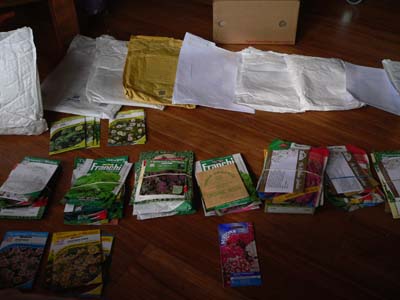
    I have a spreadsheed where I am trying to keep track of expenses, yield, stock of seeds and plants. Quite a sizeable stock (179 species for next year, to be precise – I am a collector by character, no doubt of that!). Which stock, taking advantage of a cooler, gray day, I have catalogued and sorted by month of planting.
    During the winter, I will need to assess the family of belonging of the plants, and find a suitable place for them in my 4-year crop rotation. I think the most difficult thing will be keeping in mind all the relative lifespans of the plants so as to introduce catch crops and plan timely succession.
    I do not know if I will manage to be that precise anyway, though, gardening is after all my hobby , I should allow myself to leave some spontaneous enjoyment in it!