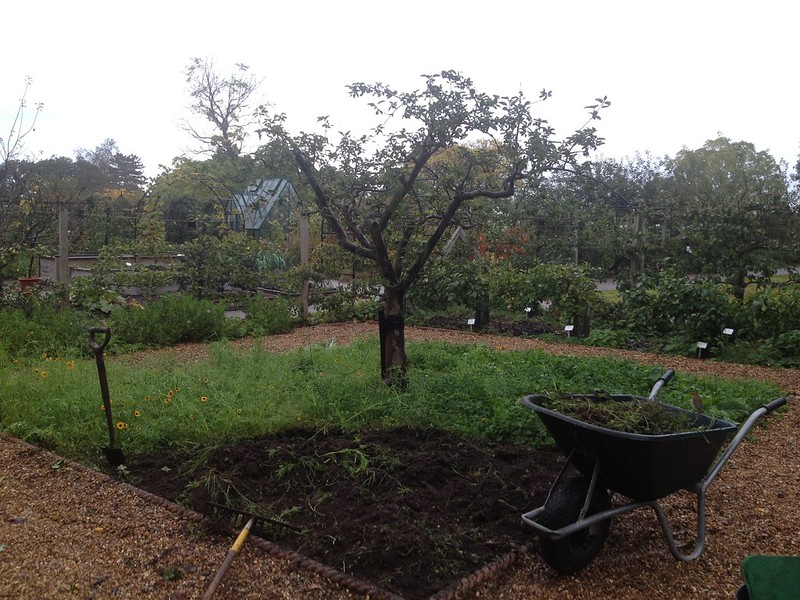
This week I will be working in the fruit garden, where, in preparation for the winter, raspberries (Rubus idaeus) need to freed from the netting cages that protected them for birds in the summer.
Plaiting netting
First of all, we removed the side netting, which is stiffer plastic, and we rolled it up. Then we had to deal with the top, knitted netting. We cleaned it of all leaves, then we laid it on the lawn to fold it. Because knitted netting is quite unwieldy, it is tied in a plait to keep it tidy in the shed over winter, and I learnt how to do that this morning.
![]() |
| Rolling up the net… |
![]() |
| … to a rope |
![]() |
| Plating: loop 1 |
![]() |
| Plating: loop 1 |
![]() |
| Plating: loop 2 |
![]() |
| Plating: loop 2 |
![]() |
| Plating: further loops |
![]() |
| A tidy net, ready for storing |
Lacing in summer-fruiting raspberry canes
Once the raspberries had been freed of the cage, the summer-fruiting varieties, or floricanes (so called because they put up vegetative growth in the first year and only flower and set fruit in the second, some of which had grown quite tall and through the netting) had to be tidied up. As they are trained along a post-and-wire system, we also proceeded to tie them in for the winter, to prevent wind rock.
Autumn-fruiting varieties do not need such management, as they flower and set fruit on first year’s canes (primocanes) and are cut back to the ground at the end of the season. Because of that, they are also trained on a different support: a single fence with parallel wires.
It is quite a frustrating process, to start with, I found, as the canes have a mind of their own, but – having now down some three rows – my technique has improved and consists of the following:
- Clean the area around the base of the raspberries from weeds and fallen leaves, so that you can easily identify the best canes to keep; if there are any stumps left from previous canes that were badly pruned, it’s best to remove those too
- Remove any fruited canes (the ones that have the remains of fruit stalks and look as they are past their best
- We use twine, which needs moving it into tight spaces, so my colleague taught me how to make a sort of weaving shuttle around a short stick (one can use a finger-thick slice of cane that has just been cut); I must say there is still ample room for improvement for me at this stage, as my “shuttle” tends to unroll at some stage of the process, which makes tying more complicated than it should
- Tie the twine to one of the post, with a self-tightening knot if possible, but, whichever the knot, making sure it is not going to loosen up over time. We have three wires in our system: at the bottom, middle and top of the canes, and we start tying canes to the lower one. Before starting, we tie a self-tightening knot at the beginning of the wire (this step is mirrored at the end of the wire)
- Choose the first cane to tie in: it has to be strong, higher than the top wire and be stiffer with secondary growth (avoiding green, sappy canes); it is better if it is not damaged, but one has to do with what one sees in front of them
- Tie in the first cane (see pictures below), then proceed to the next one that needs to be tied in at about 10 cm distance on the wire. It does not matter which side of the wire the cane comes from, or whether it is actually 10 cm (or so depending on the amount of canes and length of the wire) away from the previous one: canes can be bent to one’s needs, provided that there is a rigorous successional sequence and they are not selected randomly.
- Any canes that have not been chosen are best trimmed back to the ground as one goes along. As raspberries tend to produce buds straight at the bottom of the canes, it is best to do any pruning right back to the ground, so that stumps do not get in the way of new growth
- Repeat on the middle and the top wires: canes need to go up parallel from now on, 10 cm from each other
-
Pruning cordons

Pink currants (Ribes rubrum cultivars) Soft fruit shrubs tend put up a lot of growth over the summer, and the last of summer pruning needed doing to keep the trained forms in check and tidy, so I was asked to start working on currants and gooseberries, cutting new growth back to 1-3 buds.

Currants before pruning Against our toolshed, were some currants (Ribes rubrum cultivars), including pink ones, which I had never come across. Online suppliers I researched report them to be sweeter than redcurrants, but also having high pectin levels, which makes them ideal for preserve-making. Essentially, though, they have decorative value as a novelty. ‘Gloire de Sablon’ seems to be the only cultivar available to the general public in the UK but the one I pruned was called ‘Champagne’.

Currants against the tool shed,
after pruningMore learning, however, I got from the gooseberries, which came with an interesting story.
In fact, the collection at Wisley was donated by the Cheshire Gooseberry Society, which was one of the earliest to be set up in the mid-eighteen century, as I learned just this week from a booklet I was reading, called The Cottage Garden.
Horticultural societies were popular at the time, generally the preserve of men, dedicated amateurs from the working classes that started benefiting from wider availability and dropping prices of plant material, and encouraged as a means of moral improvement. Gooseberry took centre stage, as they were a very popular dessert fruit, both fresh and preserved, and easily grown in England.
Dead serious business it was, but if one wanted to take a modern humourous view of the story of the Gooseberry Societies and their ways, they could not put it better than an article in The Indipendent (which made me giggle):
“So popular was the meadow-green berry in Georgian and Victorian times that gooseberry clubs sprang up across northern England – at one time there were 120 – where growers (mostly men) competed to grow the biggest fruits. As men well know, size is everything, so bushes were pruned almost out of existence to allow just a handful of fruits to be coaxed to supersize proportions.”
But, according to tradition and in the spirit of the donors, the gooseberry collection continues to be grown here for their size for display purposes: tied to bamboo canes on a post and wire system, and carefully pruned as cordons. The base of the main stem is kept clear for 15 cm and one stem is grown as leader to reach to the top wire. Sideshoots, however, are grown as fruiting spurs, in a pyramid shape that ensures the plant energy is directed to fruits size, and that the same fruits ripen to perfection as the maximum surface is exposed to sunshine, while at the same time keeping good airflow through the plant.The cultivars names are really fascinating: from ‘Postman’ to ‘Cook’s Eagle’ through ‘Espera’, a testament to the creativity of the Society’s members.
Two specimen of each cultivar are planted side by side in the collection, but despite that redundancy, most plants are plagued by American gooseberry mildew (Podosphaera mors-uvae) which causes dieback of shoots, so we were collecting good prunings (some 20 cm long and pencil thickness) for propagation purposes. We also had to sterilise our secateurs every time before starting on a new plant, to avoid spreading the fungus even further.
When the leader of a plant was rather weak, we were encouraged to prune it back to one third of its length in the hope it got stronger, besides pruning the new growth ito 1-3 buds.
I thought pruning these gooseberries required considerable concentration and that the shape of the plant needed careful consideration, to make sure they had the best chance to thrive, but it is possible that with experience I will find it less daunting: I was told by our fruit expert Jim that often people worry too much about pruning.
-
Grape stars
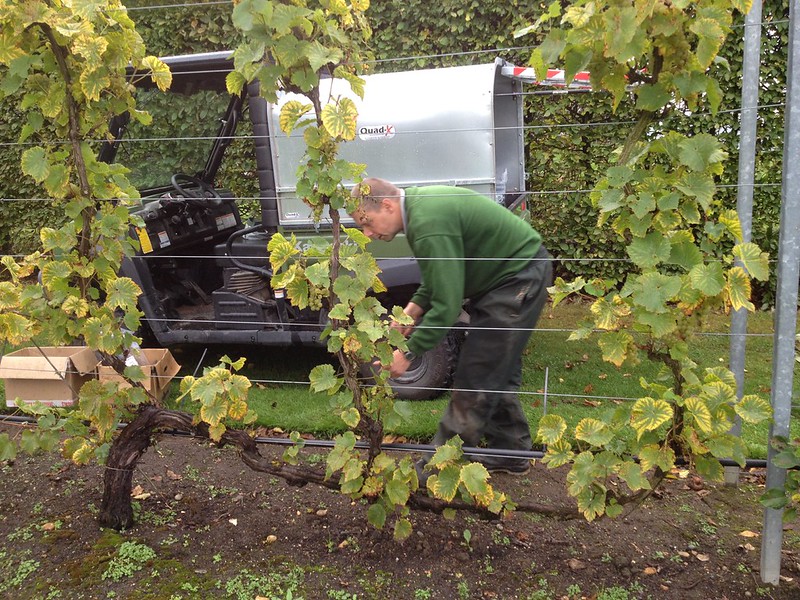
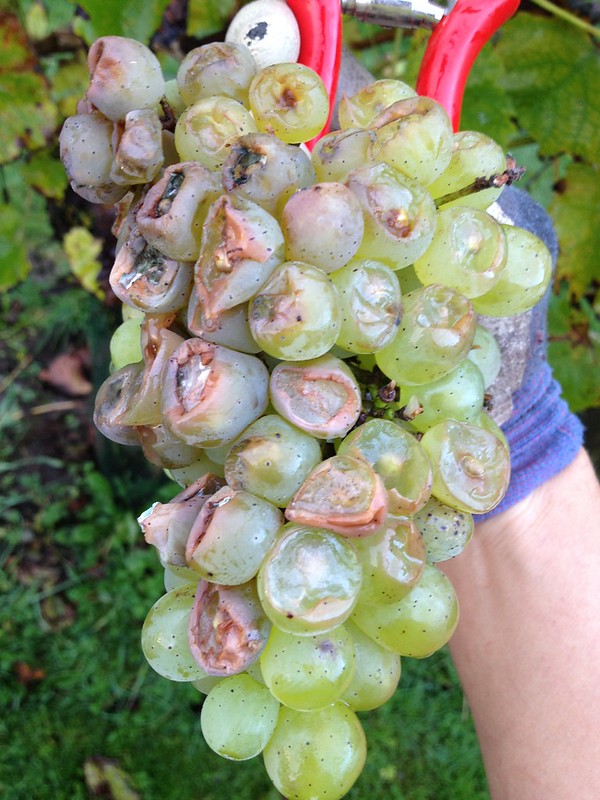
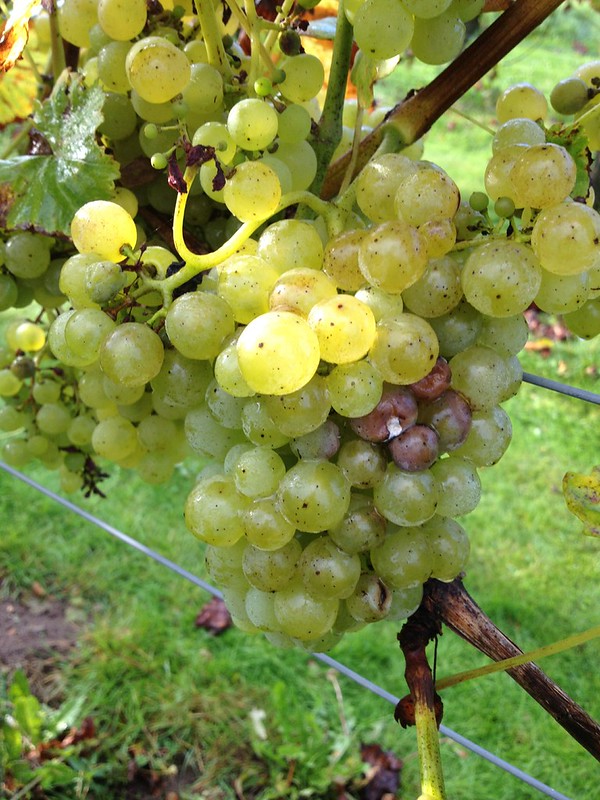
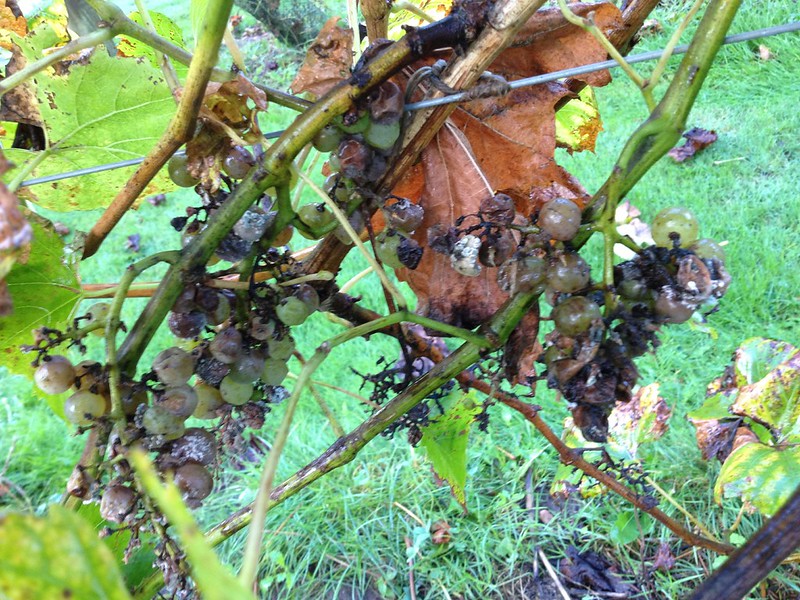
When my team leader gave us trainees an introduction to the Fruit Department, he showed us some dessert grapes grown in a small greenhouse by the orchard, remarking that they were high maintenance, requiring: an intensive regime of pruning and trimming, fruit thinning and stripping of the bark from the stems to expose pests before treating in the winter.
Today, one of those grapevines: Vitis vinifera ‘Muscat of Alexandria’, was the object of extra attentions, as it was of interest to a filming crew coming to the gardens.

Vitis vinifera ‘Muscat of Alexandria’
under glass at RHS Garden WisleyAs we were not quite sure why that specific plant was in the limelight, I did a bit of research. An excellent quality variety, although not high-yielding and potentially unreliable , it has been very popular in the Mediterranean from time immemorial, and used as dessert, for raisins and wine-making . Incidentally, I found it really interesting to discover that one of the synonyms for this variety is ‘Zibibbo’, from the Arab for grapes (the grapes of grapes?), which gives the name to a fortified wine from Southern Italy that was the favourite of my grandfather.
Anyway, the reason we worked on the ‘Muscat of Alexandria’ today was the sooty mould growing on the excretions of brown scales (Parthenolecanium corni), one of the glasshouse’s longstanding pests.

Sooty mould 
Parthenolecanium corni on Vitis sp Some of the leaves were completely blackened, which, besides affecting their photosynthesising capacity (and occasionally clogging the pores on the underside), was rather aesthetically unappealing.
So we washed them, bucket of water and sponge in hand. High maintenance stars indeed!
Fruit picking in the orchard
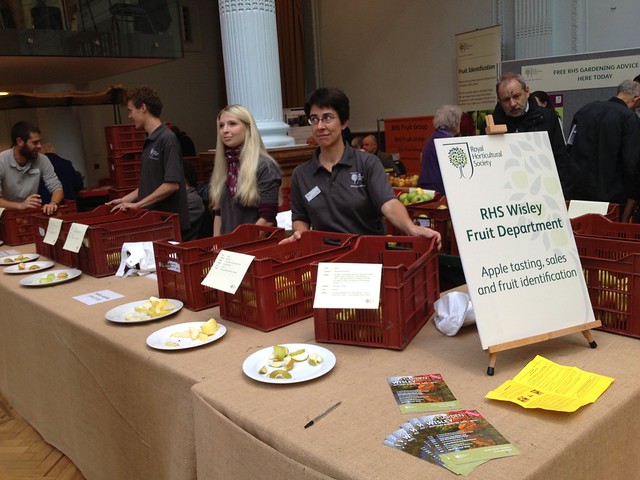
My first full day in the team and we were all working together fruit picking in preparation for the ‘Wisley Taste of Autumn Festival’ that will take place in mid-October. A number of colleagues from across the Society and numerous volunteers joined us, in addition to the regular Fruit Department volunteers and the fruit pickers hired for the season.
The day could not but start with some training in the use of picking ladders. They have three legs, and come in two types: we have Welsh ones, that are good for picking in the orchard, with a spike at the bottom of one leg to fix them in the ground and that finishing in a triangular point which is easier to place within the tree canopy, and Japanese ones that are more lightweight, have an extendable leg for uneven ground and terminate in a platform.
Lifting safely
I have been here at Wisley for over a week now, but this is the week when we start doing some real work in our departments after a few days of induction. It started for me with a full day’s training on safe lifting, which I had never attended before.
Do we have to lift a weight? Can we use some manual handling aid? And, if it is repetitive lifting, can we mechanise the process?
Those were some of the main questions raised by the trainer, as he explained that the best he could do for us was to make us aware of the risks of lifting and the best ways to minimise them, the most part had to be done by us in changing our ways and, together with our employers, the workplace processes whenever we found that they were not suitable.
My main takeway was that nobody gains anything by doing more effort than is needed: work-related illnesses cost in the millions of lost days every year to the UK economy (there is quite a lot of information about this on the HSE website), and to the individuals their health, of course.
I was aware of the standard rules for lifting: bend your knees, keep your back straight. But I had not quite realised – being quite stockily built myself, and enjoying hard physical work – that there are marked differences in bone structure that make it safer for men to lift heavier weights than women and that it is silly to ignore, for example. In fact, health risks for women increase, more than the UK Health and Safety laws consider advisable, from lifting anything above 15kg. Also, I had not quite realised than the position of the weight makes lifting more or less risky: for example weights picked from the ground or lifted above shoulder height pose a greater risk than those picked from waist height.

A practical exercise also made me consider the difference that using a correct tool makes in minimising the lifting effort. We were asked to shovel some soil. I offered to try, and found the tool was so short I had to bend quite low, almost to the ground, which was hard work. Then, we were made to try a long-handled shovel, customary elsewhere in Europe. The leverage of the long handle made it light work indeed! The legend goes that English short-handled shovels originate from when miners were living the mines (where they were digging while kneeling) and carried their tools with them to other professions.It may not be the whole story, but it certainly highlights the power of tradition in the practices we use, and the difficulty in introducing new ways of doing things where practices are established.
I will be certainly more careful now in considering my personal capacity to carry out a task and the possible consequences of excessive lifting, planning ahead to minimize the stress on my back (twisting it when handling weight is particularly damaging): hernias felt like a rather real risk after we got graphical explanation of bones and muscles in good detail.
Here’s what HSE suggest about manual handling:
- Remove obstructions from the route.
- For a long lift, plan to rest the load midway on a table or bench to change grip.
- Keep the load close to the waist. The load should be kept close to the body for as long as possible while lifting.
- Keep the heaviest side of the load next to the body.
- Adopt a stable position and make sure your feet are apart, with one leg slightly forward to maintain balance
And I will be remembering to drink more to avoid reduced muscle performance from dehydration.
Horticulture and innovation
Today I was tidying up my shed, one of those routine horticulture jobs that you could do without and that invite numerous breaks. During one I checked my Twitter and James Wong’s caught my attention:
@Botanygeek: Yey! My first article for a weekend paper is out today. Why UK hort needs to be dragged into the 21st Century…. http://t.co/uxcjJYMJiZ
so I went and read the article.
It is a rather interesting description of how Singapore aims to be a garden city by incorporating landscaping in the city planning process. Examples describe the airport’s very efficient indoor & outdoor gardens, kept always immaculate by replacing any faded plants with new ones from the on-site nursery; the Marina Bay Sands resort, which indeed looks quite spectacular with an immense pool and garden extending across the top of three hotels; the new harbour front botanic garden.
Very much focusing on garden design and cool in a 20th century kind of cool, no environmental considerations there, at a time when the world’s ecological systems are so strained they might be approaching irrevesible tipping points (when I pointed that out, James challenged me: wasn’t urban greening intrinsically good for the environment? I don’t think that necessary follows, especially from the examples in his article). The article concluded
Singapore’s glossy, thematic approach to horticulture may seem theatrical and gimmicky, but in many ways it is more faithful to the pioneering spirit of the British Victorian gardeners we often try to emulate than our own obsession for rehashing the past.
Fascinating as the article was to read, I could not find how it related to the question “Why UK hort needs to be dragged into the 21st Century”. Why did I bother to point that out to the author?
Well, you know I am trying to make a career in horticulture, and I am aware that James is heavily involved as an educator in a motivational campaign to get more young people into horticulture. Apparently, there’s not enough young blood in the industry, it is “dying”, and so is farming.
If it is true that in the free market scarcity means higher value, and higher value by-and-large means more money, one would argue: why is the salary for the average horticulturist in the range £15-25k? Also, why are there no more botany degrees in UK universities? We are, after all, talking about plants… in this specific case, do plants like growing on buildings? A botanist should know.
I guess one would have to define horticulture to start with. The Oxford dictionaries say “the art or practice of garden cultivation and management” but Wikipedia “technically the science, technology, and business involved in intensive plant cultivation for human use.” Quite a different starting point, rather different implications, right?
Anyway, to cut a long story short, James basically replied to me that we need to “drag” horticulture in the 21st century because we need “cutting edge innovation” because young people want it and because that is really the UK heritage that we should follow.
I was rather confused by then. We need innovation, because that is what the UK heritage really means. And that is what the UK youth wants.
In his words:
@Botanygeek: @mpaola Want a copy of my original text outlining why flagging youth interest in UK hort is due to lack of innov & our nostalgia obsession?
and
@Botanygeek: @mpaola What we need is pioneering hort innovation. Ironically THAT is our heritage, not the Disneyfied rehashings of ‘heritage’ gardens.
Well, heritage or not heritage, I don’t think I would be too far off the mark saying that UK youth, like most youth in the world, does not like getting dirty, doing hard physical labour for a miserable pay, exposed not only to the weather but to an astonishing range of toxic chemical substances, that are apparently essential to the smooth running of the “industry”. Would that be fair enough?
But, you see, I go by the Oxford definition of horticulture (which I would slightly modify as “art, science and practice of cultivation”). James obviously goes for the Wikepedia one, and in the industry so defined there are indeed a few better paid, office jobs: TV show presenters like himself, magazine journalists and editors, architects and garden designer, high- and bio-tech engineers and researches of various kind, and – like in any other industry – plenty of managerial, marketing and sales roles.
Even by the Wikipedia definition, though, the article does not explain what it is meant by “pioneering/cutting edge innovation” and why we need it. And, in general, I have issues with the innovation argument.
Innovation is the normal state of life. Things change, improve and get worse all the time, in all areas.
The pursuit of innovation per se has no meaning, and does not add value to anything. A new thing is not necessarily good for being new, just as an old thing is not particularly good for being old. That is a wrong assumption in the (quite outdated) Western concept of progress, that assumes history is a linear progression towards improvement. But I once read a very simple statement that was rather mindblowing: when you are on the brink of a precipice, progress is taking a step back.
How does innovation make horticulture better for its purpose? First one would have to define the purpose of horticulture. The innovation argument assumes the self-perpetuation of the current industry is the purpose of horticulture, I guess. And the current industry implies some highly paid jobs for the services around horticulture, and rather miserable pay and conditions for the people that actually cultivate those plants, the people on whom all the industry is built.
Is that something you want to drag kids in with the illusion of some shiny and cool future?
I myself, with my strong motivation, and a good baggage of experience in my career, find those conditions hard to stomach.Horticulture, well defined, is however a fantastic profession.
Plants are amazing: they have supported life on the planet since its inception (we owe the oxygen we breathe to them), they support and nourish us (as food and medicine), they are beautiful, a joy to work with and have a calming effect on moods. We still know very little about how they work: it teaches one humility, at the same time understanding them and being able to grow them is a continuous learning experience.
It is often frustrating: things do not always turn out as you would them too, for example the weather. But success is exhilarating. You can actually enjoy (smell, taste, touch) the fruits of your labour, and you have the bonus of getting fit in the process (I am not joking when I say that in 5 months I worked at Kew I lost 6 kg and my body turned so much leaner and muscular I felt great). But you get very tired, aching at times, cold and wet in bad weather, and hot and weak when the temperature goes up.
I am talking of essentially organic horticulture, where you do your own weeding by hand, where you bend your back to dig, where you look at plants close up and make an effort to understand how they fit in the environment they live in, how pollinators and pests affect them and why, and how you can facilitate the work of one and outsmart the other; how the soil does not just hold plants in but contributes to their growth, thanks to the complex interactions of the organisms that live in it. It’s a highly skilled job and not one that I see much of around.
What’s the skill in spraying to kill weeds and pests, keeping plants just alive in contexts where they would normally not survive, damaging one’s own health in the process? What’s the skill in the industrial replacing of one plant, as soon as it’s faded, with a new one straight from the production line?
From that point of view, James is right: we need to help horticulture out of the 20th century. Gardeners need better pay and healthier, more skilled jobs. Horticulture should contribute not only to feeding people, to their enjoyment and physical wellbeing, but to sustaining wildlife and the environment. Then kids might get more interested in a profession that has a worthwhile purpose. But it’s not by the innovation argument that that will be achieved, I think.
Young apple trees, old apple trees
The London Orchard Project gave me the opportunity to spend another two lovely days pruning.

Yesterday, we were in Fryent Park, taking care of a young orchard that had never been pruned before and whose trees required formative pruning.It was a lovely sunny day, and a rather big team was set loose on a strip of trees 1200 m long! We had kids with us – very keen to learn indeed, and passers-by would stop and enquire about the orchard and what we were doing. There was definitely a community feeling, even though the project had gathered together people from all over London, some from as far as Croydon.
We had Bob Lever with us again, and it was great, as he was just as informative this time as he had been before.
Also, I got to work with Amy again, and you know what? we ended up making a very strong team, architect and horticulturist: we did a good job and I had a lot of fun in the process!

We worked all day, with a brief break for lunch, to open up the centres of those trees (so as to get the sun in to ripen the apples),
nudging the canopy to develop into a goblet shape, while bringing the energy down to the lower branches, where it’s easier to pick the fruits.But there were a few saplings that were bucking the trend, having sent out numerous branches at the very bottom of an otherwise naked main stem. In the picture, Bob explaining how to deal with them.
It is the case with those plants, that the energy needs sending higher up the main stem, rather than downwards; therefore, all the low branches need to be removed. Then, the main stem must be cut to a suitably healthy bud at the height required. In such circumstances, the bud in question would acquire apical dominance, and grow straight up towards the sky: the new leader. That is avoided by cutting a notch right underneath it. The next bud down would then try to become the leader, growing straight up, says the theory. So it’s disbudded. Following that procedure, the hormones should distribute more evenly, and the other buds should – with a bit of luck (not an exact science!) – develop to wider angles, the ones suitable for cropping.
Such a different job, that at Fryent Park – with secateurs and handsaw – from the polesaw restoration pruning of the 70-or-so-year-old apple trees we did at Stanmore Hospital last time. In both instances, it was good learning and great practice, and really lovely to be back at Stanmore today for more, completing the work on the orchard for this year.
Amy and myself, the winning duo, decided to tackle a couple of big trees, one of which had unfortunately started to rot at the base, but still retained a great shape from its past life, aside from a couple of “trees on top of the tree”; we had to be careful not to throw it off its balance. And one that had been maimed, and responded by sending out a massive, eventually unealthy, limb growing inwards, which we removed.

Tree 1: almost there 
Last but one cut 
And it’s done 
Tree 2: on the right… and you’re only as good as your last cut 🙂
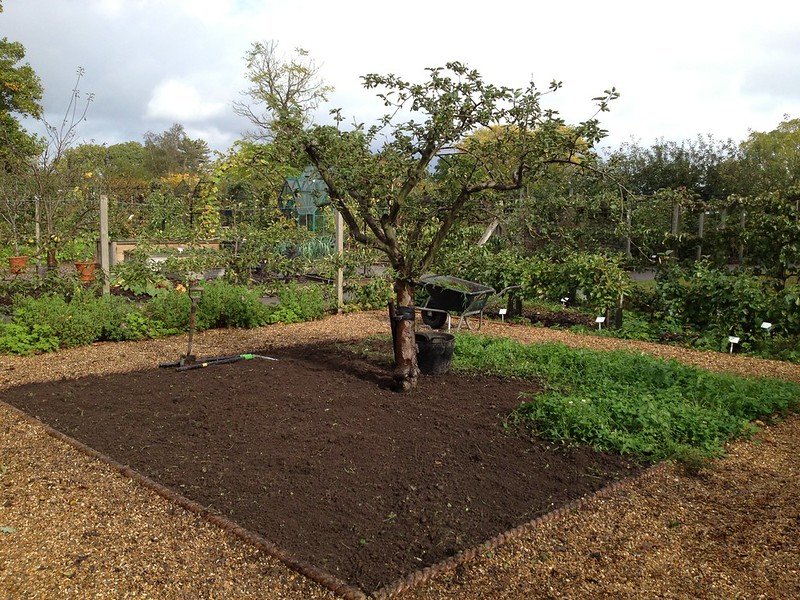
![]() |
| Before clearing the area |
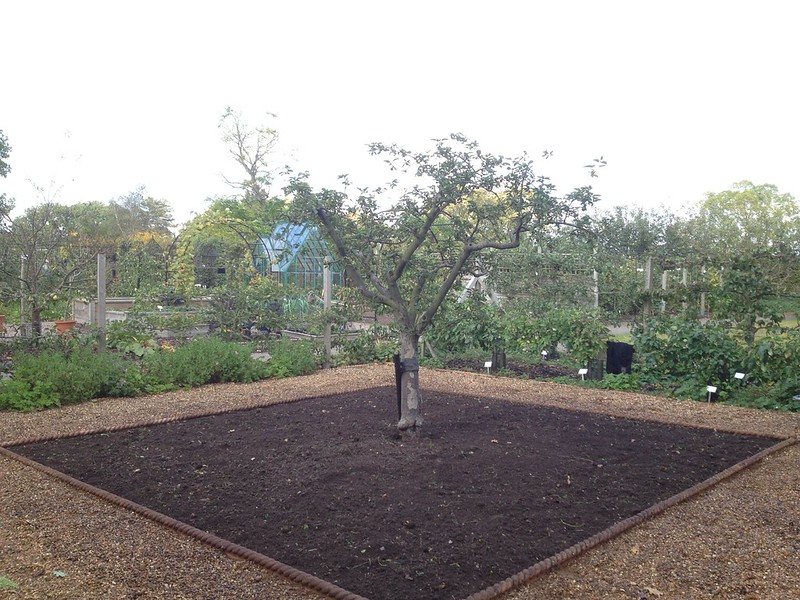
![]() |
| After clearing the area |
Tying in canes: the knots
![]() |
| “Parallel lines” |
![]() |
| The “cobweb” and “in the middle” |
Taping in the loose ends
The final flourish requires one to bend down the top of the canes in equally spaced and high arches, and to tape them in, in one-way succession, to the top wire, for a decorative (as well as functional) finishing effect.
Et voila
![]() |
| Canes tied |