An unusual day, today: I joined in to assist a colleague who was leading the activities of a team of corporate volunteers on a teamwork day.
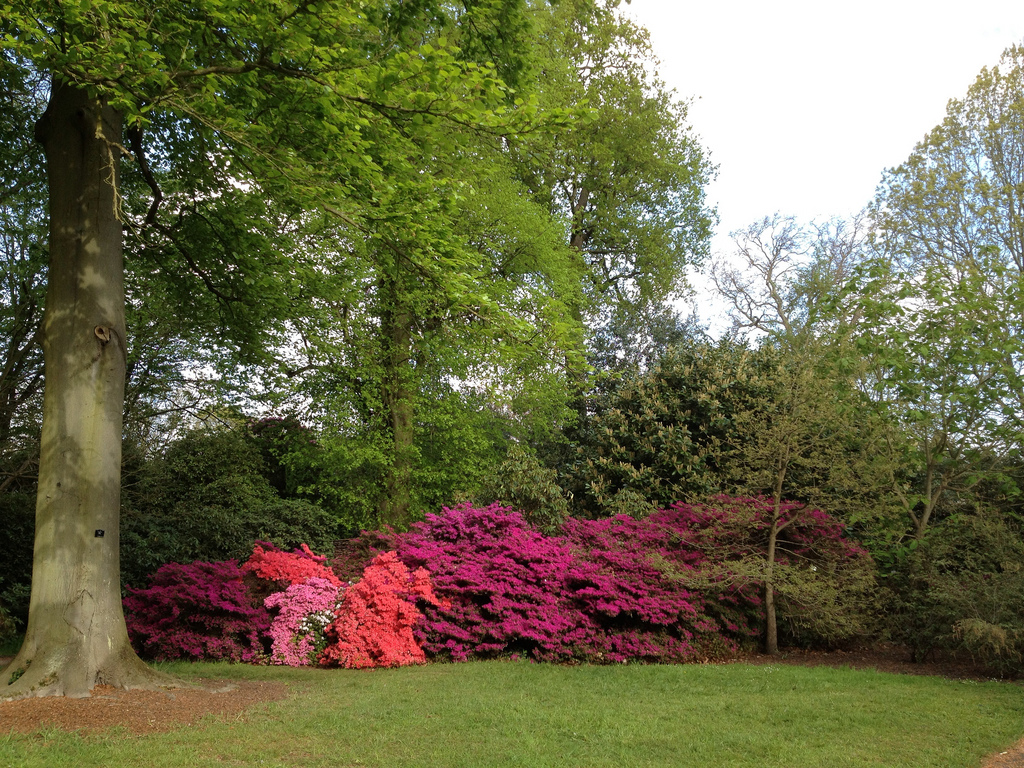
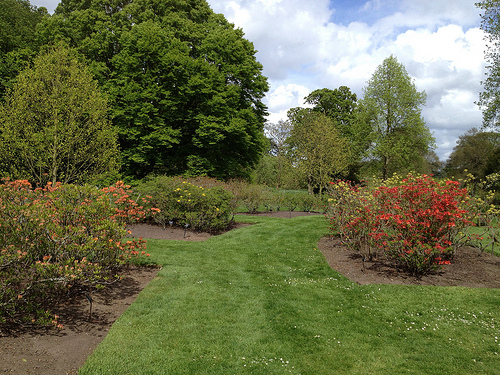
The azaleas are coming into flower and we forecast the Azalea Garden will major as an attraction for tourists at the weekend, so the volunteers were asked to help weed and edge the azaleas’ beds.
While waiting for the 20 or so strong team to arrive on site, I had a walk round the circles of beds, each section containing one of 12 hybrid groups in chronological order of breeding, with highlights:
- Ghent Hybrids, created by a Belgian baker in the 1820s from crosses between azaleas from eastern North America;
- Mollis Hybrids, from Rhododendron japonicum and other Asian species;
- Knap Hill Hybrids, designed to improve the Ghent Hybrids;
- Rustica Flore Pleno Hybrids, introduced in around 1890.
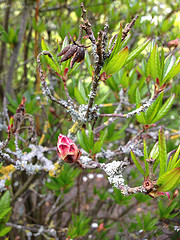 |
| R. occidentale |
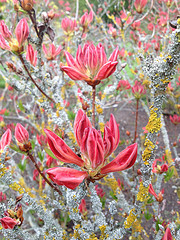 |
| R. ‘Kosters Brilliant Red’ |
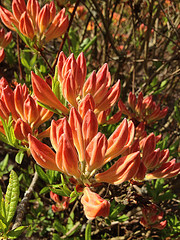 |
| R. ‘Hortulanus H. Witte’ |
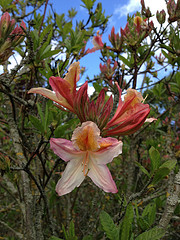 |
| R. ‘Magnificum’ |
by the way, if you were wondering, azaleas all belong to the genus Rhododendron (they were originally considered different but have now been reclassified). The US National Arboretum defines them for the layperson as:
Taxonomically, Rhododendron is the correct genus name for all azaleas and rhododendrons. Azaleas generally have smaller flowers, bloom a bit earlier, and have much smaller leaves that may be deciduous or partly so. Rhododendrons usually have larger flowers, bloom later, and have large leaves that persist during the winter.
When the volunteers arrived, my colleague introduced them to the task at hand and showed them how to use the tools, after which we both spent the day making sure everything went well, answering questions and helping out with the tasks and clearing.
There was some real engagement, and the beds were trim and clean in good time, so we moved on and tidied up the surrounding tree circles. The weather kept, with the exception of a shower, which rather conveniently happened around lunchtime.
At the end of the day, I asked the volunteers what they got out of the day: they enjoyed being out in the open, doing something different from their usual workday, and in such a beautiful place as Kew (some of them had never been and were keen to take their families). They do similar volunteering a couple of times a year and for us they were a welcome help. One of the ladies I chatted to mentioned she would like to do some veg gardening, but she did not feel confident enough, so we discussed easy plants to grow for a start, and I really hope she is having a go at it, because it is so rewarding!
The result of the day’s work, were very visible for the team to be proud of, and for the visitors to enjoy at the weekend.
Kew Fungarium (Week 5, Wednesday)
After a visit to the Herbarium, we couldn’t miss the Fungarium.
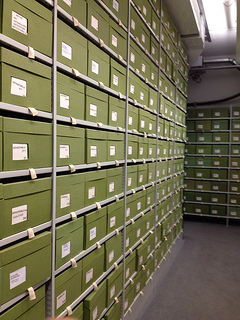
What an amazing place! A fungarium is a collection of dried specimens, and Kew collection was recently complemented with a donation by CABI, to create one of the largest collection in the world. It contains 1.25 m specimens, including plenty of types – ca 45,000, and is continually growing, at the rate of ca 5,000 specimens a year.
Fungi are fascinating: not a plant, nor an animal, they make up a taxonomic kingdom of their own, their distinguishing characteristic being they contain chetin in their cell walls (plants contain cellulose instead) like that in the exoskeleton of insects. We know comparatively little about fungi, and reclassification is continually happening: our knowledgeable, and most entertaining, guide for the day, Begoña Aguirre-Hudson, mentioned three taxonomic reorganisations since she has been taking care of the collection…
… she features in a Kew video, about fungi and the Fungarium, available on YouTube, by the way.
We were shown an interesting selection of specimens: one collected by Darwin (which is more valuable from a historical point of view than for its scientific value: Darwin apparently preserved his specimens in port wine for lack of anything else, so they are not well preserved!) One was the renowned Chinese caterpillar fungus (a clever parasite of the caterpillar, indeed) and potato blight… plus some dried porcini, Amanita and giant puffballs…
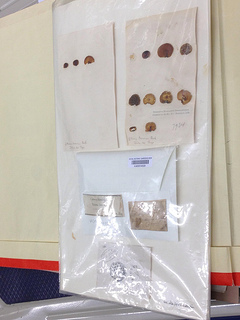


The mycology department, where the Fungarium is located, also includes a lab where mushrooms are collected, cleaned, analysed, their genetic material extracted for any necessary DNA testing, and then dried to be added to the collection.

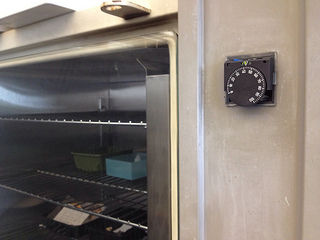
A special machine ensures the fungi are quickly dried at a low enough temperature to preserve their genetic material (40°C). Then they go into a freezer that can reach a temperature of -35°C so that all insects that might damage the specimen, and their eggs, are killed.
The specimens need to be packeted, glued to the archival paper and archived by hand.
They are also being digitised: records are available in the HerbIMI database, while a project is ongoing to get high resolution images of all the collections.
We were also given a leaflet on fungi: do you know why we really really need them?
- fungi recycle animal and vegetable waste so that the nutrients from them become available to the ecosystem once again;
- mycorrhizae: the relationships that many fungi form with particular plants, helping them extend the reach of their roots and absorb water and nutrients (phosphates in particular); but not only that, it appears they may also help plants to communicate;
- many of our medicines derive from secondary compounds produced by fungi (including penicillin, a dried culture of which we had a look at in the Fungarium);
- yeasts, which help our bread rise, our beer brew, our wine ferment… indeed all fermentation processes, belong to the kingdom Fungi.
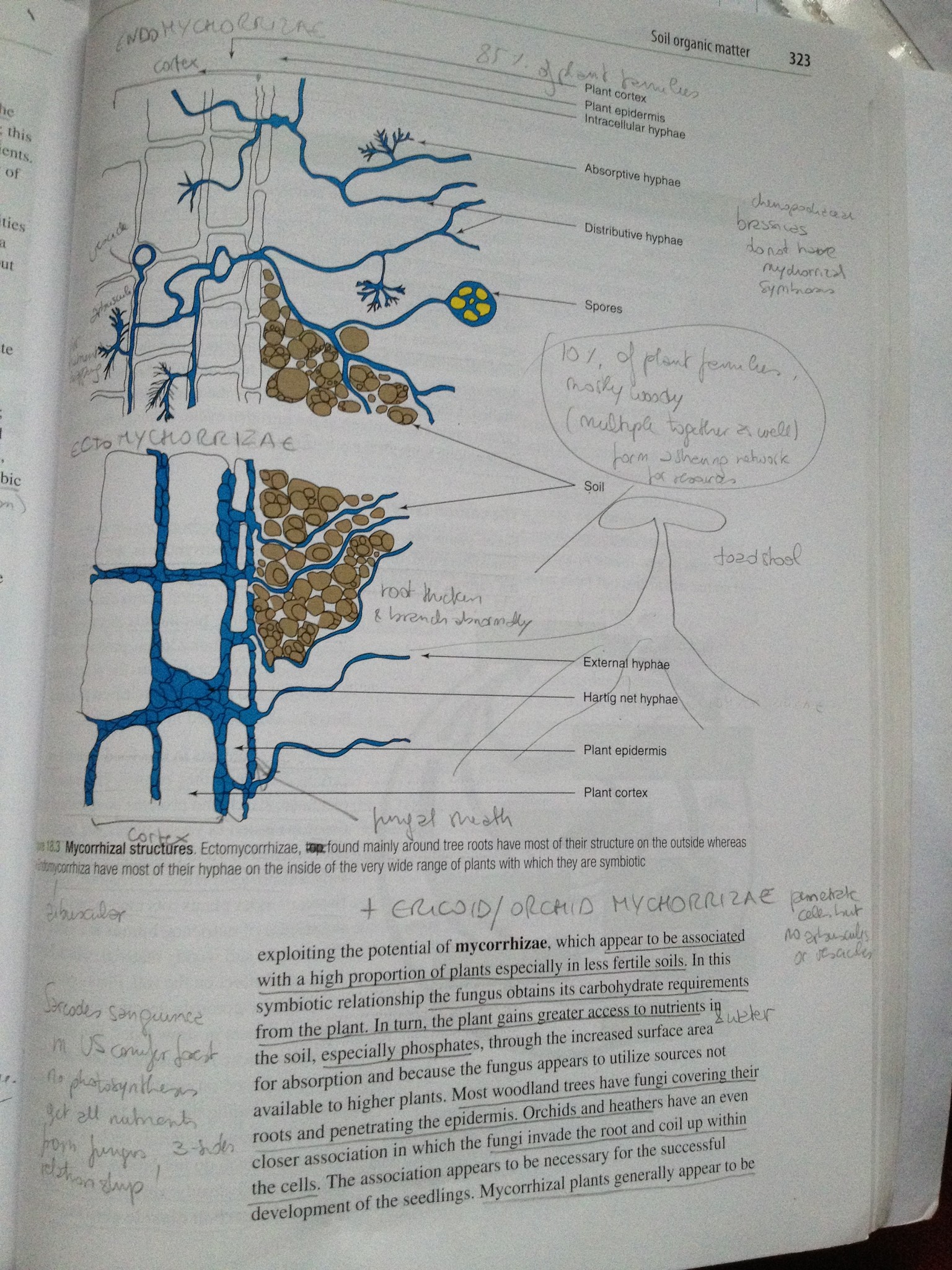
I won’t even attempt to go into the systematics of fungi: the way fungi are grouped, based of their features (mobile spores, spores in a sac or in a club etc) and modes of reproduction (sexual, asexual or both…). If you want to know more about it, I found book Pest, Diseases & Disorders of Garden Plants by Buczacki & Harris quite comprehensive
Dips and bumps on the way (Week 5, Tuesday)
The David Nash at Kew exhibition has just closed, so sculptures and installations throughout the gardens are being dismantled, leaving behind rather large pits in the ground that need filling. So I am learning the art of filling holes, as part of our team days 🙂
The main issue with filling holes is to make sure they do not sink, leaving unsightly and potentially unsafe dips and bumps where people walk. Therefore, one has to make sure the filling is quite compact. In order to achieve that, a process was developed:
- Soil is taken in with tractors and spread in layers;
- The layers are treaded on, with a typical heels-in walk to ensure that the most weight is applied (if you see us going round in circles and walking funnily, that’s why);
- The layers are raked with a landscape rake to ensure they are even;
- The pits are thus filled up to slightly above the surrounding ground level;
- The soil is levelled carefully;
- Grass seeds are sown and raked in gently;
- The area, in particular if large, is fenced off to allow grass to grow undisturbed.
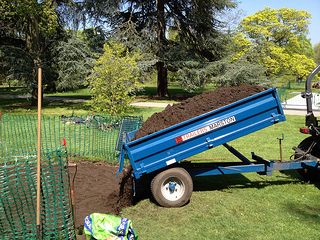 |
| Soil is taken to the pit |
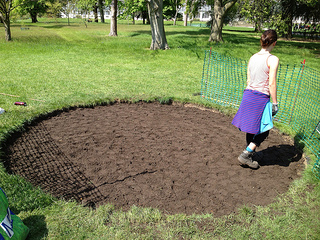 |
| A layer of soil is treaded on |
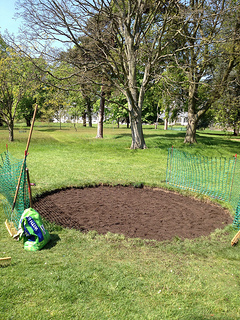 |
| A layer ready for raking |
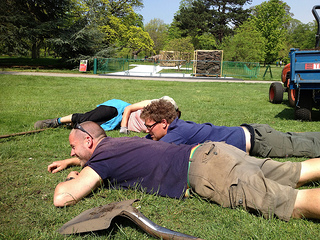 |
| Checking the filling is level |
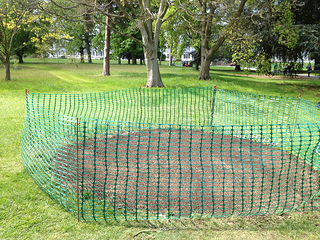 |
| Grass sown , area fenced off
|
I did gardening at the weekend as well as during the week, and that meant I was so unbelievably tired, probably the most tired I’ve ever been, and therefore felt overwhelmed and started questioning my new career.
For someone that is used to work mainly in an office, for how much one can love it, physical work is demanding and takes some getting used to. I needed to pace myself throughout the task, as I felt that my muscles were not going to take much more, and because I was trying to conserve energy, it was even difficult to join in the team banter.
It is getting better now, my colleagues were very supportive, apparently everyone gets very tired if they do not get proper rest it’s not only me being a relative newbie – but that is definitely something to take into consideration: you can get quite disheartened from sheer fatigue.
A typical day of maintenance (Week 4, Friday)
Today it has been a typical day of garden maintenance.
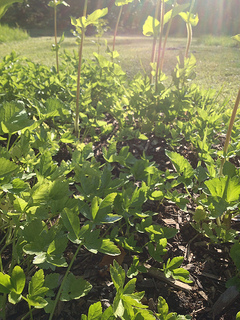
For a start, we continued our collective effort to eradicate Smyrnium. The Smyrminators, we call ourselves nowadays, having spent almost every morning from 7.30 to 10 clearing the various areas of the gardens from this highly invasive weed, which tends to smother the lovely bluebells (themselves a bit of a noxious weed…). Smyrnium plants need to be pulled out whole, including the tuber (which has a habit of lodging itself in between roots so that if you are not careful you’ll leave it behind) or it will re-emerge, flowering (and setting seeds) low to the ground, difficult to spot and impossible to mow.
A biennial plant, it will require to be weeded again next year. In fact, young plants have tiny tubers, which are difficult to pull out. But there’s plenty of them: they look similar to parsley.
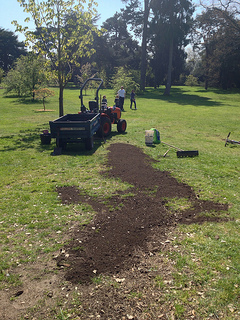 The second part of the morning, my colleague and I spent filling in a dip left by a tree that was removed a short while ago, and we sowed grass seeds to bring it back to lawn. From a frosty start, the day had turned lovely and it was a pleasure to work outside.
After lunch, I was given the task to rake lines in the gravel at the Japanese landscape: something new to me! There is a special heavy rake to draw those lines, which are meant to represent ripples in water.
I tried to approach the task with zen meditation in mind, but under the baking sun and with limited time to finish the patterns, my peace of mind turned rather soon into pressure…
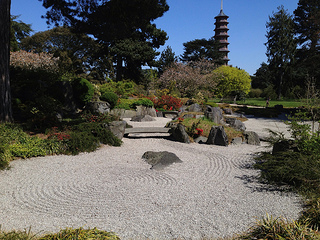 … in particular as the landscape is a major tourist attraction, and there are always plenty of people around.
Most visitors are very appreciative of the raking, and often stop to have a chat. Seeing me all set on not leaving footprints, one visitor cracked into a joke: “Do you know you are not supposed to walk on the gravel while raking it?” That drew a smile: “I haven’t quite mastered that yet!”
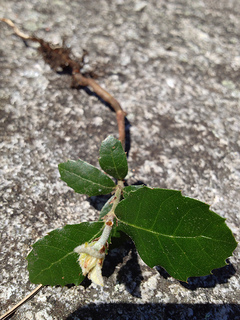 By then the task was complete and I had a little time for weeding. I do like weeding: the surprise of finding unexpected seedlings, and trying to identify the weeds I’m pulling, makes it more interesting for me.
My find for the day was a seedling of Quercus ilex, likely from the big specimen just outside the landscape. I had identified it just the other day, as one of the plants for my ID test.
Ashes to ashes (Week 4, Thursday)
Today we found some ashes scattered under a Pyrus while weeding. And then again under another tree.
I knew that ash spreading was allowed at Kew because as soon as I started working here a friend suggested I go and visit her mum in the conservation area (which, unfortunately, I have not been able to do yet).
But finding them when we are there to clean the beds up and it is work, it feels like it is too mundane a place to find something that has that certain sacredness to it, if nothing else for the memories of all the loved ones: a rather weird experience and one does not quite know how to behave around them…
I guess the perspective of those scattering the ashes is quite different: they will enjoy the remembrance of their relative (or pet) resting in such a peaceful, beautiful place, almost the stereotype of beauty itself.
In fact, I myself experienced that sense of awe you get when in the presence of sheer beauty just this morning, while weeding Smyrnium in the dappled shade, and I wondered whether Kew might be an earthly representation of the garden of Eden…
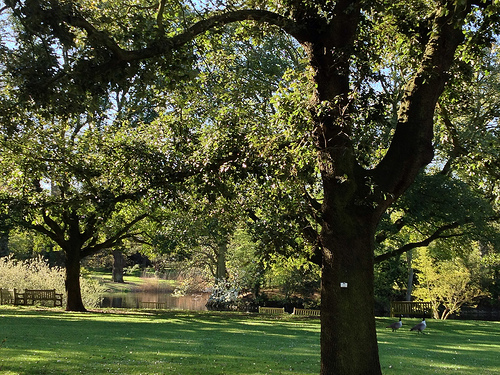
Shortly afterwards, I read @giacecco’s blog post, in which he too mentions Kew as an image of paradise. And the scattering of ashes probably testifies to other people also feeling that way.
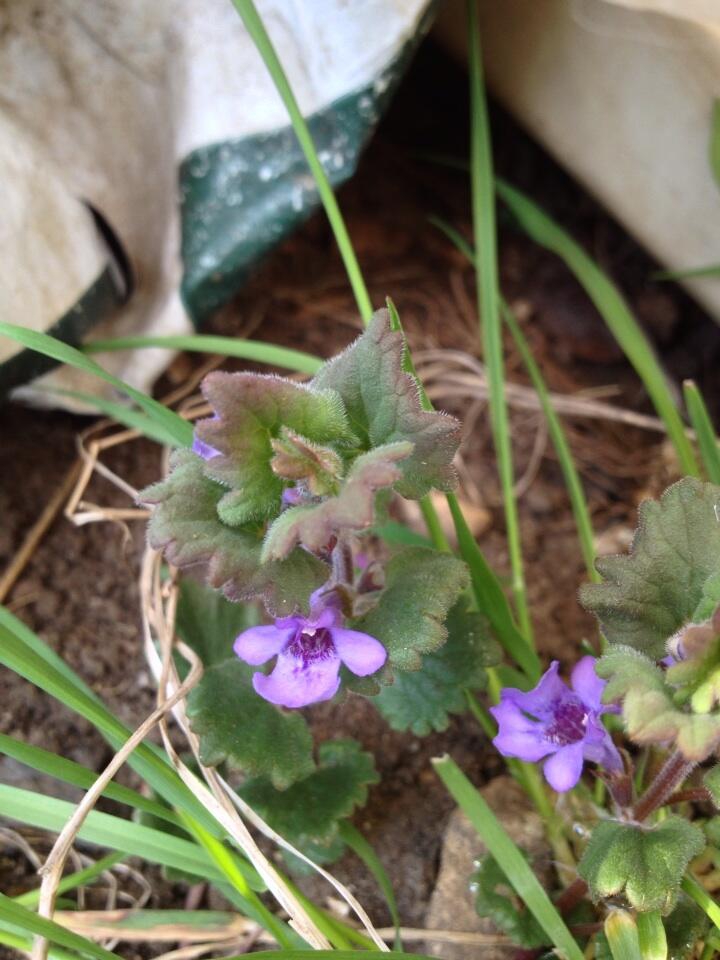
A totally different finding was my favourite Lamiaceae, a weed I usually pull out from the allotment and plant in my (wildflower meadow) front garden and whose name I had not found before. It’s
Ground-ivy, Glechoma hederacea, ± softly hairy creeping and rooting per herb, with ascending lfy fl-stems 10-20 cm tall; lvs 1-3 cm wide, kidney-shaped, blunt-tipped, toothed, long-stalked; fls in 2-4 fld whorls in lf-axils; calyx tubular, ± two-lipped; corollas 15-20 mm, pale violet (or, rarely, pink) with purple spots on hanging, three-lobed lower lip; upper lip flat; tube straight, tapered to base. Br Isles, vc (but NW Scot r); in wds on all except poorest soils, scrub, hbs, gslds. Fl 3-5.*
PFAF says the leaves have edible uses, was apparently used in beer-making prior to hops, it’s good for bees and highly invasive.
” We come from earth, we return to the earth, and in between we garden.” (anon)
(had written that yesterday – when I first became aware of it – but had to move it here, it was so appropriate to today’s experiences…)
* [Rose F., O’Reilly C. (2006), The wild flower key, London, Penguin Books]
Two thirds of a day (Week 4, Wednesday)
This morning I woke up with a headache… so not a great start and one that would not put you in a good mood, then I went out and all was frosty, including the car windscreen: back to winter?
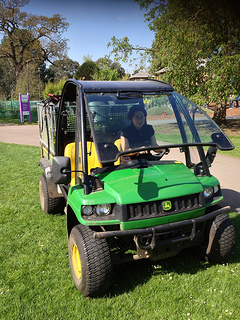 Luckily, gardening usually alleviates all my ailments and annoyances, so I headed into work rather full of hope. Learning to drive a Gator first thing was a good beginning of the work day: it’s not a tractor yet, but at least now I am not always waiting for someone to carry me around, and I can help out when needed.
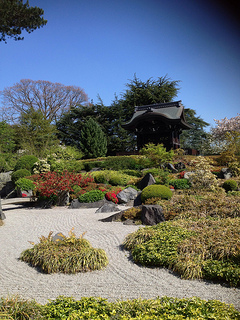
The rest of the morning we moved to the Japanese gateway (which incidentally looked gorgeous in the sun and with the red azaleas all in flower at the front, as you can see in the picture) to mow the lawn again.
My nature is rather impatient and frustration started to mount when my stripes were not straight, due to the rather uneven surface of the area combined with my still limited skills. It was noticeable – and in fact I was asked could I make them straighter? Of course, I would try: mowing had sorted my headache, so I pressed on and I think I managed a decent enough finish in the end, even though the stripes were definitely not perfectly straight.
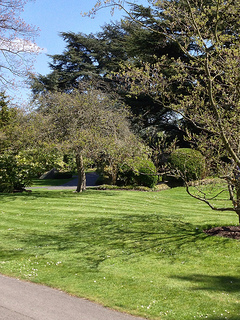 That’s a picture of how it came out.
Incidentally, while going to and fro I noticed that daisies did not get damaged by the mower much. It is pretty impressive how they manage to sense what is the mowing level, and to grow and flower just below it. Do they rely on the height of the lawn around them, maybe its shade?
How plants adapt to environmental factors is something we have been discussing this week, and I am interested to know more. Will have to research this a bit, but I am still adjusting to my new life and its patterns, and time and energy are not allocated in the most efficient way yet.
That was the end of my day, as I had the afternoon off to go and visit a nursery with a friend. A great experience, will talk about that separately.
Cleaning up after the Romans (Week 4, Tuesday)
Since I moved to the UK I get that a lot: where are you from? Italy? Oh, the Romans were great… or something like that, for example: do you see that weed, Smyrnium, the Roman introduced it to England… ;p
It would be fair to point out that not all Italians feel they are descendants of the Romans (that would be people in Rome) most of the rest of Italy was just conquered, as was England… if it makes any sense to attribute oneself an ascendancy at all, then it would be the ones they thought me in school: we people of Lombardy descend from the Germanic tribe of the Lombards. There, I’ve said it!
Anyway, I’m happy to clean after the Romans, if that helps. And that is basically what I’ve been doing since I came here. I’m talking about Smyrnium, of course.
In 2005 I landed in the UK and one of the first things I did was to take part in a volunteer day at Kew to clear this weed. One year later, I took part again. Look what I dug out of my archives.
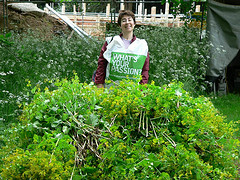
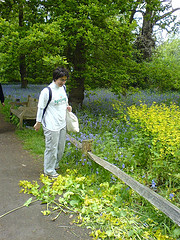
Then, in 2007, I was looking forward to the event once again, but I was told Kew was clear of Smyrnium [disappointment].
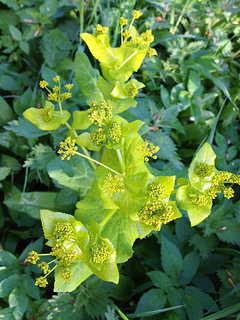 Well. it’s back, alive and kicking, and we are going to spend a few man-hours on it, before it gets too rampant.
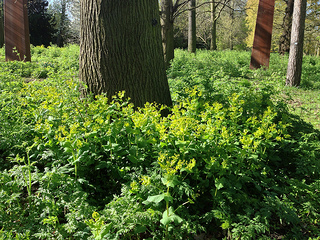
I did a short research online. It appears that the Romans introduced so-called alexanders, Smyrnium olusatrum (a plant whose all parts are edible, apparently tasting of celery, and including the seeds as a substitute for black pepper). The weed we have a problem with, however, is the perfoliatum species (also edible but used as an ornamental because of the striking yellow-green leaves around the inflorescence).
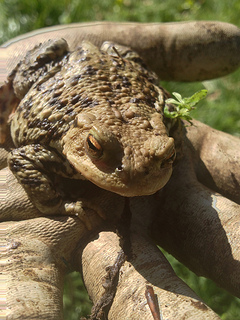
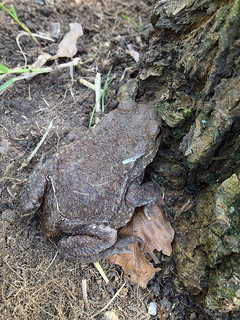
And we thank goodness for the striking appearance of the perfoliatum, because it stands out and is easy to spot even from a distance and in long grass when we are after it. By the way, amidst the long grass and weeds, we found a couple of beauties of the Bufo bufo species: what a treat.
About Me
 M.Paola, that’s me
I got my first allotment in the UK in 2007 and started growing my own food. Learning as I went along was not enough, so I studied horticulture. Faced with the horticultural warfare, I became a conscientious objector: I use no chemicals and support organic principles and regulations.
Brexit gave me a new life in the Netherlands, three new plots by a nature reserve and an MSc in sustainable food systems.
I write in my personal capacity and, as a language perfectionist and a non native speaker, I keep reviewing my entries’ text for clarity.
Some Rights Reserved

This work is licenced under a Creative Commons Licence.