“Herbaria are collections of dried preserved specimens that document the identity of plants and fungi. They represent reference collections with many and varied functions including identification, research and education”.
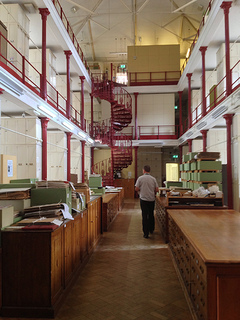
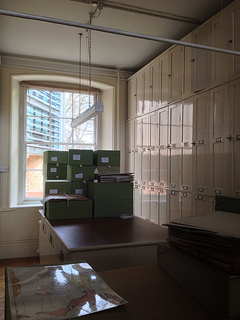 When you take into consideration that the cupboards (here and in other more modern parts of the building, as this was filled to capacity shortly after being created) contain 7.5 million specimens, some 350,000 of which are type specimens, that is the “official” description of how a plants looks like for reference and identification, then you really feel how extraordinary this place is.
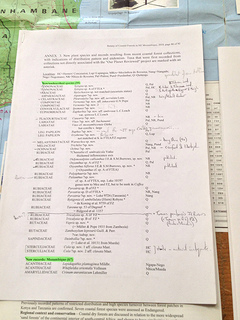
Then we were shown some specimens he has dried but not fully identified yet, as they are from his most recent trip to Angola. As expeditions are rather expensive, one has to concentrate on getting a representative selection of the local flora, collecting specimens and avoiding they get damaged (i.e. mould). All the rest can be done once you are back at the Herbarium, where you can consult previous collections to help you identify your specimens (redundant collections are welcome because they document the variety within and/or distribution of species) or any species new to science.
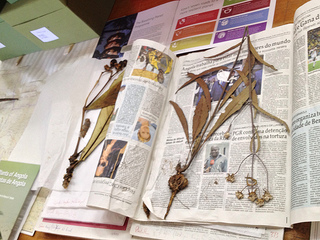 |
| One of David’s most recent specimens |
David also showed us an identified specimen from the expedition to Mozambique, and one of the reference specimens they consulted, from the collections, when identifying plants; it’s by 19th century Scottish missionary and explorer David Livingstone (more about his correspondence with Kew).
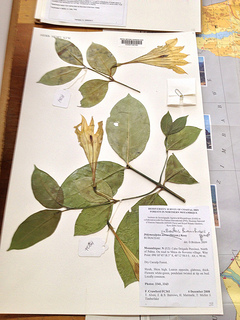 |
| Contemporary specimen |
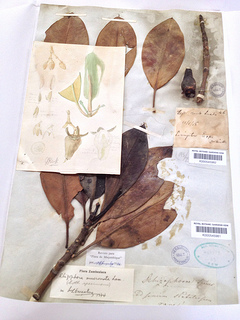 |
| 19th century specimen |
Pruning (Week 3, Friday)
Pruning is something I have never done much for various reasons so I am keen to learn more.
This early morning it was raining so we did not go out straight away, and I took the opportunity to try and sharpen my secateurs on my own.
I popped into the toolshed and observed a colleague doing it, then I did it myself, first disassembling… then sharpening and finally reassembling the lot. I reckon I made the edge a bit too wide in the middle and a colleague said it might have been made sharper, but it was a good start.


Then, one of my fab colleagues spent some times explaining to me how to use the said secateurs properly – I know, it’s probably basic stuff, but it is the little things that make a difference. She explained that the anvil blade helps protect buds when you cut over them…

… and that, if you need a neat cut, you have to use your secateur from the blade side, making sure you leverage on it, through the opposite handle, so as not to bruise the stem.
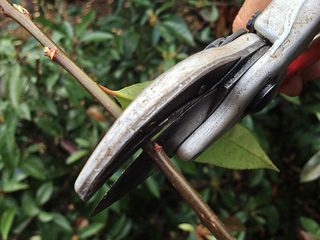
She also advised on a book on pruning that I have bought… my journey towards learning how to prune properly is ongoing, but every day I am realising something more.
 The rest of the day I spent working with Rubus again, trying to apply my colleague’s advice while cutting it back, in particular by avoiding leaving stumps that will eventually die back and be unsightly, besides being bad practice as in many plants they might lead to colonisation by fungus coral spot (Nectria cinnabarina).
This being what I have to deal with in terms of spines, it was a rather slow task to carry out, but by the end of the day I was really satisfied with my work and rather happy.
I think the before and after pictures below show it’s totally worth all the scratches 🙂


Stripes and stars (Week 3, Thursday)
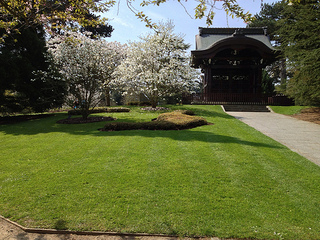
Today I went back to the Japanese Landscape: it was a gorgeous sunny day and the grass is starting to grow fast, so we had to mow the lawn. There is a specific department that takes care of the sward at Kew with ride-ons, but for the smaller areas we use lawnmowers.
My parents’ garden was sizeable when I was growing up, and the lawn was mowed regularly, I probably even had a go at times. But it was just a matter-of-fact operation, to cut the grass short so that we could use the garden… here in the UK, however, lawn mowing is more of an art, and stripes are the height of perfection.
So, today I was taught how to mow a lawn the proper way, and, for the task, I had a real star trainer, who gained his experience on golf courses. With great patience on his part, and some frustration on mine, the morning was well spent, and I even had fun once I started getting the gist of it.
Here is how it turned out:
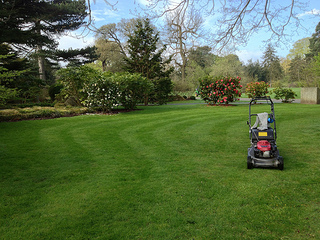 |
| First attempt… |
 |
| … and afterwards |
What do you think? Well done, eh? A star performance! ;p
In the afternoon, I helped a colleague clear some leaves from a wooded area of the garden that I had never visited, and that turned out to be very pleasant with a selection of fragrant Magnolia species and a tree I had never seen, Azara microphylla, which gives off a chocolatey scent.
Today was also the day of the first plant IDing test for me: I was very nervous as I haven’t had much time to study – even if I have seen and memorised plenty of plants over the last three weeks…
For the test, you are supposed to learn 10 plants a month, but every month you are shown 30 samples, because you have to recognise also the set plants for the previous two months… being my first month I was only supposed to learn 10 but I have recognised a few more – besides, even if I did not get them all right, I enjoyed finding myself in front of plant material and having to guess which plant it belonged to: it teaches you to look at plants more carefully, spotting those tiny details that make a difference…
Fireblight (Week 3, Wednesday)
The Rosaceae family of plants, and the sub-family Maloidae (those with pome fruits) in particular, are affected by fireblight, which is a disease caused by bacterium Erwinia amylovora; it affects blossom and shoots and may lead to the death of the plant.
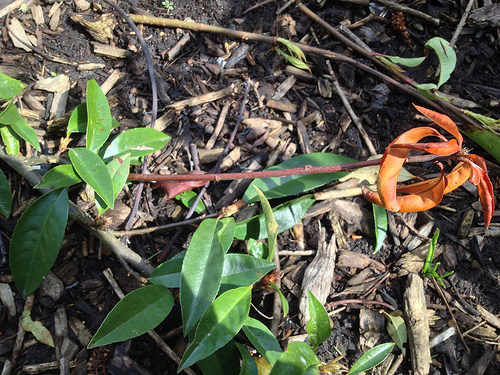 In our area we will have to identify and monitor the spread of the disease as it starts to flare up later in the spring. Any plant material affected needs to go to the incinerator.
By the way, here is how fireblight looks on a Photinia, just as if it had been scorched by fire. And inside the stem, there is orange-brown staining, sometimes in a longitudinal stripe, other times it goes around a ring in the stem.
Stone fruits, the plants in the Rosaceae family that do not get fireblight, apparently catch silverleaf instead, caused by fungus Chondrostereum purpureum.
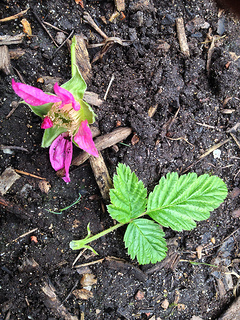
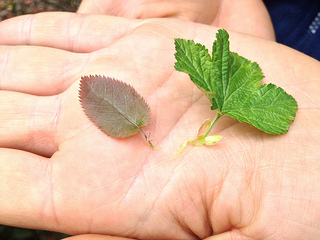
By the way, do you know an easy way to recognise a plant in the Rosaceae family? I was told it has five petal and five sepals to the flower, and two stipules for each leaf, like below.


Squaring the circle – reprise (Week 3, Tuesday)
Our teamwork today was again planting trees, something which I really looked forward to:
1. I had enjoyed it the last time
2. wanted to refresh my memory on the technique
3. the weather was good…
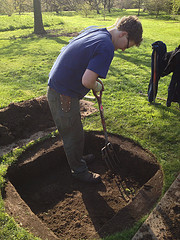
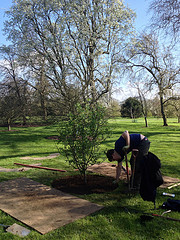
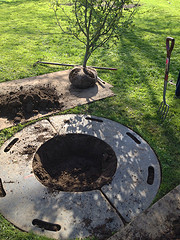
You can see the square hole, the planting hole, and the planted tree clearly in the pictures.

This time it was only two of us for each tree so I had the opportunity to take more active part, and I was working with a colleague who had done it dozens of time, who helped me perfect my technique. Using the tools felt less awkward the second time round: it is really a matter of “practice makes perfect”, and we planted a really pretty little tree, Sorbus meliosmifolia (which, according to the great book one of my colleagues suggested, Gledhill’s “The Names of Plants“, means: having leaves similar to a meliosma).
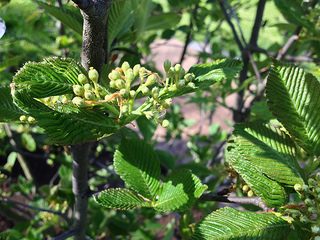
It takes around an hour to plant a tree properly from scratch, so today I worked on planting five different trees, including the Sorbus. Two of them were planted on the bank of the lake where on my very first day I had pulled ivy out: it was good to see how that clearing work I did served to prepare the bank for planting new trees.
Well, another enjoyable day, and what gorgeous weather!
There were plenty of visitors in the garden today, and an American garden designer stopped to take a picture of us digging the tree hole… we also provide entertainment for the kids, when we move around the longer distances on a tractor: they stare and wave at us.
As it was team working day, I had the opportunity to meet two different colleagues, one of which – like me, is interested in foodcrops and organic. It’s a great bunch of people, fun and knowledgeable in their different ways and areas. By the end of the day I had been outnumbered by “the boys”, who came out well in this picture, taken while finishing off the planting of the Quercus rotundifolia.
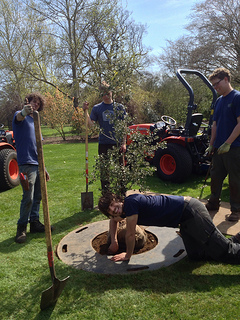
After work I went with some colleagues around the gardens, plant spotting: having a look at the plants we have to identify on Thursday – my first plant ID test!
Kew’s library (Week 3, Monday)
The highlight of the day today was a visit to Kew’s library, which was born out of the Herbarium (which we will visit next week) and which is actually known as “Library, Art & Archives” because it does not manage only books… have you ever visited the Marianne North Gallery?
I usually prefer the outside, but on a rainy day we looked for shelter in the Gallery and it was rather amazing, with plants and animals in bright colours around you on all walls… I was personally also fascinated by the story of Marianne herself: what a brave woman, travelling the world in the late 19th century and painting plants…

But, back to the library: it might look like any other library, but it is pretty vast to start with (it contains more than 500,000 items, 90 languages), a maze of collections, with special thematic sections scattered across the gardens’ buildings in Kew and at Wakehurst Place. You can read more on its history and significance. We got to see the first edition of Darwin’s “On the Origin of Species” today: there is a special section of the library that contains all the oldest of books…
Everyone can access the Kew library, and you can search the catalogue online. I myself think I will have to go and have a proper browse on my own one day, as so much information can be overwhelming: I do not think I have taken it all in from the tour this afternoon…
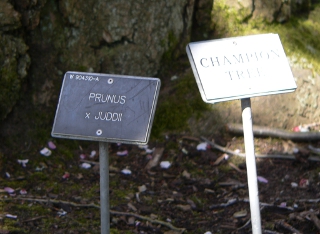
The morning I spent edging the South Canal beds. While driving there in our tractor, my colleague showed me a tree, pointing out it was a champion. That was a coincidence! Over the weekend, in a visit to RHS Wisley, I had spotted the label you can see pictured, but had no time to investigate it further, so it was on my to do list.
Champion trees are the ones that are “exceptional examples of their species (Royal Forestry Society) and several of the UK & Irish champion trees are registered in The Tree Register.
On a totally different subject, today ended in a positive way, with me finding out that I passed Level 3 “The management of plant health”. I’m halfway through that now…
Zen and the art of leaf gathering (Week 2, Friday)
It was with some hesitation that this morning I made my way to the Japanese Landscape. It is a rather formal garden, and working on it felt pretty daunting.
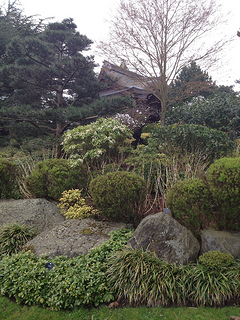
There were a few gusts of wind, and each one would scatter part of the light and somewhat sticky leaves I had managed to scrape out of the grass and bushes, while also blowing new leaves from the tree. Something that can be pretty annoying, as I’m sure you know. However, a thought came into my mind.
I remembered a book on mindfulness I recently flicked through, by Thich Nhat Hanh. The Vietnamese Zen monk suggested that happiness is only found in mindfulness and mindfulness in performing an action for the sake of it, by concentrating completely on it, bringing back one’s attention every time it goes astray and observing and acknowledging one’s distractions as they happen to avoid them being more distracting… this was a concept I had been familiar for a while, since I became interested in Hinduism while studying Religious Studies. It was guru Osho – if I recollect well – that said that our mind gets distracted by wandering into either the past or the future, preventing us from enjoying the moment. I think it is one of the reasons I like gardening so much: because it absorbs me completely in the task at hand, and I can relax.
So I thought of my leaves, and concentrated in picking them up for the sake of it. One leaf at a time, one handful at a time, one bucket at a time. It was refreshing and made me think that there’s so much that is like picking leaves just to look them fall again. If you let it get at you, then you cannot but get angry and bitter. But if you keep carrying on as if nothing had ever happened before, or was going to happen again, then you are leaving in the moment, and can find peace.
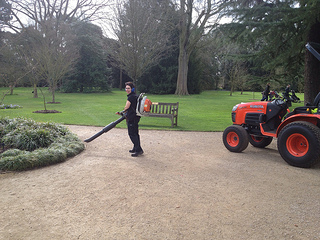
All my phylosphical musings crashed suddenly into reality when the student I was working with suggested I learnt how to use the leafblower, which I did, after the by-now-usual feeling of awkwardness when starting to use a new tool around people.
Here is me, posing as a ghostbuster, before going in for lunch…
About Me
 M.Paola, that’s me
I got my first allotment in the UK in 2007 and started growing my own food. Learning as I went along was not enough, so I studied horticulture. Faced with the horticultural warfare, I became a conscientious objector: I use no chemicals and support organic principles and regulations.
Brexit gave me a new life in the Netherlands, three new plots by a nature reserve and an MSc in sustainable food systems.
I write in my personal capacity and, as a language perfectionist and a non native speaker, I keep reviewing my entries’ text for clarity.
Some Rights Reserved

This work is licenced under a Creative Commons Licence.