The next glut after soft fruit is going to be sage.
I have been talking about sage before, and provided a couple of recipes, not least my favourite one: sage focaccia (which I have just updated with the latest post-breadmaking course improvements).
I have found you can fry sage leaves in a batter to be used as starters (recipe in Italian here for my record, but you can search for English versions), which I will try some time. In the meantime what I tried is Hugh Fearnley-Whittingstall’s sage elixir which requires to dip 50gr sage leaves in 500ml eau de vie for 30 days before adding some syrup and bottling (my leaves in the pics, after a night in alcohol). And I was absolutely determined to make some kind of jelly. Firstly, because I thought it might taste delicious. Secondly, to use up as many leaves as possible. Thirdly, to try my newly acquired jam-making kit (I got a maslin pan, straining funnel, sieve, thermometer and a set to pick sterilised jars out of boiling water, all from Lakeland).
Difficult to find a recipe without apples, but I did (thanks to Renee!), though I had to adapt the American units. Here’s the modified recipe I used before I forget.
Sage jelly
- 50 gr fresh sage leaves
- 1000 ml water
- 60 ml white wine vinegar
- 1 kg organic granulated sugar
- 1 sachet pectin powder (it may be too much, will know later)
Blanch the leaves in the water, crushing them in the pan while bringing it to the boil; leave for 10 secs then turn off the hob and leave for 15 min to infuse.
Strain the liquid, add the sugar and vinegar and bring to the boil. When you cannot stir down the boil, add the pectin (I have spooned it in 150 ml cold water to avoid clots) and bring to the hard boil again until it cannot be stirred down. Bottle in sterilised jars.
I have almost literally licked the pan clean… so I guess it will be ok, but I defer judgement to when it’s set and ready. It must be gorgeous with cheese, or on bread and butter. And the jam-making kit made the operation much more seamless, happy with it!
Chillies flowering!
Finally the time has come when my chillies have put out the first bloom (which I read I should pluck out but have not dared yet). They are everywhere in the greenhouse, under cover outside, on the windowsill at home: will I manage to be self-sufficient?
In the meantime, salad and courgettes are filling my larder, while soft fruits are on the down.
I have a sad feeling that the summer is over, which probably comes of my exhaustion after a good three months of daily evening shifts at the allotment, mainly spent picking and watering.
Beans have just started to grow now, after a very slow start: if the weather keeps I might get some this year! Tomatoes are also in flower, and I have some cucumbers too. Gill’s ground berries are happily growing in the greenhouse, grapes are taking shape and one-meter high sweetcorns are home to plenty of ladybirds (after a few weeks of harlequin-only sightings, the natives are back en masse).
Brassicas are as yet my biggest failure: cabbage, cime, kohl rabi, broccoli – all ended up in close to nothing.
— Post From My iPhone
More preserving
Yesterday I spent the day at home, preserving some more of the glut of soft fruits. I tried three recipes which I adapted a little (see below). I also tied up the garlic and hung it in the kitchen and plan to do the same with onions. Tonight I will make a bit more pesto with the basil, but for now I am off to the plot, as I have to sow sow sow before I run into a hungry gap.
9oz/255g redcurrants, stripped from stems
9oz/255g brown sugar crystals
3 star anise
2 small pieces of fresh mint
1 ½ pints/750ml white rum
Put all the ingredients in a jar with a good seal. Shake every day for a fortnight, by which time the sugar should have dissolved completely. Strain into a bottle.
568ml carton double cream
300ml whole milk
½ vanilla pod, split
6 large egg yolks
50g caster sugar (it could do with a bit more)
300g raspberries
Icing sugar to taste
Put the cream, milk and vanilla pod in a heavy-based pan and heat until just below boiling point. Meanwhile, beat the egg yolks and sugar together in a bowl until thick and creamy. Remove the vanilla pod from the hot cream mixture. Pour the cream mixture on to the egg yolk mixture, whisking constantly. Return the mixture to the pan and heat very gently, stirring, until the custard thickens enough to lightly coat the back of a wooden spoon – this should take 10-12 minutes. Strain the custard into a clean bowl and leave to cool.
Meanwhile, purée the raspberries in a blender. Sieve to remove the pips. Cover and freeze overnight or until firm.
2 lb (900 g) redcurrants
2 lb (900 g) sugar
As soon as the fruit is cooked (about 10 minutes), add the sugar, stir until absolutely dissolved, then bring the mixture up to a rapid boil, and boil for 8 minutes. Strain through a muslin or sieve and bottle hot.
Huge disappointment…
… as my precious rhododendron turns out to be after all a weed – how could I fall for it?
My horticulture text says some plants look different in their juvenile form from their mature one… the thing is that a juvenile plant would not flower and my seedlings has blossomed, shouting weed, weed!
Hope is not lost as there’s several other seedlings that might turn out to be the real thing.
I’ve also however several seedlings to draught and am still struggling to find uses for excess soft fruits. I ate raspberries, froze raspberries, made raspberry jam, bottled raspberries and raspberry liqueur so far. However, I’m eating all my gooseberries raw, as I love it when they go slightly cloudy and taste vaguely of grapes. A lot of people that see me eating them do not seem to know they can taste fairly sweet.
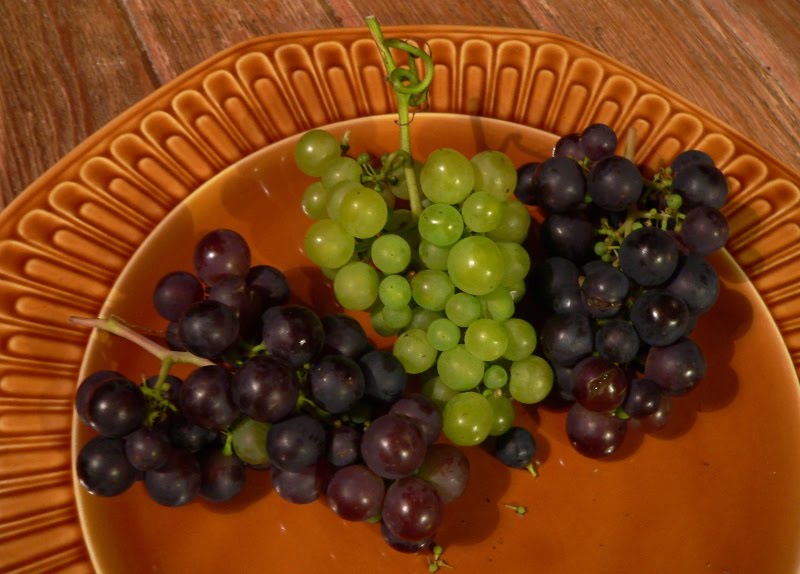
Talking of grapes, there’s a few bunches on the plants, including the new one I only bought this summer.
Today we finally hot some rain, so I will take the night off and go home straight, I am so tired.
P.S. I have added a new “Summer at the allotment” picture album with seasonal crops, flowers and insects, and you can now access my allotment pictures from the link on the right.
— Post From My iPhone
Grow-my-own changing the way I cook
I cook every meal. I like big portions, but I have little time and patience, so what I usually do is to cook a quick, big pasta, or pizza or main course and veg (recently I have also started cooking more than I need for the meal, so that I can take it to the office and eat healthily in the process). Hassle-free.
However, given the size of my plot (and apart from soft fruits and some gluts) most other produce I get in moderate quantities, a bit at a time, which requires me to change the way I cook.
- Produce is fresh and needs to be eaten or processed quicker, because it goes off and because tomorrow there will be something else fresh ready to eat;
- I throw away much less, and make do of more, because I have much less and because of all the work that goes into it!
- My native stock of recipes does not necessarily cover the amount and types of veg/herbs that are available to me.
In this situation, which is surely better for the environment, my finances and surely my health, more creativity is required.
Last night, for example, I found myself with a punnet of tree spinach (Chenopodium giganteum), a single courgette Summer Ball, five or so courgette flowers, a handful of Thai basil (which smells of aniseed) and a bunch of sage. My main course was supposed to be sole (not that filling). How to use up so little and ill assorted veg?
I kept the sage (in a vase with water) for focaccia tonight, but worked out a set of quick recipes for the rest.
Quite elaborate in terms of amount of crockery and pottery they required, the recipes produced a good dinner which my husband liked (which is always a good thing, isn’t it! :)). I blanched the spinach and served it plain with a drizzle of extra virgin olive oil. Simply pan fried the sole, but accompanied it with a Thai basil pesto made by mixing the chopped leaves with some more oil. And then bulked up the courgette and flowers by making a small omelette. A bit more proteinic than we would normally eat, with the sole AND the omelette, but the different tastes did not clash, rather went reasonably well together.Previously I had mostly used small quantities to make stir-fries, to be eaten on their own or as pasta sauce, but it was interesting to be a bit more adventurous for a change!
Now I just have to improve my dish arranging technique and my food photography skills! ;p
By the way, the tree spinach tasted more strongly than normal spinach and had a tougher and slightly rougher texture, which I liked, although it took ages to clean it as it was affected by black flies on the underside of leaves.
Preserving
aJuly is the time of endless bounty of soft fruits. This year it was raspberry first, followed by gooseberry and redcurrant is just coming now.
Pound after pound of raspberry for dessert were getting a bit too much, so I have frozen some for later on (trick to keep them whole I discovered is to dry them thoroughly), but I have just a small freezer. Last night I tried a River Cottage recipe for bottling them with gin and syrup. It was very easy, quite rewarding.
It takes:
- 1kg raspberries, firm just ripe
- 150gr sugar
- 750ml water
- 100-150 ml gin, brandy or raspberry liqueur
Make the syrup by slowly bringing to the boil water and sugar, stirring to dissolve it. Keep warm.
Pack a sterilised jar full of raspberries, pour the alcohol and then fill with the syrup.
Put the jars in simmering pan at body temperature and bring to 88C simmering point over 20 mins, leaving to simmer for 2 mins
Will have to check that the lid is airtight, which is done when cool in 24 hours.
You know, I am really at the basics with sterilising jars and checking bottletops and airtight lids: still learning the difference between “Le Parfait” (with metal buckle, particularly difficult for me but the most common here in the UK it seems) and “Quattro Stagioni” (with screw lid) handling practice, and I am so scared of poisoning someone by mistake! I have so many questions, for example: is condensation ok? It could lead to moulds, but how do I prevent it? And if I close the lid when the jam is cooler, how do I get airtight?
I wish I had learnt from grandparents/aunties before those skills went mostly lost in the 70’s. I wish I had been interested enough, for example, to learn how to bottle aubergines from my grandfather, who made delicious, spicy ones. Anyway… books should help, and I think it will be a good idea to take a preserving course – the one I did on breadmaking was such an eye-opener!
I also made gooseberry jam, but – same as last year – I added too much water so I had to cook it forever still to have it soft.
The warmest, sunniest harvest day ever
It is the first time since I have had the allotment that I can pick onions and garlic and leave them in the sun to dry.