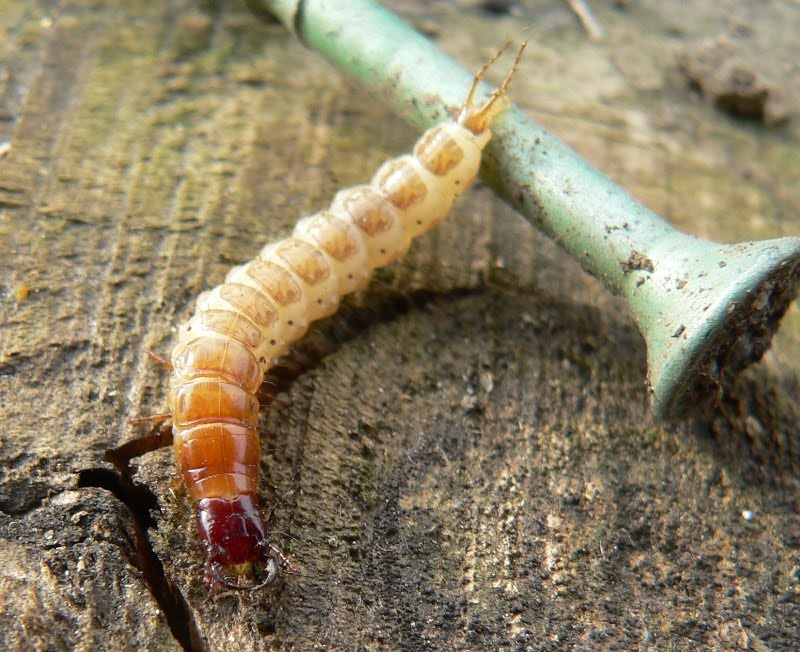
 After two years and a half on the allotment I have just realised in a frightening eureka moment that I have been killing my best friends: ground beetle larvae – notorious slug predators – because I was not sure whether they might be chafer grubs. Well, they are not! How could I be so silly?!?
-
Do not kill the slug predators!
-
Ruby tiger and pea weevil
As I was digging a little space for my courgettes & pumpkins I found a lovely moth that I had never seen before and goes by the intriguing name “ruby tiger” (Phragmatobia fuliginosa). It was very friendly indeed, climbing on my glove to be moved away, and I discovered later that my patch must be its ideal habitat, as it feeds on dock and dandelion, both of which are plentiful; it is quite strange I never saw the hairy caterpillar before!
Unfortunately I did not have a camera with me; luckily it was a prettiy conspicuous and unique moth whose image is easily available online.
Through a picture of mine, on the other hand, I identified the tiny pest that has chomped on my broadbean’s leaves: the rather prosaically named pea (leaf) weevil (Sitona lineatus) it was! Golden brown and rigged, I have not found an organic control method yet. Anyone has a suggestion? It looks like larvae feed on the nitrogen-fixing nodules on the roots, thus reducing crops…
— Post From My iPhone
-
Sowing and potting on
Like a good girl, I am weeding, sowing and potting on, as I have decided that if I wanted to meet my target of being self-sufficient in chillies I have to do things by the book and I have put to good use all the little plastic pots that I collected over the years.
Also started the “allotment in spring” set of pictures in Flickr I had mentioned, but it is still unlabelled and incomplete; as you all know time flies, but I would like to show the progress of the different plants over the season, as it is amazing…
Talking of which, the heat of the last couple of days has set off photosynthesis and today I found an asparagus that was one meter long, the sweetcorn has grown from 0 to 20 tip to toe in one day and there are little grapes on the vines! A-ma-zing!My Garden Organic experiments are also doing fine, hope I have time for some decent post in the next few days.
-
Badger, badger, badger… mushroom!
There is an online Flash video that my husband used to find amusing, and that I was reminded of last night when I thought back at what had happened. The relentless pace of the season’s rhythms, and the sudden, unexpected (both good and bad, although it feels mostly bad) popping up here & there when you deal with nature.
A bit annoyed that I lost in the ether the post on mushrooms I was writing on the train, but still glowing with the success of my new crop, I arrived at the allotment last night and had an exchange of pleasantries with Paul.
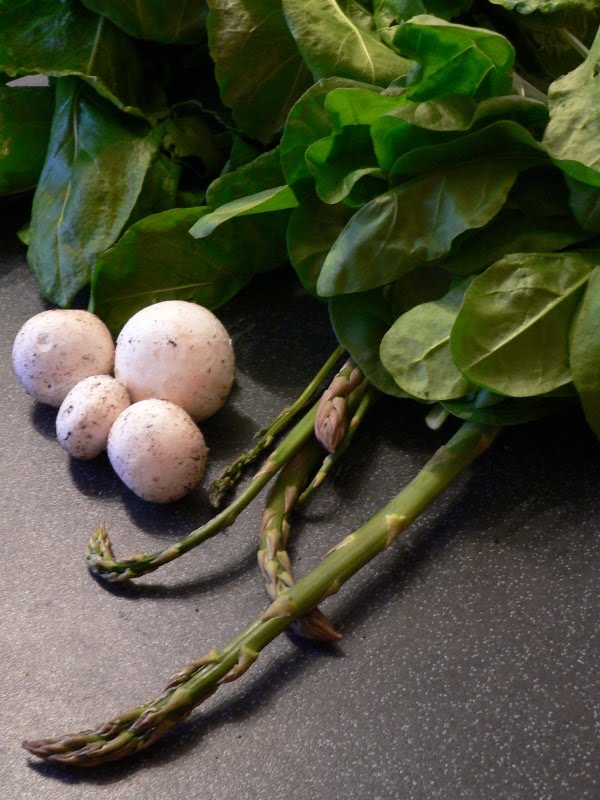 One step back. On Monday I had picked my first four mushrooms: an easy crop this time round, I was already planning to grow more at home in the garden, as allotment space is running out, even though the space/yield ratio for mushroom is excellent – unlike asparagus, as I was writing in my lost post. Eureka! Now that I am writing about it again, I have had a great idea: could grow them on top of the beasties’ hotel, behind the shed!
Anyway, back to last night, I come to the plot and HORROR! The asparagus bed was smashed to pieces and trampled on. I got duly upset, as I do nowadays with any act of pointless aggression. The rat cage was thrown on the path. My boundary line on the other side of the bed had snapped. No other damage around, I checked with Paul as well. First thing, I thought: humans, but there is a possibility it might have been an animal, trying to open the cage to get at the bait, and going on a rampage in the process. However, damage is so localised that it seems unlikely, unless the animal was very intelligent and careful, taking the cage from the top of the allotment, dragging it halfway through it without leaving any traces, just to go berserk on my asparagus bed. However, some digging of the soil suggested animal. Badger, fox, dog, cat?!?
Not happy with cats either this week, as neighbour’s has taken to sitting next to my pond at home, with the result that all the damselflies and frogs have disappeared suddenly. I sincerely hope they were not harassed and killed…
Anyway, I pulled together, fixed what could be fixed, and proceeded to dig up some space for the sweetcorn, which must be planted in blocks rather than lines as it is wind-pollinated, and clustering is useful to get the pollen from the tassels falling onto the silks.
In the process of digging, I found two sage seedlings, self-seeded: a nice surprise, the first happy note of the evening.
— Post From My iPhone
-
Discount the weatherman's word at your peril
If I thought it was time to store away the March & April sowing seeds I was in for a surprise.
Arriving at the allotment yeasterday I saw the leaves of some self- seeded potatoes were dark green, dehydrated and flat on the ground: my brain started computing on such new evidence: herbicide maybe? A disease? Yesterday everything was ok! Only when I saw the tomatoes the reality dawned upon me: frost!
I had no idea that just one night of low temperatures could kill my plants in the tent, just because I left the flap open. Some smaller seedlings seem to have come out better than the bigger plants. The beans in the open went as well but the peas are ok. And the basil in the greenhouse also looks a bit damaged.
Let’s get sowing all over again (it’s my fault, I was actually less disappointed than when slugs ate all my seedlings).
— Post From My iPhone
-
Pond life news
The damselflies are out (although I found 2 dead in the water and only one drying out on a grass blade – it must be a very delicate phase emerging from the nymph body) and there are tadpoles some 2 cm long!By the end of the day I found four damselflies alive, at different stages of drying up (not the scientific term, that one! ;)). Here is two of them: just out of the pupa and the complete item!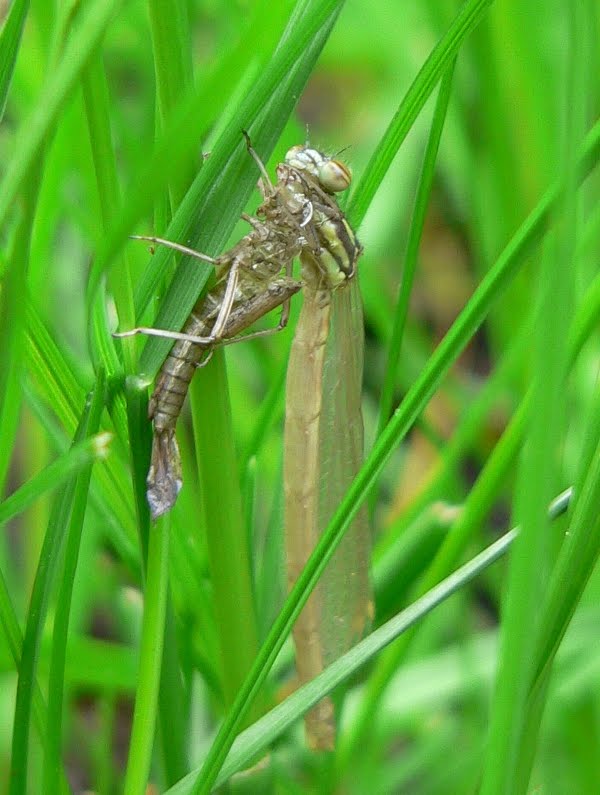
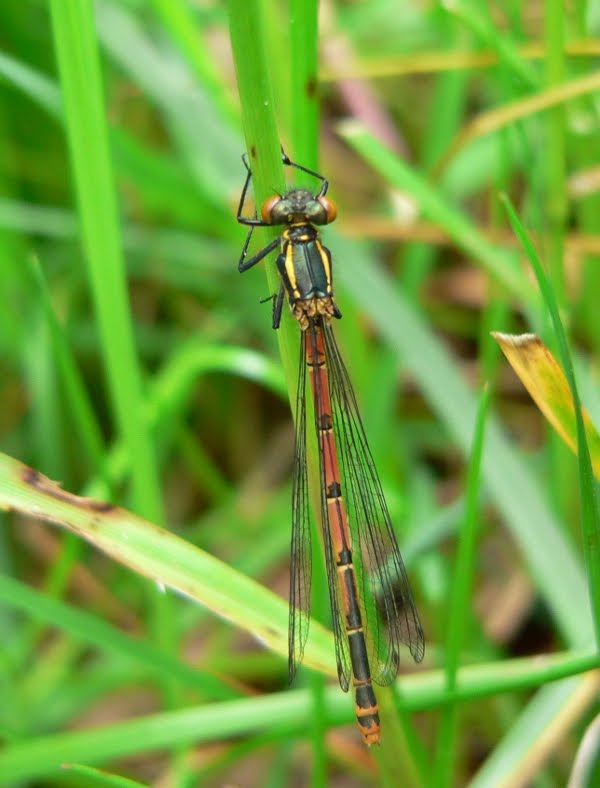 Sorry, no tadpoles pics came out decent enough.
I know I said…
… that I am in desperate need of a massive sowing session, but instead I spent my time today clearing out weeds and any overgrown grass, so that the allotment looks spotless. I haven’t even had time to plant my newly arrived organic plants (the ones I ordered when I decided to support organic growers more).
So, nothing particularly exciting to say today; however, I thought I would pick up some loose ends in this post:
- the ducks have not been seen for a while. Some of us do miss them, some others I’m sure are pretty happy. I am still divided on their usefulness v potential risks. What is certain is that soon after the mating episode they stopped visiting my pond (maybe it’s the fact that I planted some water crowfoot), although they spent some time on someone’s plastic sheeting after that. The last time I saw a male alone, he landed on the main path and – very dignified – he walked away, out of the site, through the gate.
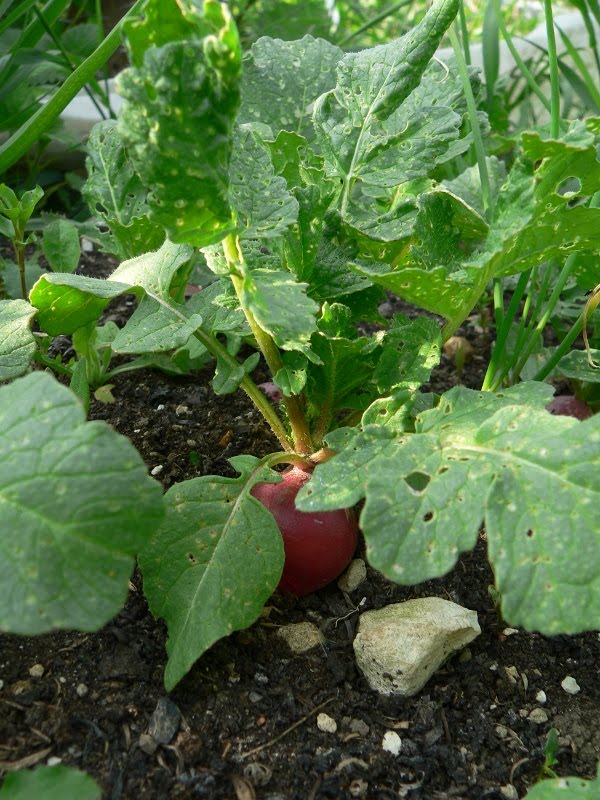 cropwise, as I said yesterday the celery is gone, but the tomatoes, strawberry spinach and the artichokes I planted out are ok. Peas and beans are doing fine and today I picked my first radishes, which went to add some piquancy to a carrot salad. Rhubarb is also growing, and I picked my third batch: 400gr, not bad at all. However, the agretti were unfortunately just a mirage: no sign whatsoever of any growing. My brassicas, the ones that Jean said would never grow, did not grow much, but are preparing to bolt, so they put on a bit of weight: I will pick them before it’s too late but at least will have enough to make a stir-fry. The cardoons are growing healthily, after a slow recovery.
- one of the elders, chopped down roughly, has recovered and is bearing flowers now. Still two tree stumps in the path (with me still getting rid of branches in the path as they grow), and nobody has taken up the plot yet: that bit of land has been without “practising” owners for most of the time I’ve been there now, but the (now-ex) allotment rep said the council is on the case.
- I have sown the Garden Organic experiments 10 days ago and the lettuce is almost ready to plant out. There are seedlings in the tree spinach tray but I am not sure it is the tree spinach – sometimes some tiny weeds manage to grow in the trays as well. I have not seen any butterflies though after my report and similar viewing the weekend after that.
I was sure I had written of clearing the herbs bed and how I had decided to split the bronze fennel root clump as it was too big, realising soon afterwards that I shouldn’t have. However, it seems one at least of the transplants has survived, and the original plant is growing nicely. I also seemed to remember telling you about the wasp that wanted to nest in my greenhouse, but that too was only in my mind. Anyway, it seems I have managed to distract her by taking away her half-built nest when she was not there (she kept coming back, looking for it on the ground and around, but luckily I had thrown it out altogether) and replacing it with a piece of cardboard egg box (I hoped she would think it was someone else’s nest). She did not come back.
That’s enough for today.
I am planning to do a spring photo special as I did with the frost one, as soon as I have a little bit more time.About Me
 M.Paola, that’s me
I got my first allotment in the UK in 2007 and started growing my own food. Learning as I went along was not enough, so I studied horticulture. Faced with the horticultural warfare, I became a conscientious objector: I use no chemicals and support organic principles and regulations.
Brexit gave me a new life in the Netherlands, three new plots by a nature reserve and an MSc in sustainable food systems.
I write in my personal capacity and, as a language perfectionist and a non native speaker, I keep reviewing my entries’ text for clarity.
Some Rights Reserved

This work is licenced under a Creative Commons Licence.