Orto di Casa Cecconi

My first allotment, and then one thing leading to another…

  • Ready, steady… no!

    On Saturday I spent the whole day clearing, cleaning and disinfecting the greenhouse – one of the messiest jobs of the year – ready to sow for spring.

    Having taken a day off, as today it was meant to be sunny, I was raring to go… but not only it’s not sunny, IT’S actually SNOWING!

    While on the plot over the weekend, I met a very sweet lady, Jean, in her 70s and from Zimbabwe who, having gardened all her life, told me that my cabbages and cauliflowers willnot grow because I was too late planting them (which is very true). She suggests I compost everything and start all over again. Hard to take in, really, as I realize that it will be so easy falling behind again this year, having only the weekends (and not all of them) to work on the allotment. Darkness this week did not come until a quarter to 6, but there’s still so long to go before I will be able to work in the evenings after work.

    It is a bit discouraging, but – instead of moaning – I will try spending the rest of the day on my botany book, to finish it and write the first paper (yes, I fell behind on that as well).

    Just to end this brief post on a happier note, I will say that – digging under the greenhouse bench – I found a few garlic cloves growing, from seed that I had carelessly left in there two years ago… I split them and planted in the greenhouse bed: let’s see if they produce a small crop.

  • I love my beetroot!

    Last summer for the first time I planted beetroot (Beta vulgaris). It was not a great success as slugs got at them at a time when I was not free to care for them much, but I managed to pick a couple, and the leaves are still growing in the bed.

    In my previous life in Italy I had always seen beetroot only packaged, never fresh: I liked it anyway, but the sweet taste was nauseating after a while, so you could only eat a little if well dosed with olive oil and vinegar.

    In the UK, I first tasted beetroot as a drink at the garden centre cafe, and it tasted lovely. Then I found beetroots in my vegbox and finally I started buying them purposefully a couple of months ago. I had always boiled them before, so I had not realized their potential. But then I started dicing them to roast and stir fry with (sweet) potato, pumpkin, carrot and turnips, and yesterday I had a revelation when using them for pasta sauce. My goodness it was divine …

    Here’s the recipe (for 3 people): very quick to make, it takes just the time for the water to boil on the hob and the pasta to cook (less than half an hour).

    BLOODY GOOD PASTA (we named it after its colour)
    1 small yellow onion
    1 small aubergine
    1 big beetroot
    350gr plain passata di pomodoro
    1 spoon dried oregano
    Extra virgin olive oil q.b.
    350 gr pasta (i.e. maccheroni or penne)

    Finely chop the onion and dice the aubergine (some slice the aubergine, cover in salt and leave it to shed water before using it) and the peeled beetroot – the beetroot’s bits should be half the size of the aubergine’s.

    Big pan with water on the hob, unsalted (takes a litre of water per 100gr pasta otherwise will be hard inside and soft outside). A spoonful salt needs adding when the water boils first and then the pasta when it starts boiling again. While the water warms up, put enough oil in a flat non-stick pan to cover the bottom with a thin layer. Cook the onion on low until soft then add the beetroot and the aubergine (be careful as this will absorb the oil quickly, add a little bit if necessary). When the veg is soft, add the passata and oregano and simmer until the pasta is cooked (or the mixture going dry if the sauce is ready first). Drain the pasta, leaving a couple of spoonfuls of the cooking water, throw in the sauce and sauté!

    Well, well, February is sowing time for aubergines (under cover) and in one month it will be beetroot’s time. I have four species for this year:

    • Dobbies Purple, organic;
    • Globe Boro F1;
    • Red Ace F1;
    • Bull’s Blood, organic, plants (I thought I would have an emergency backup);

    and the bed I had left out of my drawing is perfect to host them. Look forward to beetroot pasta with my own veg!

    Beetroot is supposed to be a very healthy vegetable as well; on the BBC website I found an introduction to beetroot that looks very comprehensive.

  • Frost is back and cabbages do not grow!

    Lovely lovely day but freezing cold, with icy ground, so the only things I could do today were:

    • trimming bushes,
    • tidy up the shed, and
    • try my new hickory axe.

    The axe works (such a useful tool to have on an allotment by the way) so I have split a pallet in two, in view of making a table and have some more space for potting and sorting. The old fence posts I will use for the legs, but I still have to think of a suitable place for it.
    Didn’t have to leave until 5.30 (in a week the day has lenghtened by about half an hour) and took with me three things from the day:

    • the relief of discovering that there’s one more bed than I could remember when I drew from memory: precious space!
    • a tinsely bit of fuming annoyance, as someone had thrown all the ice from the blooming water tank on my allotment – but I now think I have an idea to address the issue of people using my plot around the tank as a dump, and my new axe has a part in it 🙂
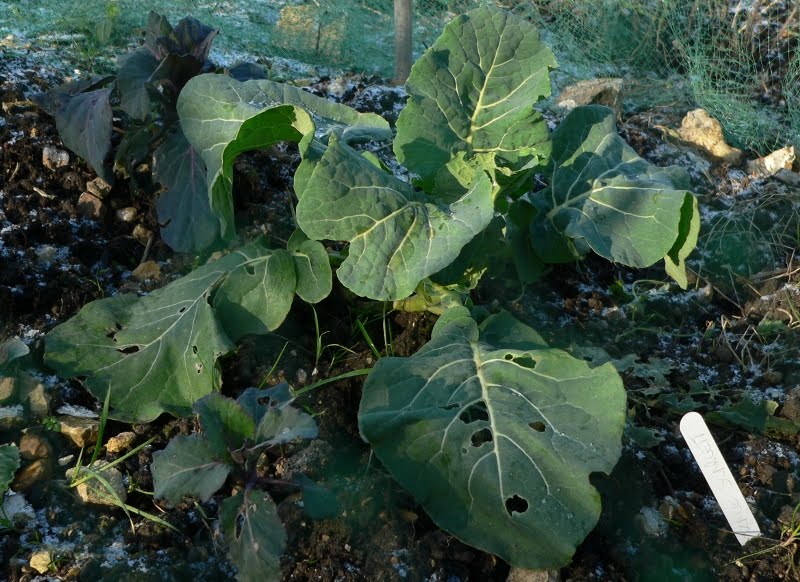
    • a task for the week: to investigate why my cabbages are NOT growing (below the biggest). Do you have any suggestions for me? Should I start picking the leaves to encourage further growth?

  • Glimpses of spring!

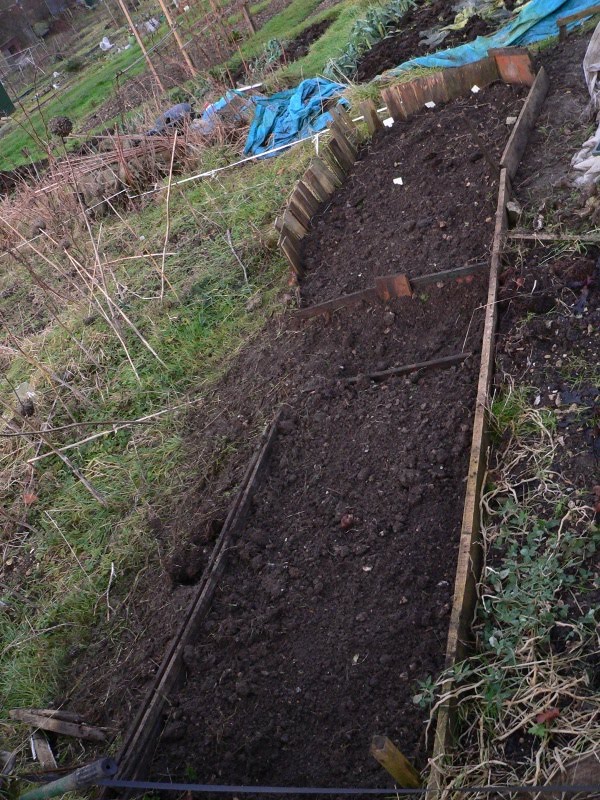
    All the snow melted, the soil is surprisingly dry and crumbly: today it was the perfect day to weed the wildflower meadow around the pond and create my new umbrelliferae bed, next to the asparagus’s.
    I am very proud of the result, that you can see in the picture.

    Digging and clearing the dried weeds was made much more pleasant by the fact that ladybirds were half awake and could move to a new suitable rest place when disturbed. I came across quite a few natives, and just one Harlequin: very good.

    I decided to be brave and do some proper pruning, winning my reluctance to get rid of anything with buds on it. Managed much more ruthlessness than usual, and the suggestions from the RHS pruning book I read last autumn have been very useful. The only thing I did not feel confident enough to tackle was the vines.

    The most disappointing thing has been my compost heap: I guess it is too dry so there’s no compost at all, just branches, flourishing weeds and insects. I have to figure out how to take kitchen scraps to the allotment without too much mess.

    It was great to be out and realise that days are getting longer again, and I am really looking forward to spring now!

    The first glimpse of future crops was salad seedlings emerging in the greenhouse, and of course the leeks I planted last autumn have been growing through the snow and frost…

  • Kill it, cook it, kill another one…

    The BBC is the one medium through which I learnt a lot about “the Good Life”, such a British concept of self-sufficiency, pretty alien to the Italy I come from and so fascinating to me. So I keep looking out for programmes about food production, sustainability etc. and over the last few days I watched the second series of Kill it, cook it, eat it.

    I know, it is a pretty rubbish format, but still there is something that compels me to watch it. I think this programme is such a waste of a good opportunity. Enabling people to get in touch with real food and the food chain I would say is a good thing, and this series focussed around production of genuine v fast food.

    For example, I found it much better than Jimmy’s Food Factory which was so uncommittal that you were almost in no position to judge whether “supermarket food” (did they mean processed?!?) was any better for you than… what? Jimmy seemed to enjoy the ingenuity needed to make the food in his barn, but I am still not sure what was the point of the programme.

    However, it seems to me the eccessive fuss made around the slaughtering process and the presenter’s continuous references to the gruesomeness and any moral/ethical issues connected to it have a place only in heating up the dislike between vegetarians/vegans and “meat eaters”.

    I personally come from not only a meat-eating but a meat-producing family. My grandfather was a butcher. He was born at the end of the 19th century and lived in Milan. The Milanese were required to bring any meat to the public slaughterhouse, so because he wanted to slaughter the animals himself, grandad moved to the countryside. He was passionate about his job and wanted to ensure high standards of butchery. My grandmother is said to have made delicious capons by castrating chickens. Unfortunately, as they were too old when I was born, I never had the chance to watch them at work. But I would have loved to, and I am sure I would have gladly helped out. My father and auntie have always referred to meat and its production with great passion.

    In the BBC3 programme, though, such a basic life-sustaining activity as meat production gets so politicized it feel so weird.

    I am considering a future in smallholding, and would love to keep animals. And yes, in order to eat them you would have to kill them, and cook them. Same applies to vegetables, though. They are alive and pretty amazing things. Without them we would not exist. But would anyone ever dream to make a programme: “Harvest it, cook it, eat it”? And debate on the moral issues of chopping off plants?

    That’s extremes and hope nobody gets me wrong: I think respect is due where consistency is, and the same principles are applied to fish as to meat, to invertebrates as to vertebrates. It is strange to realise that you can love and kill animals, respect nature and make use of it to sustain yourself.

    I have killed animals but also suffered from seeing animals (and plants) killed pointlessly – most spiders around the house for example get rescued rather than killed. And – unfortunately and unaware – a German cockroach’s nymph too (as it looked so pretty, in its third mould, that I did not realise what it was).

    However, it is the squeamishness of the participants that I find so out of place to be annoying. Somehow it seems to imply a lack of respect, and it must come from living in a world that is more and more virtual and less and less in contact with what surrounds us. I am sure I was much more squeamish myself before getting an allotment. Even though as a kid I used to eat fried calf brain as a kid, and still love chicken heart, and tripe.

  • Gardening behind the scenes

    I seem to have gone quiet on my blog, but I am doing a lot of gardening thinking.

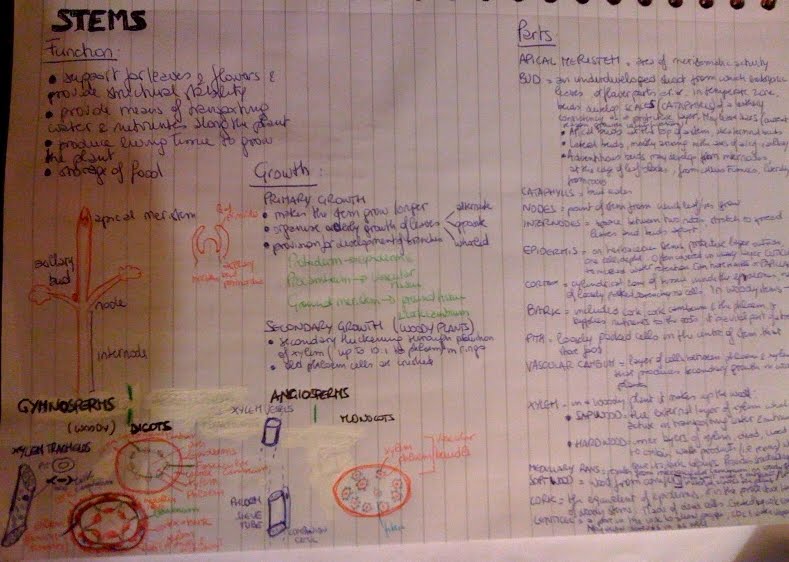
    First of all, I have progressed with my study, putting together a good summary of stems after the one on roots I posted before.

    Then, over the weekend, I almost read three books: one on self-sufficiency & organic gardening, one about grapes (which I have to start managing, if they survive the snow that is), and one on companion planting.

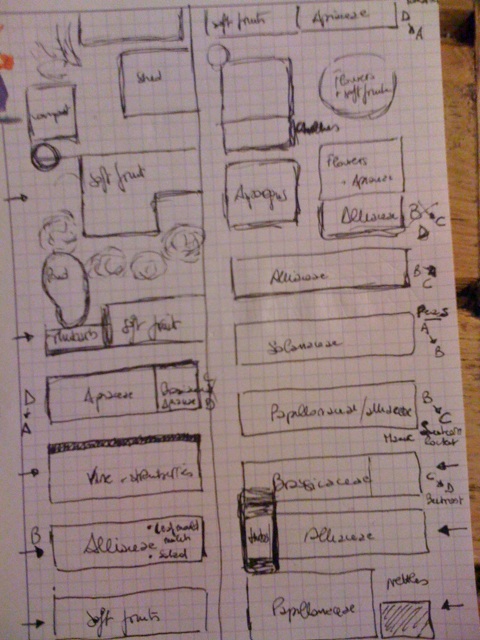
    I made an updated drawing of the planting scheme & rotation on my plot and have decided to give myself SMART (Specific Measurable Achievable Realistic Timed) objectives for this year’s gardening. So far, I have just experimented and got whatever came. It’s now time for me to make a step forward and see if I can achieve according to plan.

    The only objective I have come up with so far is being self-sufficient on chilli (and garlic).

    Garlic-wise, what I have done is planting double what I planted the years before. But that was before I decided on establishing objectives. I could actually plant some spring garlic. I’ll have to have a think about it, as space is scarce already. The council measured my plot and came back with a vague answer, of the kind ‘size varies every year, we cannot keep measuring all the plots all the time’. Except they did measure mine and never told me how big it is. Not 10 poles for sure.

    The trick will be growing the chillies, as I never made it beyond flower – well, I got some chillies from the garden centre’s grown-up plants, so once the plant is established it is not too difficult. It’s getting the plants established that I have to work on, so I am alreading trying to figure out where and how to grow them. I have seen them grown in polytunnels at Riverford and at my neighbour’s, so I guess I will have to build some such structure.

    — Post From My iPhone

  • Stuck indoor and researching garlic

    Stuck indoor once again by beautiful (I do mean it!) snowfall, and having given up addictive iPhone game, I spent the edges around my working day trying to concentrate again on my future in horticulture.

    Garlic caught my attention, as I remembered that the two variants I was given by Neil and did plant before the frost, were yet unnamed. So I started searching for garlic names and ended up knowing a bit more about garlic overall.

    There seem to be two subspecies of garlic proper:

    • hardnecks (Allium sativum var. ophioscorodon): mainly grown in the Northern emisphere, they may grow a flower stalk, and have on average fewer, bigger cloves, which have a shorter shelf life.
    • softnecks (Allium sativum var sativum): mainly grown in the Mediterranean region and for supermarket use because of a longer shelf life. Taste is stronger and cloves are more but smaller. It is recognisable by the stalk inside the bulb being papery rather than woody, so that it can be braided.

    There is then something called elephant garlic, which not real garlic but is related to leek, and has bigger cloves and milder flavour so that it can easily be eaten row.

    Remember the strange cloves I found on one of my garlic plants left in the ground beyond its time? It was not a dream! Apparently they are the normalest of thing for hardneck garlic, and come with their own name: bulbils. They are a reproductive device (not seeds though), as they produce immature plants in the first year, and then proper bulbs in another couple of years.

    There, now I have identified my previously grown garlic as hardneck, and with it the mysterious bulbils, besides learning the name for the coiling flower stalks: scapes. These need to be pulled off to redirect energies to the bulb (which I did) and can be eaten in a variety of ways: roasted, stir fried, as pesto or seasoning (which I didn’t – what a waste!).

    Also, I realised that that previously grown garlic had Wight in their name (‘Lautrec Wight’ and ‘Albigensian Wight’) because the Isle of Wight is home to a big UK garlic farm (unfortunately not organic).

    Incidentally, I have also found the name of Neil’s garlic on Delfland Nurseries‘ website: they are both softneck varieties, ‘Messidrome’ and ‘Printanor’. I wonder whether there’s enough sun up here to develop them. And I worry for planting them at the wrong time (the first should have been planted in October/November and the second in January…)

    Garlic has been used for centuries for its medicinal properties, being allegedly an antiseptic and antiviral and benefiting the cardiovascular system (including on cholesterol and erectile dysfunctions). It is also an insect repellent and useful for companion planting of carrot and lettuce. Unfortunately, it has side-effects as the smell is expelled through the skin pores and perspiration and in breath. Some people are also allergic to it.