Orto di Casa Cecconi

My first allotment, and then one thing leading to another…

  • Roots

    I have done my first revision table for plant organs: starting from the bottom I chose the root, one of the vegetative organs (together with stem and leaf) as opposed to reproductive organs (flower, seed and fruit).

    Very proud of having managed, when I spilled my tea on it (it’s time to go to bed, but I wanted to finish at least one organ!) – it’s ok, not much damage.

    The way I organised it is a summary of: function, drawing of structure (with great help from an online one), organ parts, non-standard characteristics and any types or adaptations in which the organ presents itself.


    Will I have rememberd the most important things? There’s so much!

    One thing I had no idea about and found interesting is that there are root tubers and stem tubers, both are adaptations of an organ for food storage, and they enable the plant to survive in winter under cover of the soil, but a stem tuber is a stem with buds & all… the potato is a stem tuber and the ‘eyes’ are its buds. The sweet potato instead is a root tuber.

  • Tiredness, GM, knowledge wisdom and innovation

    Some three weeks ago I drafted the post below. I was reluctant to publish it, as I do not like to address a serious topic lightly, and my blog is meant to be about my allotment, anyway. However, after two years of gardening and now with the horticulture course, my knowledge of organic gardening is influencing other areas of my life.

    Although the post is still half thought through, and three years have passed since I read the book I mention (so my memory might be selective), I have decided to post it all the same – A friend has been recently just about saved by the latest medical technology from a life-threatening medical condition brought about by an innovative drug. I see a parallel with my previous post, as pharmaceutical and biotech are both industries of disproportionate power, and relying on rapid innovation.

    I wish we all had more time to stop and think more.

    Comments anyone?

    I am very tired after a few stressful weeks, and the weather at the weekend does not allow me to exercise on the allotment, so – beside not having much to talk about – all my leftover physical energy goes straight into worry-power: very unproductive.

    And what I am becoming very concerned about, without having the energy to study the topic in more scientifical detail, is what I put into my mouth.

    I stopped drinking milk in the office as it is not organic, and am considering cutting on the Indian takeaway and the sushi place where, when I asked: “Is the soya GM?” they looked at me as if I was asking them to solve a differential equation… The problem seems humongous and I do not want to become a campaigning fanatic: I believe in balance and skepticism… but I also feel strongly about this. The science of genetics is so new, and yet we dare mess with genes that took thousands of year to arrange themselves as they are…

    It is the idea of the “silent invasion” that irks me most: the lack of control, the idea that money means power and power results in someone else making decisions for me. That I have tiny power to influence. And that the techniques of persuasion are used on both sides to make their case more appealing, rather than debating the truth. The truth…

    Musing on the idea of the pressure for innovation that comes from the need of big corporations to make money, new money with new products, useful or not, healthy or not.

    My profession before gardening is knowledge management, and the theorists of KM have gone through a lot of talk about knowledge and wisdom, and more recently knowledge and innovation (to put some ROI behind the theory, I guess). Most assume that knowledge leads to innovation, but I will never forget a book by a Swedish KM guru (and an economist to boot): the most ‘alternative’ and ‘environmentalist’ of KM books “Treading lightly” by E. Sveiby. I had to reflect on this book more than usual, as I was writing a review. It did puzzle me, but the more I thought of the topic, I was fascinated. It seemed to imply that wisdom (seen as conserving) may be in conflict with innovation (seen as leap of change), although they are also linked in complex ways – the book analyses stories from an Australian aboriginal society and the supposedly underlying culture – knowledge is linked with wisdom more than innovation.

    It does make some sense. Knowledge is based on your experience, it comes from trying and failing and succeeding, through your coming to terms with reality. It takes time to acquire. What about innovation? Although commonly defined as ideas that do work in practice, the world moves so fast from one innovation to the other, there is no time to reflect: what does actually work in practice? Are unwanted consequences considered? And there are a wealth of political and economical considerations connected to the furthering of innovation, that might influence the reflection…

    Maybe I am getting old, but I start to think that life is going too fast, and unsustainably so. I wish there was time to stop and think more.

    BTW I went back on Sveiby’s website to have a look, and he seems to have written an article that is spookily relevant to my thoughts on the dark side of innovation (pro-innovation bias). Did not have time to read it yet myself, but it’s printed, and in my bag.

  • Catching up with my gardening related activities

    I am slowly catching up with my gardening related activities: the allotment, my horticulture course and the blog.

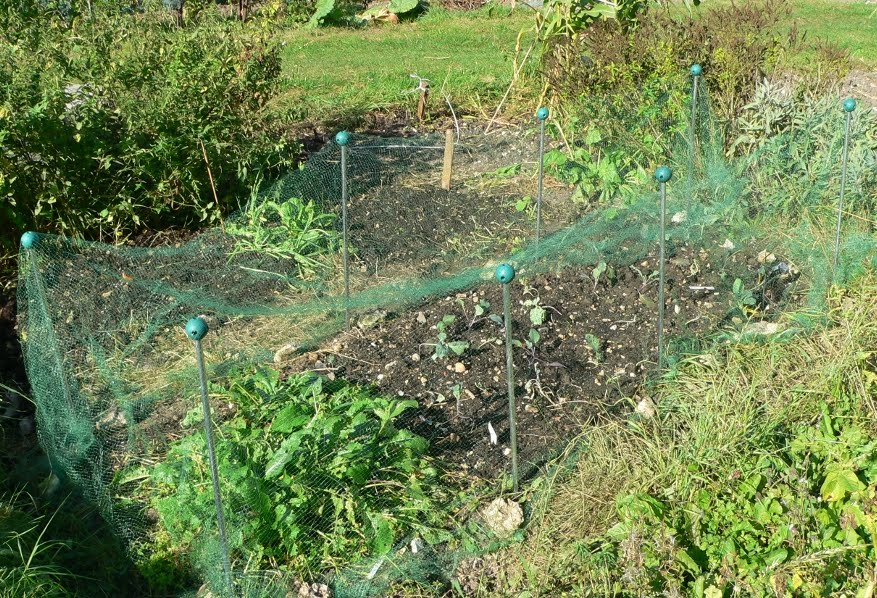
    Today I made a big order at Garden Organic: some seeds (but not too many, as you know my collection is of a size it might save the world from famine already), the fantastic aluminium tubes and connecting balls (the cage I made for my brassica is successfully keeping the birds off, it is sturdy and easy access), gloves (which never seem to last much) and a few other bits and bobs.

    The charity seems to be struggling, and they are not the only ones, as the Soil Association have also been asking for more money lately. So I hope the oder was a little help.

    Another thing that I did and got me a bit of excitement back (after the last three very weak weeks) is enrolling in the Garden Organic experiments 2010. There are four:

    • compost as a growing medium;
    • growing tree spinach;
    • surveying butterflies;
    • slug barriers (which I most definitely would love to do)

    and I signed up for three as it seems most appropriate for a horticulture student – I left the one on compost as I do not feel confident enough of my composting skills yet, and similarly I left the one about helping the University of Plymouth on a study on invertebrates in compost heaps.

    Tonight I promise I will sit down and make a graph of all the plants’ organs. I keep procrastinating on this, as is seems an unwieldy, enormous task, but it’s no good: I am falling behind with my study schedule!

    Studying science after some 20 years of humanities only is trying, and weird. On one side it is very schematic and logical as you would expect, but unexpectedly to me so many things are not known – i.e. the taxonomy of plants keeps changing as more knowledge is acquired: Kew magazine this month mentioned one such re-classification of plants based on DNA research has just completed.

    It’s fascinating, though, to learn more about such an important resource for humankind as plants are. It set me thinking again about nature and ecosystems versus science and technology and human ambitions. Maybe I will write more about it.

  • Setting an example

    Finally, this weekend was decent enough to go to the allotment and I didn’t take any chances: husband made me packed lunch and I stayed from morning to sunset, 6 hours.

    How good that was! Did not seem to do a lot though.

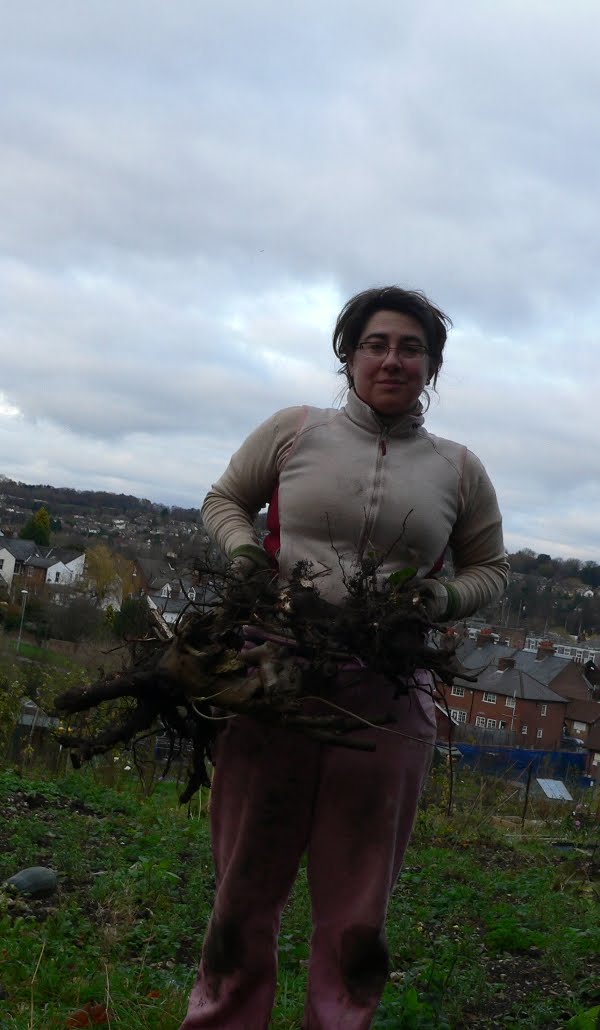
    I finished clearing and transplanting the strawberry runners (there’s a handful of strawberries still ripening: amazing!), managed to sow the broad beans, picked all the remaining tomatoes in the greenhouse (a couple of plants were still flowering!) and made a bed for salad with the leftover compost… then I uprooted a maple tree that was in the middle of the path, as I thought it worthwhile to set an example for my neighbours, who have more than one to remove. ;p

    The garlic remains yet unplanted, but the salad I sowed under fleece the last time seems to have germinated. I am pretty amazed that two days to December and everything still flowering (including borage, nasturtium and lavender at home).

    Did not manage to pick anything apart from the tomatoes, but Paul gave me some leeks, and I am going to make risotto with them: slurp!

    Recipe: slice the leeks, stir fry in olive oil (and a little butter if you wish) until soft, then add risotto rice and sprinkle with white wine. When slightly toasted add vegetable stock (2-3 times the amount of rice). Finish with some grated parmesan as soon as the hob is turned off.

    I have to study, and the muscle pain tonight is very conducive to sitting on the sofa with a book!

  • Miserable weather

    Another weekend of miserable weather has gone, and my stored onions are rotting already.

    Not much to say.

    — Post From My iPhone

  • Allotment roast for dinner

    I had a roast with my own potatoes (after a laborious cleaning of all the slugs’ and varied other holes) and turnip Rapa Bianca Lodigiana… the only non-allotment ingredient was sweet potato from my vegbox.
    It is always very rewarding when you can cook most of a meal with your own stuff.

  • A little sowing today

    Despite the mud, I decided to sow some rocket and salad under fleece in front of the greenhouse where the sun reflecting on the panels should make the area warmer.

    It was too waterclogged to try and sow garlic or onions, and I made a call to delay broadbeans at least another week. Instead, I cleared another couple of beds and planted the chrysanthemums that had overspent their time in pots and last year’s bulbs, the ones I did not like in my garden at home.

    Inside the greenhouse, the tomatoes are still growing and ripening, even though more and more are getting mildew. The cucumber is sadly no more, and I will have to plant the artichoke from the pot as it is starting to suffer.

    Such a pity it gets dark really quickly.