“The best time to plant a tree is 20 years ago, the next best time is now”
unknownGrowing a tree is a long term investment, often a conspicuous one, so you want to ensure it will thrive and perform its function in the garden by planting it in the appropriate way.
It is a fact of life that, while there are a range of different science-based ways of planting trees (as different techniques develop on what works best on a particular site and within particular conditions: the horticulturist’s personal experience of translating into practice the applicable scientific principles in soil and plant science), not all techniques developed over time are equally good or even science-based.
No trademark is of course associated with an “RHS way”, as it would contradict its ethos of sharing of horticultural best practice: information on techniques for planting trees are widely available in print, online (like this guide to buying good specimens or this well explained planting video) and through courses.
When participating in a tree planting masterclass today, as part of my learning process, I was mentally comparing “the RHS way” to what I was taughtlast year, when I was working in the Arboretum at Kew, planting trees, and – of course – being inducted into “the Kew way”.
Choosing a plant carefully before buying is universally considered a best practice: last year I visited a specialist nursery for the first time with a professional horticulturist, and the way she selected plants surprised me: not only did she ask a lot of questions and look for healthy specimens, well grafted (if the case), with no signs of having been long in their pots and badly cared for (i.e. moss and weeds on the soil surface, suckering stems, roots sticking out or deforming the pot), she would actually be rather physical with the trees, touching them and shaking them gently out of their pots (they should come out easily with the soil attached, if the soil does not come out then the roots have not developed correctly, if the tree won’t let go of the pot, it has been in there far too much, and if it comes out but with all roots running around the pot or even backwards towards the tree that is not good either).
While at Kew we did not disturb the rootball (probably because their own nursery trees are grown in airpots which train roots to develop outwards anyway), here (something that is probably closer to the average gardener’s experience) rootballs needed to be, and were therefore teased out, before planting, preferably in the autumn, when the soil is still warm and roots can start establishing once they have shed their canopy.
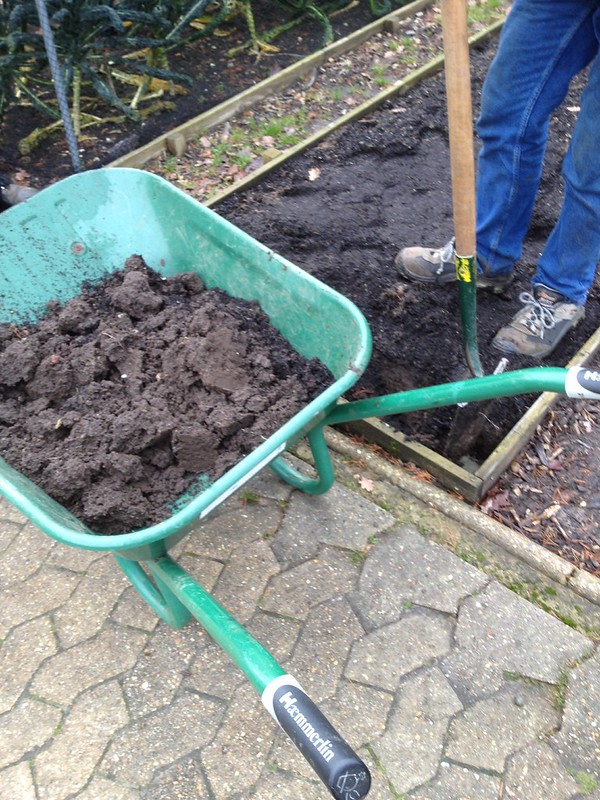
Planting hole dug, surfaces forked, mound filled back in to place the tree on so the root flare is just above soil level On Kew instructions, I have previously dug large square holes and back-filled them before planting the tree, to avoid the roots getting bound in their pits; here, however, we achieved the same result by digging smaller, round holes (a minimum of three times the pot diameter), forking the bottom and sides, then planting the tree with its root spreading out on a little well-pressed mound of soil to take the root flare just above soil surface. That is to account for some initial sinking; incidentally no organic matter is used by either garden I’ve worked in, as it would rot and sink with the roots in it; besides, the roots would be too cosy in the hole with its added nutrients to make the effort to spread out and anchor properly into the soil.
A correctly planted tree will have
its root flare above soil levelThe root flare is a very important part of the plant: the area where the trunk joins the roots, which spread out, it is a weak point in the tree that should be never planted below soil level. Bark, in fact, risks rotting and undermining the health and stability of the tree.
Tree planted too low,
girdling root just visibleI’ve seen the damage caused by low planting: in the best cases plants start to sucker, in the worst, roots girdle the tree or the bark dies back and the plant dies. So one should always find the root flare before planting a tree, if necessary freeing it of any soil accumulated over it in the pot.
As roots can grow bark if exposed, some prefer to plant higher rather then lower on the soil level, within reason. There are other considerations too: if trees are on a slope, soil will wash away from above it and might accumulate below it. In the garden there is also an oak whose root flare ended up 1 m below ground over the years, as part of natural land sliding.Mycorrhizae – beneficial fungi that work in symbiosis with plants, providing them with some nutrients they dig out from the soil, while getting carbohydrates in return – are used in planting in both gardens, some scatter them in the planting hole, while we rubbed them on the roots for maximum contact.
Newly planted tree – staked, and watering bag Something that I had not had the opportunity to learn about previously was staking of trees.
Staking prevents windrock from disturbing the roots (sometimes it may even pull out the plant altogether) but it has to allow the stem to flex and bend in the wind, something that helps appropriate secondary thickening to take place, and with it healthy bark development.So stakes should be short, at a 45° angle into the wind (so the stem, bending in the wind, is not swept into it, but away from it, pushing the stake into the ground at the same time).
One inch between the tree and the stake allows the use of soft pads firmed with rubber or plastic canvas ties, to minimise chafing.
Tree guards may be needed to protect the tree from ringbarking and death, where rabbit and deer are active.
A doughnut shape of mulching completes the planting hole, which needs to be well watered: proprietary watering bags are used that can be left overnight to allow water to soak thoroughly and percolate throughout the hole.
Implementing complex designs
As I am working on the cottage garden design, today’s short masterclass on how to implement complex designs came in quite handy.
The new winter display for the Walled Garden, a grass and white gravel knot design, was being finished after a month’s work (as narrated by my colleague who could see from his window)…
Lots going on outside my office window today…new bedding scheme being created….watch this space! pic.twitter.com/5u0EHl2bhE
— Tim Hughes (@TimHughes_) October 7, 2014Mmm it’s not your standard seasonal bedding display…..what do you think it is going to be? pic.twitter.com/7ZLdD8ihZi
— Tim Hughes (@TimHughes_) October 7, 2014Measure twice, cut once! pic.twitter.com/HS5tlvO3dm
— Tim Hughes (@TimHughes_) October 22, 2014Weed control fabric being installed, crucial this does not show through the next layer (gravel?). pic.twitter.com/1CxLDR3HjX
— Tim Hughes (@TimHughes_) October 24, 2014Hmm not sure about this….Mowing should be interesting!..Kids will love the gravel!….perhaps it will grow on me. pic.twitter.com/OPa5jxO75m
— Tim Hughes (@TimHughes_) November 3, 2014… and we had an opportunity to learn some of the principles that were behind its implementation.
The most important points were:
![]()
- measurements should always be from straight perpendicular lines, and the bricks in the Walled Garden beds are obviously not, so and external measurement baseline is needed
- a builder’s square with two tape measurers, pins and some string are all the equipment needed
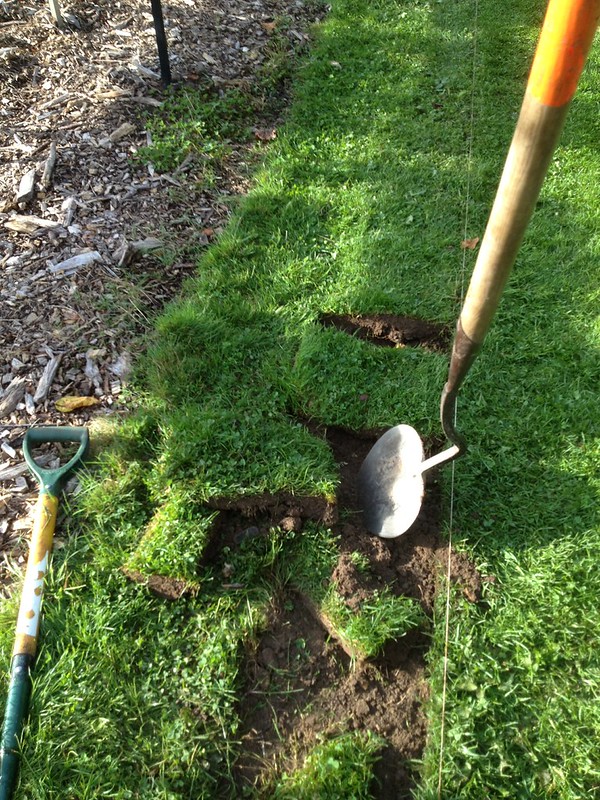
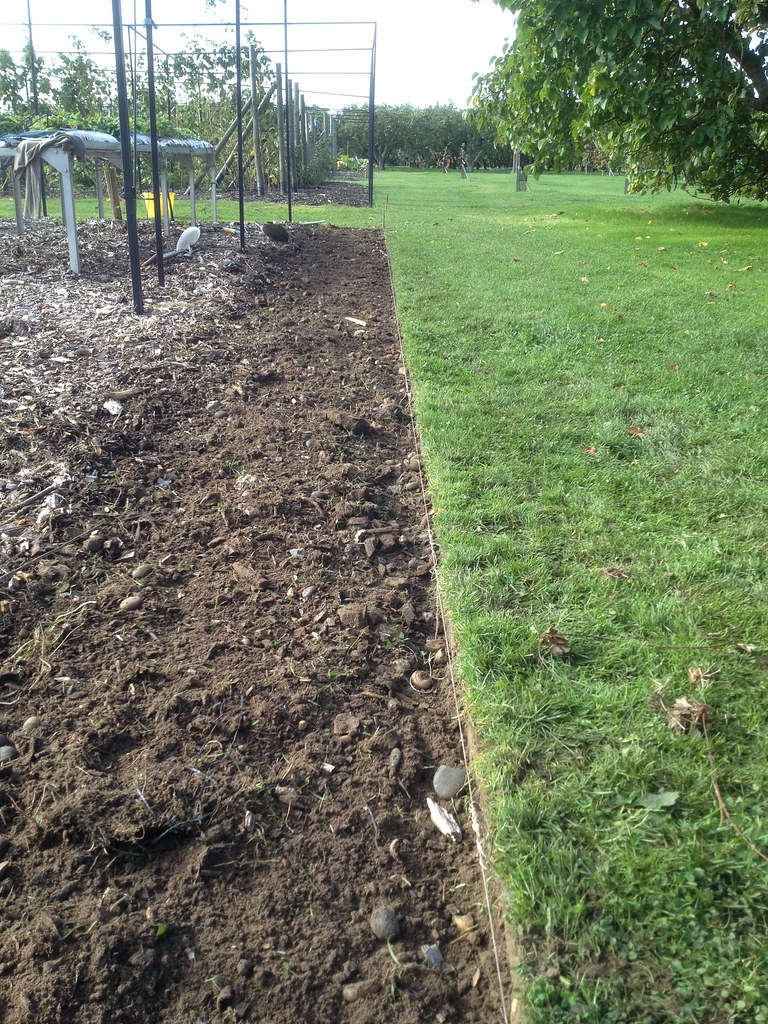
- a circle is a line of points equidistant from a centre, so to draw circles you have to know where the centre is and then, from it, mark as many points on the line as you can to make it more accurate (in this case before cutting in the turf). The string at the bottom of the pins marks the outline of the shape.
Another suggestions we were given was that weed membrane is better than woven plastic when making designs, as it is easier to shape.
A rambling rose
Surprisingly challenging task for me in the herb garden today, where I was asked to prune a rambling rose to fit on an arch.
I had never done that and my colleague explained we were cutting back 1/3rd of the older branches to the ground, then arranging the remaining ones on the arch and shortening laterals to 2/3rds.
Before starting First part of the task was removing all the old ties from the arch, and taking down the (rather heavy) branches so we could have a good look at them before choosing the ones we wanted to tie back.
All branches untied and spread out Once the branches were all on the ground, however, it looked to me very much like a tangled mess, and I found it so much more difficult to decide which ones were good to keep than I usually do: normally, by clearing around the plant and observing it from all sides, the branches that are to go “reveal themselves” to me (for want of a better expression). But here no clearing was possible and the plant had not much of a shape…
A previously pruned rose My colleague had to leave me to it, with a previously pruned rose as my sample, and I proceeded with as much care as possible, tying back branches to the back of the arch first, some 15-20 cm apart. Then I had to tackle the top. I was told that the arch would look best by having some branches softening its front, so I worked towards creating the desired effect.
It looked to me the plant was rather top heavy, with plenty of laterals and sublaterals on a single stem, so the most challenging part was to reconcile the principle of keeping suitably shortened branches and allowing some distance between them to avoide rubbing (that might cause dieback and provide access to other pests and diseases). By the end, I found what I thought was a good compromise, but I had cut more than the expected one third of the plant.
The final pruned rose, tied back on the arch My colleague confirmed: this was much more than she was expecting to prune, which was a bit demoralising, especially as this was the last rose that needed pruning, and I would have benefited from pratising on other plants with her, to get used to this new to me shape of plant.
Roses usually respond well to hard pruning, and there were some vigorous new shoots in this one that I left, but I am a bit worried that the plant might put too much energy in vegetative growth next year, as opposed to flowering, which would be a pity as this is a very attractive spot for visitors.
Well, one can only wait and see…
The very special veg garden and gardeners of Wisley
Today it was the first time I ever managed to work in the veg garden and I was so excited!
In the flurry of activities that the start of our traineeship was, combined with Garden events, staff leave and who knows what else (time flies here!) I never managed to get to work in the veg garden. I had heard so much about it and the specialist colleague that works there and how the area is popular with the public.
The reason why I was specially excited was because I’m so keen to learn about vegetable growing, my passion. I am the first trainee in the Fruit, Veg and Herbs Department that is not just working on Fruit and I am determined to make the most of it, so much so I’m planning to carry out my Horticultural Management project on veg growing (I’ll write more on this later on).
And the public is as excited as I am, it would appear, to learn more about growing veg, in fact the staff and volunteers in the area receive some 30-50 questions a day, from spring to autumn when most of the crops are growing!
The bright seed of runner bean ‘Hestia’ I was there just clearing spent crops (namely beans and brassicas) yet received my fair share of questions, on the unusual plants they could spot (for example achocha – Cyclanthera sp, a crop I know very well as I’ve been growing and eating it for last three years) and on our plans for the beds that I was clearing.
Most of my colleagues do love to interact with the public and talk to people about crops and cultivation details: the specialist in the veg garden is particularly well endowed for the role as he used to be in catering in a previous career, so he can not only answer horticultural question, but culinary ones too!
But that is a very special brand of gardener that they are here, as in my experience there is a huge gap between those that like interaction and those that find it uncomfortable to receive questions on biocultural information. Some may well like to write about growing plants, but answering live questions is a totally different matter – I was reading about that just recently, as someone published a case study on their dissertation about growing and sharing information about new crops.
I have received a range of questions myself since I joined the garden, and it is quite an art to abstract yourself from whatever activity you might be busy on and figure out – off the cuff – what a question thrown at you is really aimed at knowing, putting it into context with counterquestions, and finding a suitable answer. I have done it in the past when – as a student – I worked in a customer service role, so I can see how it becomes easier with experience. But, as the relatively novice gardener I am, sometimes I am still thrown off. But it feels really good when you can provide helpful information, it does add to the job’s pride.
One question that made me feel like that was about lichens on apple trees: are they a problem? I knew the answer as we had discussed this last year when restoring orchards. Lichens cause no problem to the tree, but they are an indication that the plant is not growing fast, as they take time to establish. Apple trees that do not have some good vegetative growth tend to produce worse fruit with time, so if you see lichens on your apple trees when you want them to fruit, it’s time for a good pruning session!
Some other questions result in you learning something new, like when I was asked: can one train peaches and apricots as cordons to have more space in the garden? Never had I thought about that, but luckily I had our fruit specialist on hand to ask: the answer was, unfortunately for the visitors’ plans, no. And the reason why, is that peaches do not fruit on spurs, so you need whole branches and they cannot be restricted much, hence the fan shape they are usually trained as. In the case of apricots, it’s the fact that there is no suitable dwarfing stock to grow them on, and as a plant they are too vigorous for cordons.
My experience of the RHS
Today new staff from all the gardens (Wisley, Hyde Hall, Rosemoor and Harlow Carr) was brought together for induction day.
I have been through a good few induction days in my career, and that corporate self-congratulatory feel about a lot of them has made me less than excited to attend such events. But I did enjoy today: the atmosphere was genuinely friendly and pleasant, and, despite this being an exciting time for the Society, as £100 m of investment over the next 10 years has been approved by the board and the projects linked to it (more details of which are spelled out in the Annual Report) are underway already, I liked the way the Director General was rather down-to-earth about it.
I must say that to me as new entrant in horticulture, who’s finding it hard to be self-sufficient on the average salary, the RHS attempt to improve the conditions of horticulturists is particularly appealing. It’s rather appalling that we do not pay a living wage to people that produce our food, but the priviledge to make ends meet should extend to the competent gardeners that offer us the pleasure of beautiful gardens too! It is a complex and political issue to address, I know.
It is also very important for me that the RHS (of which I am a member as well as a trainee!) is investing in research and education, as we know still so relatively little about plants, and we definitely need to bring horticulture into an era where being kind to the environment we live in and that keeps us healthy is a priority, while pressures are strong in all sorts of contrary directions.
My hope is the Society will move towards establishing themselves as the world leaders of the new gardening that they started promoting back in 2007 with Matthew Wilson’s book, which I recently started reading. I have spotted signs of development: possibly a less complex, although certainly as highly political, issue to address…There is a lot in the RHS mission statement and guiding principles that I share and feel strongly about, and I was really impressed by the genuine effort to give visitors a pleasant experience in the gardens, and to bring gardening to an increasingly wider audience, beyond the traditional Flower Shows’.
I myself first became familiar with the society at Hampton Court Flower Show years ago, when I visited as a tourist from Italy. Once my interest in horticulture developed, I decided to take advantage of the RHS qualifications, and finally applied for this traineeship, so my horticultural experience is tightly interwoven with the Society! Curiously, though, I only visited the Wisley Garden for the first time in February 2013, on a spare afternoon after my RHS qualifications’ exams – that probably makes me an unusual member. That visit was however soon followed by one to Hyde Hall: I was hooked – I grew a thing for labelled gardens!
But there is so much more to the Society, for example the plentiful information available online on plants and their cultivation (which I always find myself consulting as a first point of reference, even though I might then disagree with it and not follow it). And a fantastic member service which I somehow never realised was available: the opportunity to contact the Society to identify plants, pests and diseases and ask for advice!
RHS numbers are of course impressive, and we were given some at our induction (but, as the RHS is a charity, all the information is public, and there’s a lot about numbers in the Annual Review). RHS Garden Wisley on its own is
a total of 600 acres in size, which gather together 27k taxa of
cultivated plants and 40 champion trees. 41k kids visit the Garden on
formal school visits every year, while the total visitors of RHS Gardens
across the country (which between them host 14 National Collections)
add up to 1.7 m.Now, now look who’s sounding that tad self-congratulatory… 🙂
But there is indeed a lot to improve in the horticulture industry, in my opinion, not only in how manpower is valued (or not so much) but also in terms of :
- resources and waste (in a job I had over the summer I was shocked to experience how much goes into raising bedding plants)
- cultivation practices and, in particular, use and misuse of chemicals.
It will be fascinating for me to observe how – as it expands, acquiring new and urban gardens, widening its membership and the education opportunities it offers, grounded in its own scientific research – the Society is going to apply its influence for positive change … which, I am assuming, will offer me and other new entrants better prospects of making a decent living, with a light conscience and a lighter doctor’s bill, in a chemically wiser and environmentally sounder industry…
Planning the revamped cottage garden
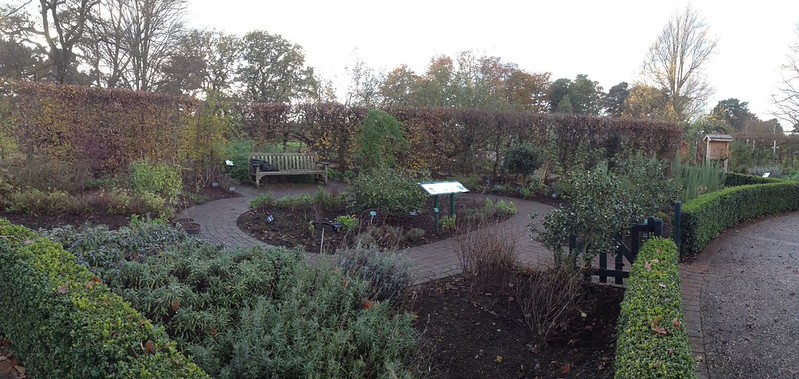
I have spent quite a few nights, planning the revamp of my area, the Cottage Garden in the Model Fruit Garden, and a few daylight hours weeding it and getting to know it close up, including measuring it up and drawing a plan.
The area consists of a formal garden on the left, with straighter lines, and an informal area with curving, fluid lines.
First thing, I sketched it out on a piece of paper. Well, more than one, as it is quite a sizeable area, so I first sketched the whole of it, then, as I started measuring, I needed further sketches of the details. With my sketches and a single tape measurer (it’s better if you have two, one as the baseline and the other for the offsets, saves loads of time, or you can use string as the baseline) I started measuring.
The straighter lines were easily measured as offsets of the boundary lines along the main paths in the Model Fruit Garden, but for the more irregular shapes I had to triangulate: measuring the distance of one point from at least two other fixed ones (some of the triangulation lines can be seen by enlarging the picture below). I then transcribed all the measurements on graph paper, which also allowed me to double check that all the measurements fitted together.
The final plan of the Cottage Garden The curved lines were the most difficult to measure and I was so grateful when I had the opportunity to have the Fruit Dept’s intern with me to help with the measuring.
Once the map was drawn, I used tracing paper to draw the existing trees (in permanent green ink in the picture below) and to experiment with ideas on how to move shrubs and what to plant in which layout. While this is still very much work in progress, I have had the opportunity to discuss a first plan with my manager, and to amend it based on our discussion. While this is still very much work in progress, two main ideas have emerged clearly for me.
Second round of ideas for the Cottage Garden First of all, I would like to use the square bed in the formal area as a little potager, with seasonal planting of interesting and decorative fruit and vegetables. I would like to structure it as a four year rotation space, with four areas, separated by short hedging. The central part of the bed is already planted with a Malus, so that will have to separated by hedging too, so as to accidentally damage the roots of the apple tree. After debating options with my colleagues, I decided I would like to use a box substitute for my hedges, as that would be rather educational and in keeping with the area’s objectives. In fact, the spread of box blight (Cylindrocladium buxicola and Pseudonectria buxi) which causes dieback and bare patches, has encouraged exploration into alternative hedging and topiary plants – not that that would be a novelty, as over the centuries several plants have been used: from Hyssopus, to Santolina, Ilex creata or Myrtus communis. I would like to experiment with Lonicera nitida, which is suitable for both hedging and topiary – I like its graceful leaves and purple berries (when not clipped).
Also, I think a path should be dug across the informal area, to allow access to the three trees located in the middle of the bed and a closer experience of the planting for visitors. The jury is still out on this feature.
Next step is to draw up a list of plants suitable for shade, as this is mainly a shady area, due to the line of tall Carpinus planted just outside the area to the East, and the beautiful and sizeable trees in the Forage Garden to the West.
10 apples or so a day: keeps the doctor away?
After all the picking, and the rehearsal in London earlier in the month, the last six days have been full-on on apples at the Wisley Taste of Autumn Festival and one can get enough of apples, I tell you!
Produce display for Wisley Taste of Autumn After a day of set up that involved me checking stored crates of apples and pears for rotting ones to discard, and making an apple mosaic in the lovely autumnal display that we created in front of our stand, we set out to display tasters of our produce so that the public could appreciate a wider variety of apples, and to sell our apples and pear to help with our budget.
October is a special month for apples: for one they are around, but also, since 1990, the Orchard Network has promoted the institution of Apple Day to bring back traditional orchards from abandon, and to celebrate the variety of apples that small scale, local production entails.
And here we grow some 750 varieties of apples (eaters and cookers) and 150 of pears: both modern and traditional varieties, some of which date back to when the National Fruit Collection was located at Wisley in the 1920s: a joy to the palate!In fact, apples do come in an amazing variety of flavours and textures, as I have learned over the last week, tasting them to help customers with their choices and to encourage tentative attempts at trying something new.
You get the whole spectrum from soft through floury to crunchy and all the in-betweens; juicy to dry; and sweet through fruity, to sharp to acidic. Amazing. And the strangest apple I tasted I was not able to describe, even after repeated tasting. It was called ‘Saturn’: floury in texture, with an aniseed note, it was almost savoury rather than sweet.What was most interesting was to observe the reactions of people visiting us to the look and taste of the apples.
Several people dismissed apples only on their looks (which have generally little to do with either flavour or nutrition) – at some point, we had quite a tasty russeted apple, and I had to tell people: ignore their look and delight in their taste – they would have otherwise been completely ignored. Some actually said they would not expect such a good flavour in an unappealing apple. That is obviously going to be a problem for anyone who wants to market tasty produce that is not grown to supermarket plastic-fantastic standard. I was really surprised by seeing this in practice, although I had read about it profusely.
And I am not sure people realise what are the costs of such shining perfect appearance of the produce they would go for. First of all, for the producers and food waste, as crops that are perfectly edible and nutritious may be rejected by supermarkets, throwing farmers into financial distress (sometimes disaster) and often ending up in the compost heap themselves (as even ITV found out). But also, that search for the perfect look pushes suppliers to treat fruits, that come from further and further away and are stored for longer and longer to be available all year round, with all sorts of chemical and physical treatments (from gamma rays in Egypt to chemicals raising health concerns in the US).
Water core in ‘Golden Pearmain’ An interesting example was apples with water core, a disorder that causes areas of the apple to be flooded with sorbitol (that is not converted to fructose) and become translucent. While not completely understood, water core is thought to be related to ripening, contributing factors including excess of nitrogen associated to low calcium, and temperature variations.
We got a cultivar called ‘Golden Pearmain‘ that seemed subject to it, and my colleagues all wanted a taste, as it is quite sweet, thanks to the sorbitol. In Japan, ‘honeyed apples’ with water core fetch higher prices and the famous ‘Fuji‘ cultivar bred there is susceptible*.Visitors at the Festival, however, shunned the plate, at least until I explained why the look of the apple was different. Would I have done the same? I had never known the disorder myself, and that is because commercially sold apples are screened for it with a variety of non-destructive techniques: light transmission, mass density sorting, MRI, CT scans and thermal imaging*… talking of keeping the doctor away!
After five days, I decided my greatest pleasure was seeing some kids and the odd adult just taste all the apples on offer, trying to discern the different flavours, rather than judge and dismiss them quickly, or favourite them. And it was a real pleasure to see so many kids so keen on fresh fruit for once: are apples the way into the heart of future healthy eaters? It is true that the demographics that visited Wisley for the Festival were likely not average of the general public…
* Sources:
Michigan State University Apples Extension, Water core in apples, http://apples.msu.edu/uploads/files/Watercore_in_apples.pdf
NSW Dept of Primary Industries http://www.dpi.nsw.gov.au/__data/assets/pdf_file/0016/40084/Watercore_of_apples-primefact49.pdf
-
Tree planting “the RHS way”