A little bit of warmth in the spring air and aphids are round the corner. Some of them feed on the underside of leaves, which causes blistering and/or deforms the leaves, so they curl up. Given as I spent some time in the last few weeks explaining red blistered and curled leaves, this post on aphids follows quite naturally. Last year was aphid heaven, greenflies, blackflies, all the colours of the rainbow and a range of sizes too! I don’t think I have ever seen so many of so many species, some quite interesting. Maybe one day I will write a special issue.
While it is true that some aphids can spread viruses from plant to plant, as they feed by piercing plant surfaces with their mouth parts to suck the sap out, in a biodiverse garden the most sustainable approach is just to bear with them. Predators populations need a little time to build up when food becomes available, but rest assured they are already on the case and will soon get rid (or at the very least manage) the problem for you. Ladybirds of all ages, as well as hoverfly and lacewing larvae, are keen on the little buggers and rather voracious (we are talking dozens to hundreds a day). There are then also tiny parasitoid wasps that lay their eggs in their bodies, turning them into shiny little golden globes. Most aphids are monophagous, I read, some have lifecycles involving two different plants, and some are quite happy to feed on several kinds of plants. In the latter case, planting sacrificial crops can be a complementary strategy.
As not so many people are familiar with these essential helpers in a garden, I made a linked post on aphid predators.
Currant blister aphid (Cryptomyzus ribis)
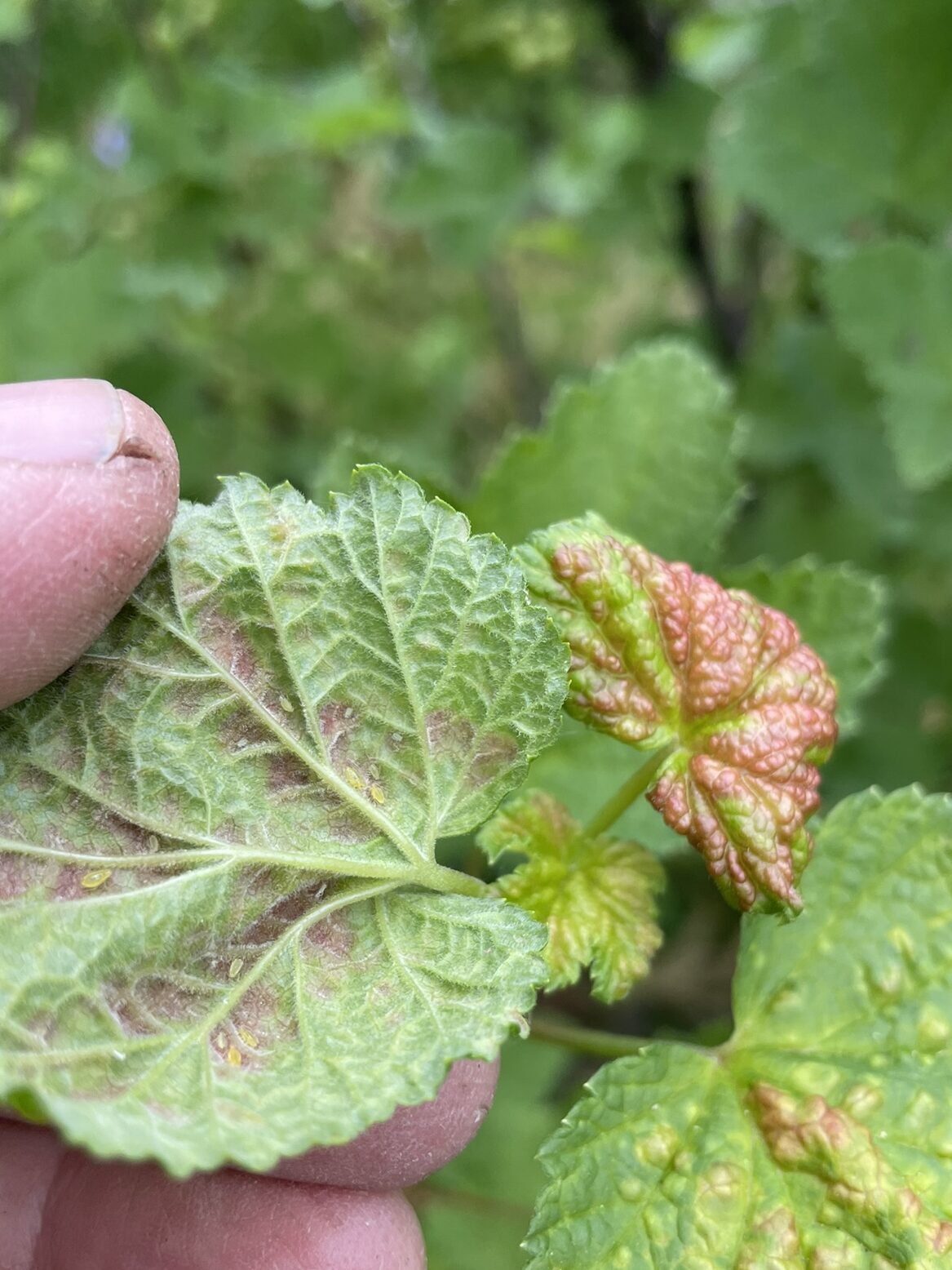
The most common culprit for red blisters on fruit plants, to be spotted on all sorts of currants, red, black or white at this time of the year. The blisters are on soft new growth, at the top of the branches and have no apparent cause, unless you inspect the underside closely. These aphids are quite small and yellow-green in colour and, when feeding, they inject chemicals in the leaf that deform it: a sort of gall. In my experience they do not generally drip enough sap to make leaves sticky and cause sooty mould, and that is why the blisters appear to have no cause.
These bugs can live all year round on currants, but most often they have a two-plant lifecycle. They overwinter as eggs on Ribes (their primary host) and live on the underside of leaves as wingless individuals until the summer, when winged individuals move onto their secondary host(s): a range of plants in the Lamiaceae family, mainly Stachys species and Lamium album.
On my plot, where both hosts are present in droves, these aphids seem to make a fleeting appearance in the early spring. They do not bother me, so I probably just stop noticing after a while. Having had a look underneath a leaf in June, they were gone except for some parasitised specimens, so probably dealt with by parasitic wasps. You can pull off and dispose of the offending leaves, if you wish.
More pictures on the website of Plan Parasites of Europe.
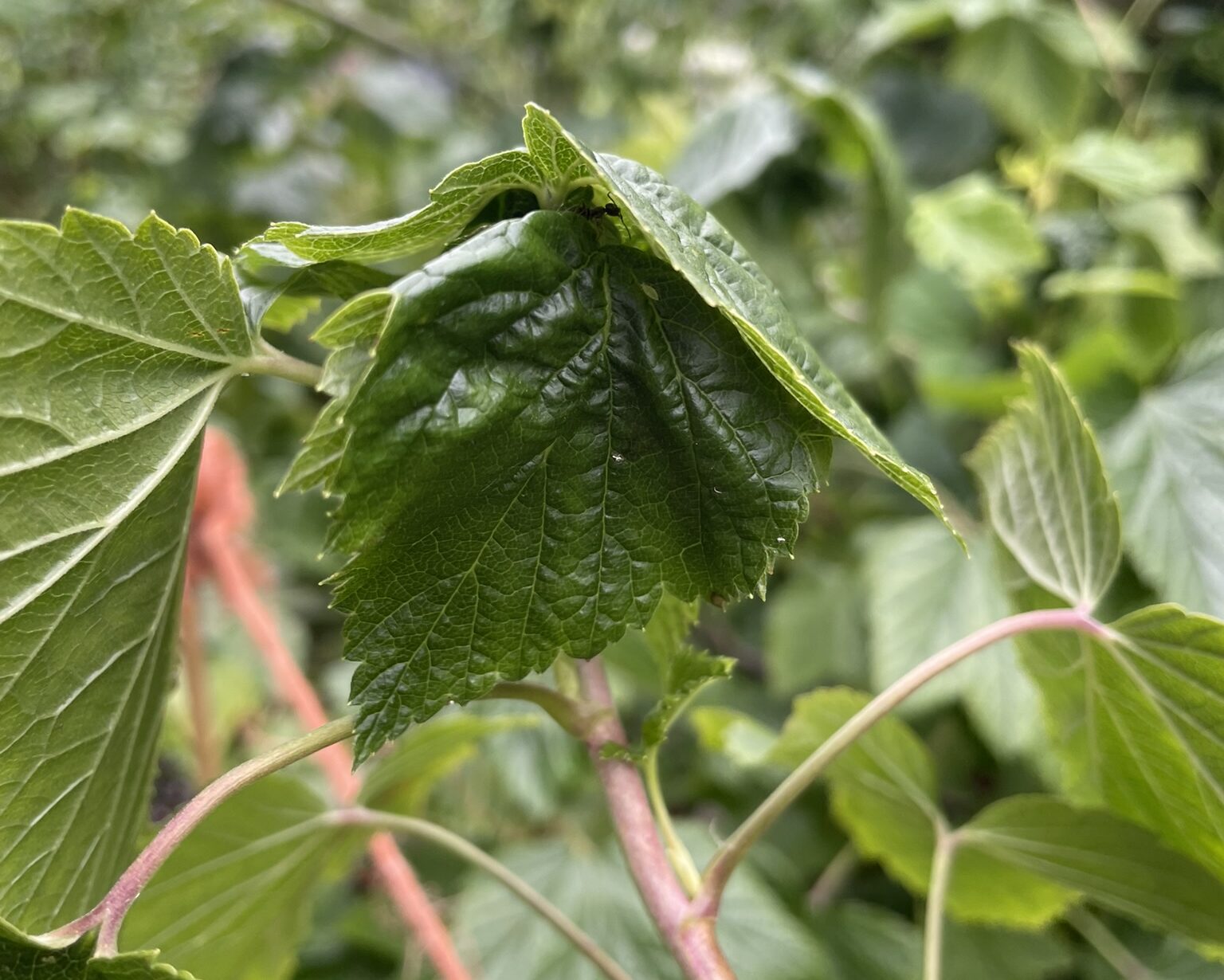
Other Ribes aphids that cause the leaves to deform and lean down against the stem to form a nest are the permanent (black)currant aphid (Aphis schneideri), waxy green aphids that are farmed by ants.
Several species of aphids that favour soft fruit are described in this AHDB Crop Walkers’ Guide to bush fruits.
Cherry blackfly (Mizus cerasi)
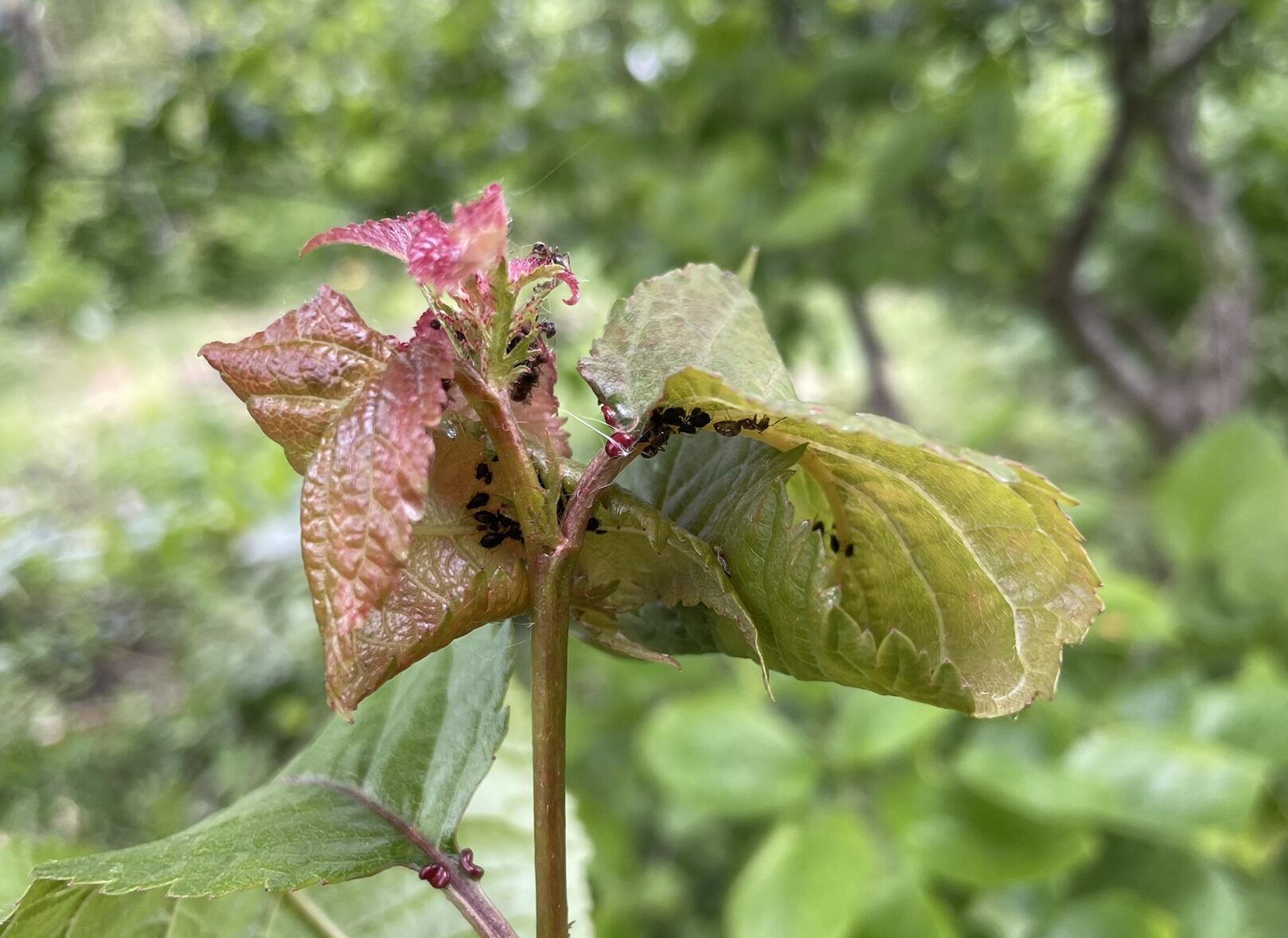
This is a messier aphid, dark in colour, that causes the leaves at the tip of new shoots on cherry (and some peaches) to get deformed and curl from the tip up. It makes quite a visible mess and drips a lot of sap, so it is both farmed by ants (can you spot the one in the picture?) and may cause sooty mould on the surrounding leaves.
This is another aphid with a dual host lifecycle. In the summer they become polyphagous and disperse on a range of plants that include a range of speedwells and Galium.
If you can bear with them, just leave them be. The leaves are permanently damaged, but predators come quickly to the rescue: the mess they make doesn’t go unnoticed. In a European study, hoverfly larvae were observed to be keen on them.
Like pasties, these critters have crimped edges. Have a look…
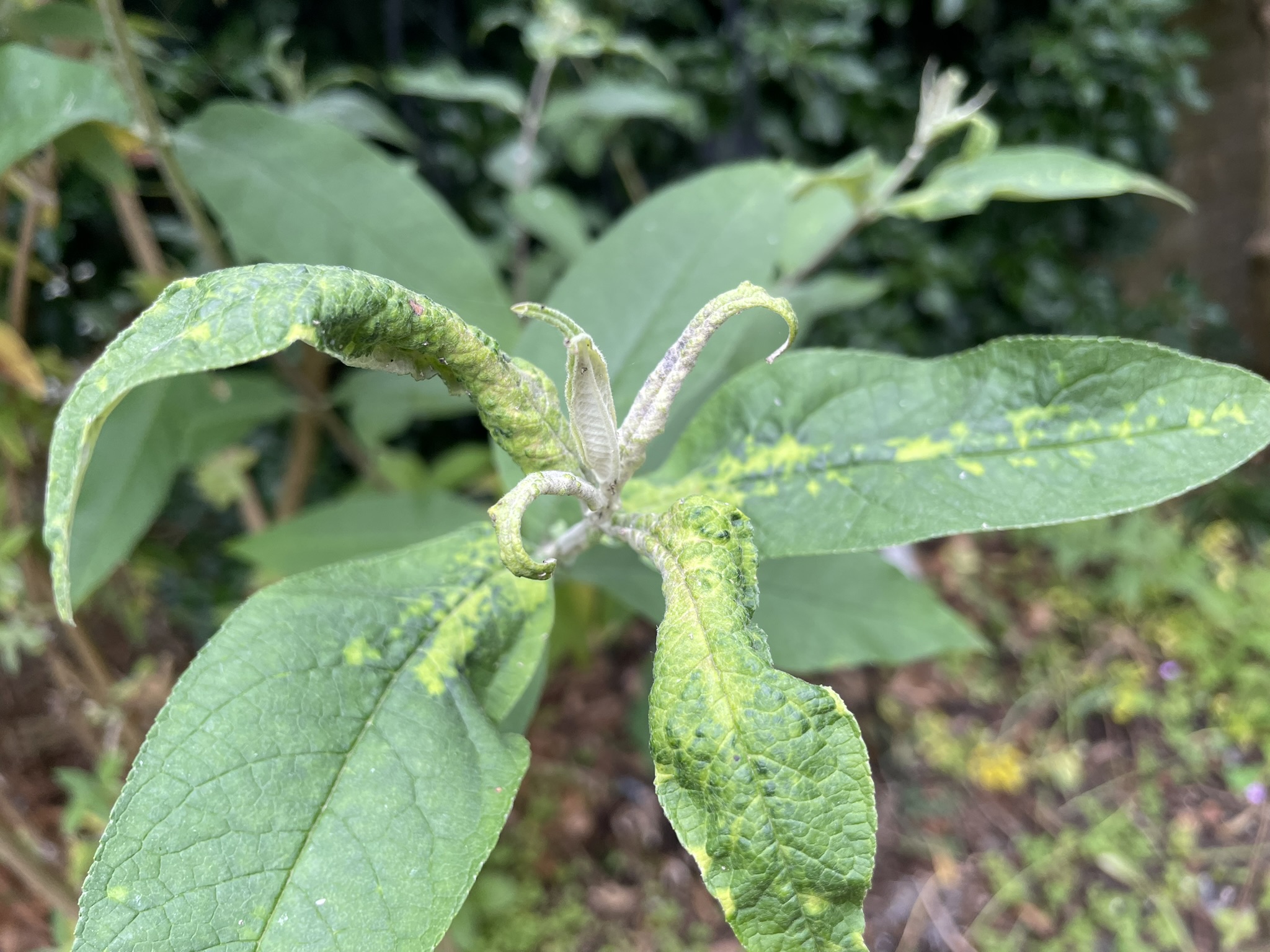
Melon-cotton aphid (Aphis gossypii) on Buddleja
Those above are the most common aphids that affect leaves on fruit that I can think of. In the last couple of years, the ornamental Buddleja has started having a noticeable problem with aphids: the RHS is investigating the extent of this new issue and any sighting of deformed leaves with yellow discolouration can be reported. Initial alarm was caused by the resemblance of symptoms to viral infection; however, test results were clear. The damage is mostly harmless and likely caused by the melon-cotton aphid (Aphis gossypii), a polyphagous bug that – as the name reminds us – is particularly fond of Cucurbitaceae (under glass at our latitudes).
My garden her in the Netherlands is not exempt: one of the two Buddleja plants I have is particularly susceptible, as you can see in the picture below.
Im pretty positive that for each plant on earth there is at least an aphid species that has a taste for it! I will write about aphids again.
For now I will just conclude by briefly going back to what I mentioned at the beginning of this post: aphids can transmit viruses if they visit an infected plant and shortly afterwards – that is in the ‘lifespan’ of the virus outside its host (virus are not technically alive, hence the inverted commas) – they move on to feed on another one that is also susceptible. A number of aphid species, for example, are suspected to be vectors for the Plum Pox Virus (see this Defra factsheet), which is a nasty disease, like most viruses. A biodiverse garden puts obstacles in the way of aphids, so that they are less likely to jump from plant to plant, spreading diseases. For one, plants can work as phyisical barriers in the way of aphids; polyfagous aphids can end up on plants that are not susceptible to the virus and feed on them, thus interrupting the chain of infection; a diversity of plants offers more opportunities, not only for aphids but for aphid predators too; and so on.
There are AHDB Crop Walkers’ Guides for most fruit crops and some ornamentals on their website, where you can find more information.
 M.Paola, that’s me
