Orto di Casa Cecconi

My first allotment, and then one thing leading to another…

  • Atropa belladonna (Week 15, Wedesday)

    Weeding around an overgrown Oemleria (and you know that an overgrown Oemleria is a swallower, don’t you?) I found inside it a large herbaceous plant with beautiful purple, bell-shaped flowers and entire, ovate leaves.


    A little bit of research online did not provide a match, and my colleague also had no idea what it might be so I took the pictures with me at lunch time. Luckily we have a colleague who is a weed enthusiast and she identified it: Atropa belladonna, deadly nightshade, it is!

    Of course I removed it straight away, because all the parts of the plant are poisonous to humans, they are neurotoxic. I knew the plant for its medicinal use in opthalmology, as in Italy they use atropine during eye checks to dilate pupils.

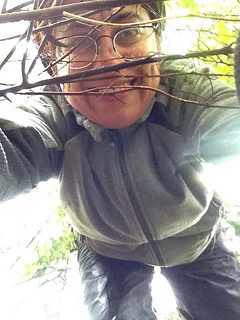
    Round the corner, well inside the bed, another plant, under another Oemleria: obviously that creates the right environment. This plant was rather large and, once I had pulled it, I took a picture of myself with it.

    And I understood why it is so dangerous: the ripe berries are such a delightful glossy black that they are screaming: “Eat me!” at whoever happens to lay their eyes on them…

    … the plant is so poisonous that even the name of the genus derives from the mythical figure Atropa: the third Fate, who held the scissors to cut the thread of life*. The species name, instead, is from the Italian “beautiful woman”: apparently the juice of the deadly nightshade was applied as a decoction to beautify – which at the time meant pallid skin and dilated eyes…

    Be careful if you find one, I only touched it with gloves on.

    Notes

    Source: The names of plants http://dnulib.edu.vn:8080/dspace/bitstream/DNULIB_52011/190/1/tencuathucvat.pdf

  • Holly Walk (Week 15, Tuesday)

    The Ilex collection at Kew is the largest of mature cultivars in the world but I must admit my prejudice: I find Holly Walk rather depressing, it’s my least favourite place in Kew and not only because it is an area under renovation. I’m not a fan of evergreens, or hollies, and this is 1 km of them!

    Today it was the first team day after I have been back, and we were doing it again… but heigh-ho, we were there to make it prettier and I was determined to tackle some of the big tree circles.


    First holly: plenty of dead leaves, affected by cushion scales, and an Oxalis that I have not seen before, probably O. debilis, with bulbils at the base so that if  you pull the plant, they scatter everywhere – clever!

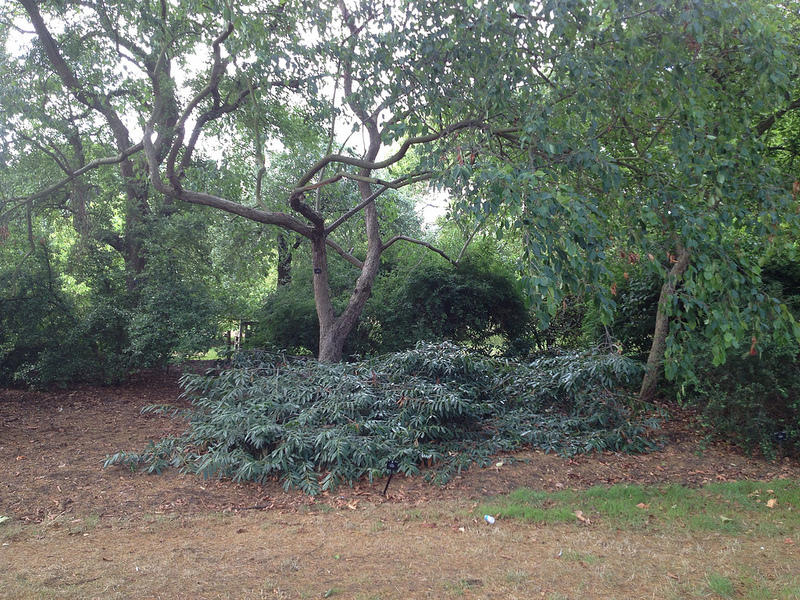
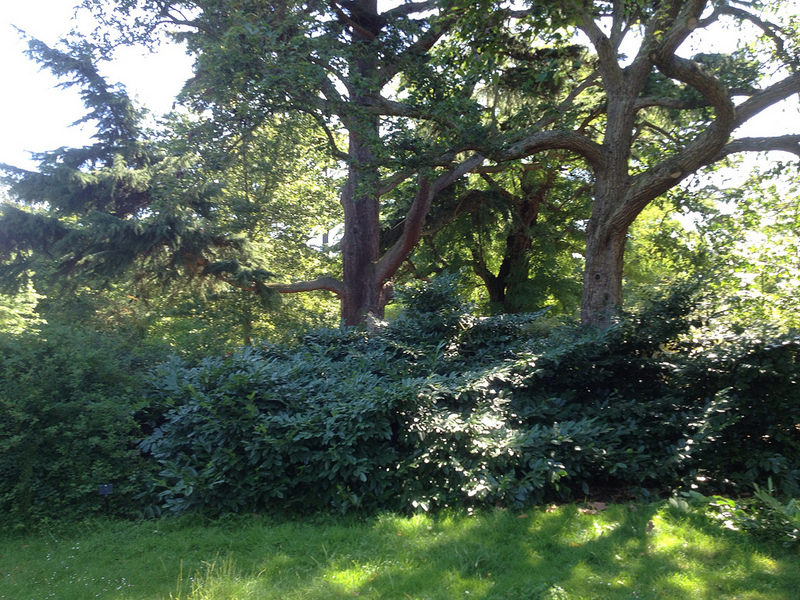
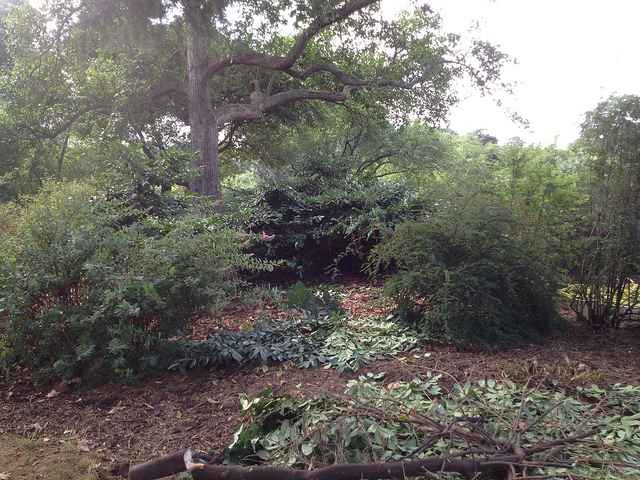
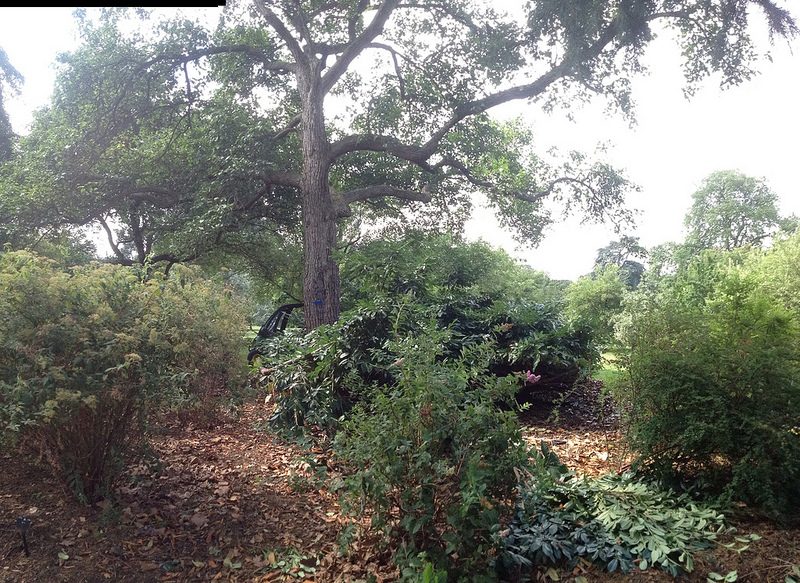
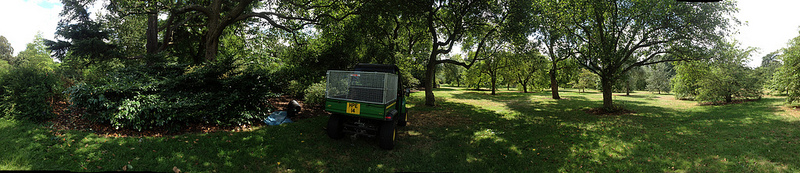
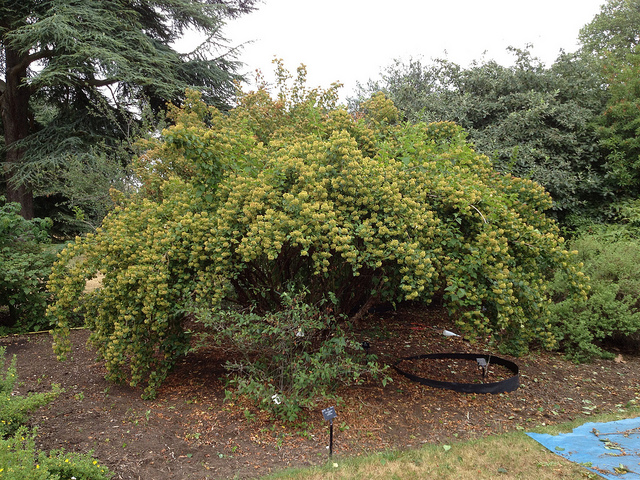
    After warming up under that holly, I spotted Ilex cornuta “Burfordii”, a rather large specimen, under which every sort of weed was growing and that was particularly difficult to access: the project for me!


    Actually, it kept me busy for the rest of the morning, me and two colleagues who joined in.

    We found under it:

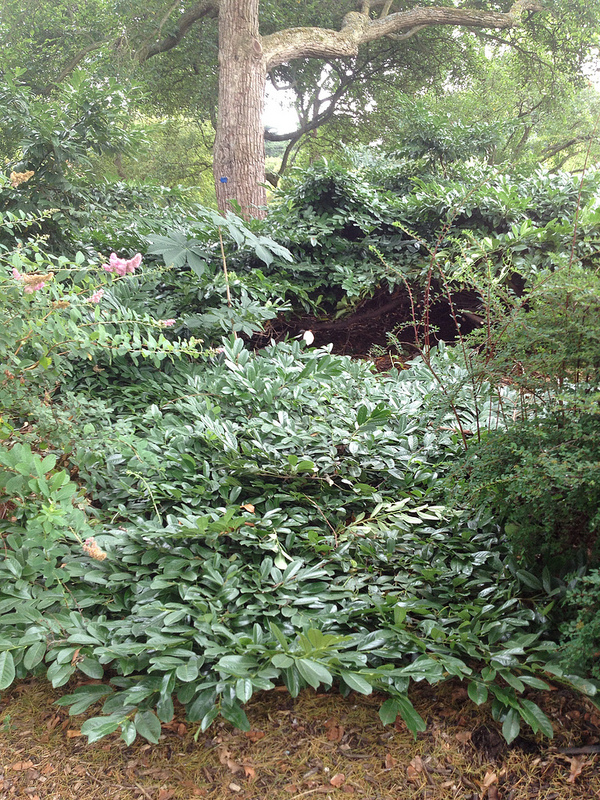
    • a badger sett
    • a few brambles rambling over the branches
    • one holly
    • three unidentified little trees, possibly Diospyros spp.
    • a few bryonies, a couple of them the biggest roots I have digged out so far!

    Badger sett
    Bryony’s roots

    Bryony is a lovely wild plant and one of the first weeds I encountered in my beds at Kew. I did not know what it was and neither did my colleagues, so I decided to grow one plant in a hidden spot to see what flowers would come out. After that, identification was the easiest thing!

    Bryony as I first saw it
    The first flowers!

    After scraping the soil
    How it looks now
    Bryonia dioica, red bryony is a dioecious (you need male and female plants for viable seeds) herbaceous perennial (it dies back at the end of the vegetative seasons and perennates as roots) of the Cucurbitaceae family, that climbs over other plants through tendrils (twining, modified stems). The genus name means “sprouter”: it certainly does come back year after year, building up a huge perennating tuber as food store! Unfortunately, it is not edible, rather toxic. 

    After lunch we did a rather satisfying job, and one that really made a difference to Holly Walk: we raked away tons of dead leaves – it looks so much better for it! 

    It was a really hot day, so we needed plenty of fluids to keep us going, but we did achieve a lot: productive team work.

  • Back in the beds! (Week 15, Monday)

    I am back in the beds today and I think nobody could fail to notice the vast smile on my face & the jolly greetings I was dishing out, even first thing in the morning. Not I for one: it surprised me, how much happier being outdoors made me feel!

    Three months gone, so the third year student I was working with has moved on, assigned to the Japanese Gateway he loved so much: I’m happy for him as these are his last three months with Kew before he’s off. While I was in the nursery, he spent some more time mulching the South Canal beds with the new student assigned to them, but now he has left the two of us to take care of them.


    The weather has been dry for a while: there are cracks in the beds and our plants, especially the Spireas, look a bit sad and wilted, so my colleague has spent most of the day sorting the watering , while I tackled the weeds head on.

    I have been away only two weeks and Oxalis repens is all over the place, and what is worse, it’s going to seed!

    By the end of the day I had filled a couple of buckets. All in all, a quiet day of maintenance and a soft start, but now I feel the pressure of finishing the stock-check before I myself move on!

  • Euonymus: a plant I'll never forget (Week 14, Friday)

    Euonymus europeus, the spindle tree, with its characteristic bright pink seedpods with orange seeds sticking out, is a plant I have known for a while. I had it in my garden, I picked seeds from one last winter which I am trying to germinate, and it’s in my next plant ID test.

    But I had never known Euonymus fortunei. Or, rather, everyone knows it, it is so pervasive in gardens, only I had never know it was that plant. Before I potted on some 200 rooted cuttings, that is.

    The most famous specimens are the variegated ones, coming with such cultivar names as “Emerald ‘n’ gold” and are so pervasive that I can see them in at least 3 gardens only in my road, including my next door’s neighbour. Who, incidentally, the other day asked me what to do with some branches that were reverting back to plain green, as he had heard that it might spoil the plant.*

    Here are some pictures of the specimens I potted on:


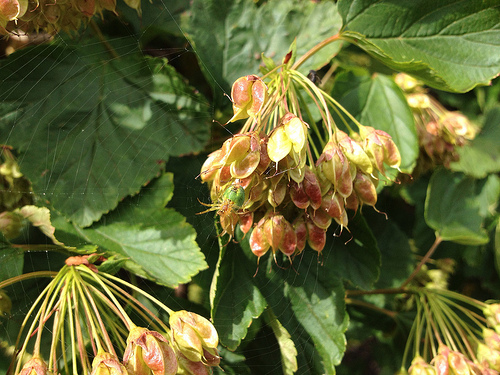
    Some of the cuttings were flowering, with small, inconspicuous but cute green flowers, on cymose inflorescences (one flower at the end of each branch) with antisepalous stamens (in between the petals) and  green carpel with superior ovary (above the other floral parts). Like in the picture below.


    What do you think of this species?

    I also potted on another Euonymus sp., not identified, which – I must say – was my favourite, as it was a bit more unusual and I found the little opposite leaves with white veins rather graceful.

    Note: *Variegated plants are usually derived from a sport, and propagated vegetatively. The variegated part of the leaf is not green, hence contains less chlorophyll and photysintesizes less effectively. As a consequence the plant is less vigorous. Reversion to the plain green form makes the stems more vigorous, and they may overpower the variegated ones.

  • Mastering the art of watering – and some science too (Week 14, Thursday)

    Having watered every single day, first thing in the morning, for almost two weeks, with the responsibility to keep a botanical collection in good nick, has really changed my perspective on what I have never considered one of my favourite activities: I would do a raindance any time rather than have to water!

    Anyway, even on the plot, I notice the difference. I really pay attention that plants have a good soak, because it is incredible how much water it might take for a pot to get soaked through, and for water to seep down beyond the soil surface.

    It was strikingly clear when potting on, look at the three samples below: I thought I had soaked all of them through, but only one was, while in the other two most of the compost was dry.


    Air pots do not help in that respect, as water easily pours out of a hole, at the end of a cone, if it finds a way through. On the other hand, they cannot really get waterlogged. Considering that, I am now checking that all lighter pots are not dry at the bottom, and if they are, I keep pouring water until I can see it running out of the bottom with my own eyes. In the case of some compacted, or particularly dry pots, it might mean passing over the plant five or six times.

    At the plot, I noticed the same: I was watering with a hose, which I had left on the same spot quite some time, but when I scratched the surface, water had not really seeped past the first few millimeters. As I could not remember all the details of how water moves through the soil, and what factors affect that, and was really keen to understand more, I did a bit of research.

    Infiltration is the entry of water through the soil surface. It depends on several factors, including soil texture and porosity (cracks and pores allow water into the soil more easily while compaction prevents water from seeping through), which in turn depends on soil composition (sandy soil have generally bigger pores, clay soil expand and contract with the level of humidity, organic matter favours absorpion of water), on previous soil moisture content (wet soil absorb less than dry ones), whether the impact of the drop of water is sealing any pores (soil capping; the presence of vegetation, for example, usually prevents that, that is why you should not leave soil bare in winter), whether there are any hydrophobic substances on the soil surface (such as some oils from chaparral leaves). A presentation on the University of Wisconsin’s website finally cleared my doubts about how infiltration happens. Infiltration depends on the balance between cohesive and adhesive forces. Water drops stick together because of cohesive forces among their particles that create what is known as the water surface tension. The angle with which a water drop touches the soil may or may not cause adhesive forces, and the composition of the soil happens to alter such angle, and that is how some soils’ “wettability” is higher than others.

    Once inside the soil, water moves both vertically and laterally through gravity and capillary action.


    Movement through gravity is called percolation and the wetting front’s route is through soil pores (that are big enough) and until it reaches the water table (if there is enough water, otherwise the flow stops when the pull of gravity equals the film tension), saturating a zone before moving on to the next. Field capacity is the state of a soil that has been wetted through, after gravitational drainage has taken place and macropores (>0.05 mm) contain air instead of water again. The amount of water in such soil is its water holding capacity (WHC, measured in mm water/depth of soil). The ideal soil for most plants has a 10-15% air-filled porosity or air capacity, so basically that percentage of macropores.

    Capillary movement is both vertical (up from the water table, or up from wet soil to dry soil because of evaporation*, and down from wet soils) and lateral, and it caused by the cohesion forces inside water. It takes place in micropores (< 0.05 mm). Plants’ roots can only grow into pores that are > 0.02 mm (and anyway if a pore was < 0.01 mm the adhesion forces on the soil particles’ walls would hold the water film so strongly that it is not accessible to root). Permanent wilting point is the state of a soil that does not make any more water available to plants, so that they remain wilted after the night (while wilting during the day because of transpiration, at night they would usually recover, that is until PWP is reached), and until they get watered.

    Notes:

    *a dry layer of soil (20 mm) helps conserve moisture underneath, acting as a buffer by interrupting the suction forces exercised by water films and their internal cohesion: a reason not to water little and often, but soaking through! Also, a life canopy shading the soil surface prevents drying out, again: do not leave soil bare.

    Availability of water to roots is restricted by high salt concentrations in it: osmosis works from low salt to high salt, so if the salt levels are higher in the soil, osmosis is actually reversed, water flows out of the roots, cells lose water and may die (plasmolysis). A good reason not to apply too much fertiliser.

    Organic matter in the soil improves
    a. soil fertility and availability of nutrients
    b. aeration (before decomposition, when particles are still large) and infiltration by opening up the soil, and
    c. soil aggregation and water holding capacity once transformed into humus by soil micro-organisms.
    Humus is a colloidal material that coats soil particles, giving topsoil (where micro-organisms are active) its darker colour. It acts as a sponge and can absorb up to 7 times its volume in water.

    Image from Principles of Horticulture, 5th edition

    The “My agriculture information bank” website has rather clear basic explanations of these concepts and I found it useful as a starting point in my research.

  • Hygiene (Week 14, Wednesday)

    Quite a few plants grow in a restricted space in greenhouses, so hygiene is particularly important to prevent and control the spread of pests and diseases.

    In terms of prevention, clean tools and surfaces are very important. So pots are dipped into a sterilising solution and tools are cleaned with Hortisept, a persistent germicide active against bacteria, viruses and fungi.


    The greenhouse is hoovered clean of plant debris, including the benches, which I did today.

    Bench after hoovering
    Bench before hoovering


    The pots in which the plants grow are also kept clean, by removing plant debris and any weeds, liverworts, mosses or algae that decide to take residence. In fact, although these last three groups do not have roots and do not strictly compete for nutrients with the plant, they are in the way of good maintenance. Availing myself of the latest technology, I used a kitchen fork to help me with the task.

    We have quite a lot of Merchantia polymorpha on our pots… I find bryophytes really interesting! 

    Unlike the spermatophites (conifers and flowering plants), more familiar to us, where reproduction happens in the cones or in the flowers’ ovaries respectively, resulting in the production of seed from which the next generation will be born, bryophytes have a two-generation reproduction process. The gametophyte generation produces sperm and ovules that meet outside the plant in any moisture film that might be present (i.e. after rain) and give birth to the sporophyte generation, growing on top of it (like the umbrellas of Merchantia) and producing spores, starting the process all over again. If you want to know more about Merchantia‘s lifecycle the University of Miami dept. of Biology has a nice graph and some information about them.


    In terms of pests and diseases, scouting for their appearance and monitoring spread is the best way to prevent them reaching unsustainable levels.

    For this purpose, in the greenhouses we have plenty of butterwort (Pinguicola sp.), a carnivorous plant with sticky leaves, which is used to monitor the appearance of aphids, so as to release bio control at the right moment.

    Today, when clearing debris from under the weaning pots outside, I found some vine weevils (Otiorhynchus sulcatus), so I alerted the greenhouse manager who is going to spread some more nematodes.

    Inside, I encountered three pests so far:

    • soft scales (Coccus hesperidum), which I was familiar with as they infected my Citrus at home a while ago, and which I was instructed to spray with insecticidal soap
    • cushion scales (Pulvinaria floccifera), which were new to me, look like soft scale except when they lay eggs in sacs that appear on plants – holly in my case – as white cottony stripes (in fact they are also known as camellia cottony scales); they are most susceptible to insecticidal soap in the crawling stage
    • mealybugs (Pseudococcus sp.). They nest in crevices in plants and are rather difficult to get rid of. They look like tiny, white woodlice with three tails, and cluster in masses, protected by waxy threads.
    Individual mealybugs
    Cluster of mealybugs
  • Mastering the art of potting on (Week 14, Tuesday)

    I have been potting on plants for a few days now, and, as you usually do, the more you do something the more you see what’s wrong what you are doing, and get a better feeling of what you should do.

    With air pots, I find there are two main tricky parts in potting on, and they are linked:

    • pressing the soil well
    • getting the level of potting right

    If you do not press the compost well, you will have two issues: the superficial roots will come out at the surface when you water, but not only that, the compost level will fall below the rim margin and water will start pouring out from the holes at the end of the cones, instead of soaking through the compost itself. Which is also a problem if you do not get the level of potting right, and conversely, if you plant too high, water will run off from the top of the pot, with much the same result. So you have to have enough margin to fill with water so that it can soak through the soil, not too little (flows out from the top) or too much (flows out of the holes). I found mastering this particularly tricky, because we have different generations of pots and some have larger cones, some smaller ones, or they have two rows of cones for a rim instead of one.

    Anyway, while trying to improve my potting on skills, I have also tried to speed  up and while yesterday I managed to pot up 50 plants, today I managed 75!

    Taking the potted on plants
    back to the benches
    The bench I am filling with the newly potted on plants


    I myself have mainly been potting on Euonymus cuttings, but also helped colleagues with the pretty plant in the Hamamelidaceae family, witch hazel Loropetalum chinenses f. rubrum ‘Blush’, which, besides pinkish leaves and stems, also has pink roots!