Orto di Casa Cecconi

My first allotment, and then one thing leading to another…

  • Auxins (Week 14, Monday)

    I was mentioning the other day we used synthetic auxins as rooting powders, and today, walking about the greenhouse and the yard, I found more examples of auxins’ influence on plants, which I will share with you.

    Auxins are one of the families of plant hormones, still rather elusive substances, synthesised in small quantitied by plants somewhere in their tissues (i.e. root tips) to send growth messages across to other tissues either locally or elsewhere .

    Of these substances, auxins were the first to be discovered, the most common form they take in the family being IAA (indole-3-acetic-acid). Once they were discovered, we tried to replicate their effects, synthesising substances in the lab: those, together with the natural plant hormones, are collectively known as plant growth regulators.

    The current hypothesis is that plant hormones are difficult to trace because they are active in such small quantities, and possibly different mixes of the same substances have different effects. If you read a range of books, they will all say slightly different things about plant hormones, but they generally agree that auxins:

    • affect cell elongation in stem and roots, in particular, they are behind tropic responses. For example, take phototropism, the plant’s growth response to light. Positive phototropic plants grow towards the light (i.e. Kalanchoe stems bend towards the light: mind where you put your plant! Tropic responses are irreversible). Negative phototropic plants grow away from the light (i.e ivy-leafed toadflax – Linaria cymbalaria – which grows on walls, has stems that, after flowering, bend away from the light to direct seed pods towards wall crevices, where the seeds will get a chance to survive).

      The way auxins work is by accumulating in the shady side, stimulating elongation of the cells, so that they get longer than the ones in the sun, and as a result the stem bends away from it.


      Today I was watering a Rhododendron and noticed a broken stem. At first I thought I might have broken it, and was thinking how clumsy of me… when I noticed the stem’s tip had moved upwards towards the light: a phototropic response which would have taken some time to take place… so not my fault! 

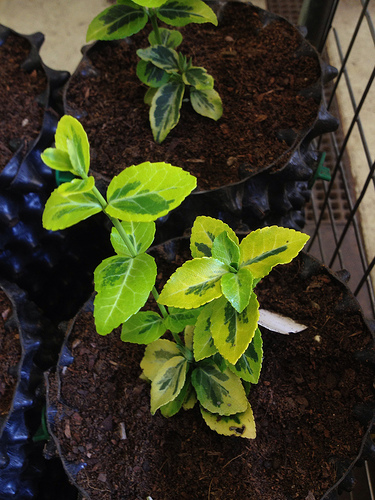
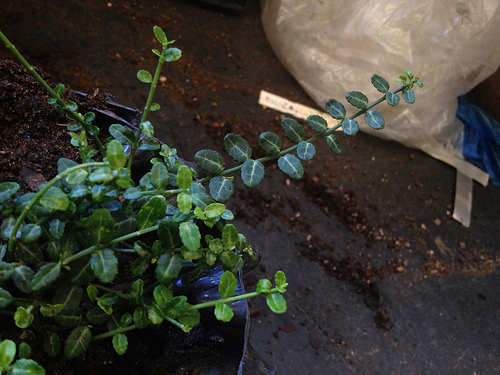
    • Auxins are mainly produced in the stem and root tips and move directionally (top to bottom and bottom to top respectively). When produced in the stem tip, they help maintain apical dominance, which means that the uppermost bud grows tall and the other ones beneath it, in the leaf axils, do not grow. Once the uppermost bud is removed, the other buds start growing. Because of that, pruning generally makes plants bushier. I noticed that quite strikingly in a Euonymus cutting.
      Apical dominance suppresses
       the growth of lateral buds
      Once the apical bud is removed,
      buds in the axils start to grow
    • Auxins promote root initiation, that is why synthetic auxins (for example α-Naphthalene acetic acid or NAA and IBA or Indole-3-butyric acid), or willow water, are used to help rooting.
    • Because of the way they make cell grow, some synthetic auxins (for example 2,4-Dichlorophenoxyacetic acid  or 2,4-D for short and dicamba – 2-Methoxy-3,6-dichlorobenzoic acid) are used as broad-leaf herbicides: the auxins cause the plant to grow abnormally and consequently die. Sigh.
  • Air Pots (Week 13, Friday)

    The polytunnel needed a tidy up, to make room for more plants, so we moved a few pots around.


    We use regular plastic and terracotta pots, but more and more we use air-pots, which have some advantages over the usual pots, mainly:

    • they don’t have a flat, circular surface, against which the roots start circling and become pot-bound; they have the same in-out structure of egg cartons;
    • where the pot walls are sticking out, the cones end in a hole; roots are funnelled into these outward cones and reach the holes where they get air-pruned: they encounter air and die back, so the plant sends out new roots in response.
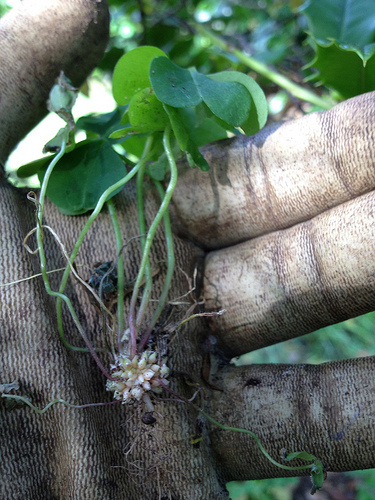
    Fascinating things as they are, however, plants sometimes respond to air pruning by sending shoots out of the holes, like the Deutzia in this picture.

    Another advantage of air pots is they unroll open, so they are quite convenient to pot on plants without disturbing the roots.

    Also, they can be rolled closed again, cleaned and reused, which we do, after keeping them a few hours in a sterilising solution.


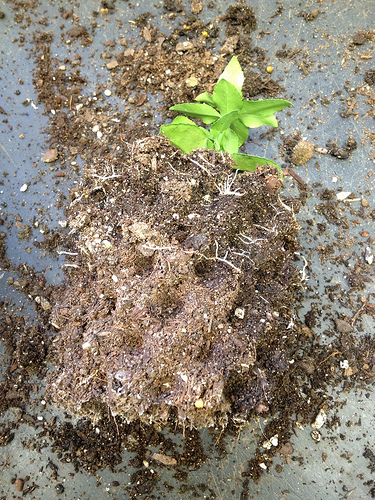
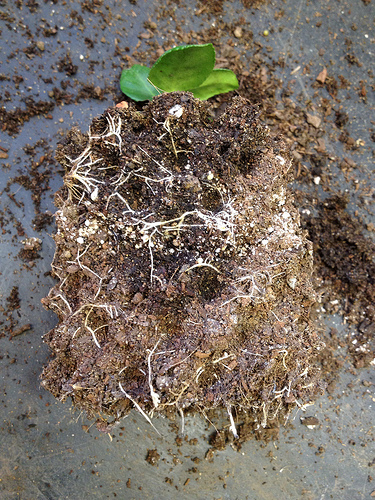
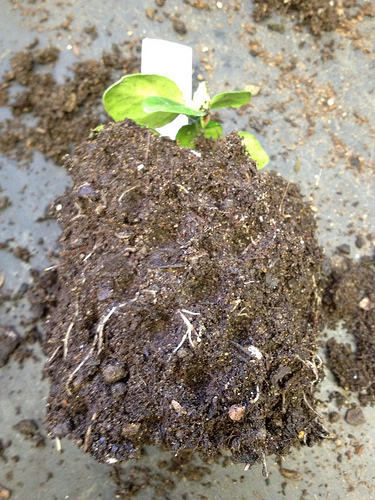
    Just out of curiosity, I have shaken clean of compost a rooted cutting that we were throwing away, and it is really amazing to see the amount and ramification of roots – they were obviously happy in the pot.

    We also got a chance to make some new pots from scratch, as a new batch arrived for us to trial. It’s a new size, tall and narrow, meant to contain rootstock plants.

    In the pictures below you can see how it is done step by step. The pots come in sheets, which I guess are easier to transport. You can tell what the top is because the first two rows of cones do not have holes, so they work as a water-retaining rim, that allows you to water the plant (otherwise the water would flow out of the holes sideways instead of downwards towards the roots)

    There is a bottom disc, which is designed as a grid so that the roots grow downwards and do not get stuck inside the pot, and a little cone at the centre directs them outwards. You place the bottom some 3 rows up, so that roots will never sit in water and rot.

    Then you roll the pot closed and firm it with a screw handle. Job done!

    Unpacking the pots


    Bottoms 3 rows up
    Roll the pot
    Screw close
  • Mixing compost and potting on (Week 13, Thursday)

    I learned how to mix compost today, that we then used for potting on. It was fun!

    We get our compost components in bulk basic mixes in massive canvas bags. Depending on the use to which the compost will be put to, we will then mix those basic mixes together to give the desired texture: shovel and buckets at the ready….

    The compost we were making today was for general potting on and had to be made up of 3 parts of a coir + woodchips + controlled-release fertilizer mix to 1 part of a sand + gravel mix.

    Add an electric mixer, like the ones builders use… et voila…

    … our potting on compost is ready for the bench.                                                                                                                                                                                  
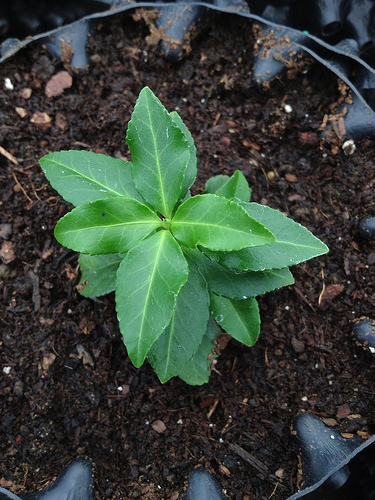
    With the compost ready, we had to pot on a range of saplings from the small pots in which they were first sowed (seeds)/potted (cuttings) into medium-sized pots, where they can grow on and establish. 
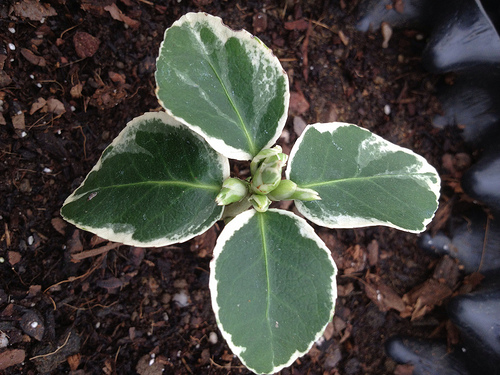
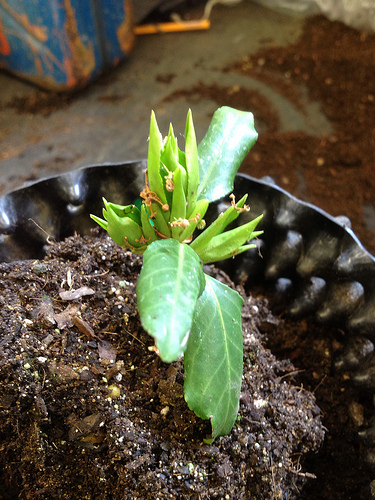
    The one in the picture is a rather elegant Pistacia species with green-bronze stems and leaves that also have a bronze underside. 
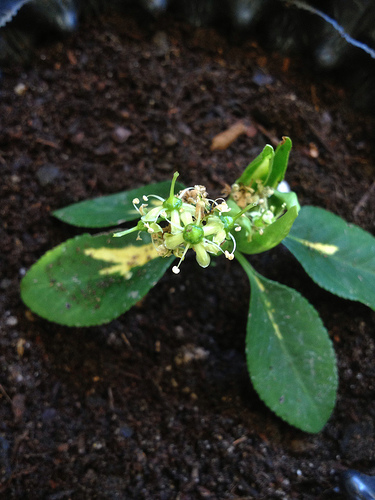
    It is interesting to be able to observe plants this close when you pot them on, but potting is not an easy task to get right, especially when you are relative new to it (of course I have done it for my veggies, but here it is serious business).

    You have to press the compost well at the bottom, otherwise the level will go down when watering and the plant will sink, so there will be less room for the roots to grow into. Also, if you don’t press it well around the plant, watering will make it unstable and it will get dislodged.

    You also have to be careful that the level of the soil is at the root flare, so that you do not plant too deep. 

    When you are finished, the plant is ready for a good soak. 

    The nursery manages the stock so that they start with as many cuttings/seed as possible depending on:

    • number of required plants needed at the end;
    • available material;
    • how easy the plants is to propagate;
    then they keep some redundant stock to account for any losses while the plants establish, but, at every round of potting on, only a selection of the best plants are kept. That is so that space, material and effort to keep them when they are already established is optimised, still allowing for some extra specimens at the end for the commissioning department to choose from. 

    If the plants are of botanical interest, such as the ones that have been collected in the wild during expeditions, any spares available thanks to this redundancy system is shared with other gardens so that genetic material is preserved, should anything occur to the Kew specimens in the future. 

    To make an example, let’s say, for an easy plant to propagate, of which the commissioner needs 10 specimens at the end, they will take/sow anything in excess of 30 cuttings/seeds. 

    Of the ones that take, they will keep a good amount, let’s say 35 and pot them on in small pots.

    Then, at each of the successive rounds of potting on they will keep a few less, choosing the best ones: the most vigorous and healthy, with a good root system.  

    In our case, let’s say there are 2 rounds of potting on: into mid-size pots and then on into large pots. 25 plants will be kept in the first round, and then 15 only will go into the large pots, to be weaned out of the nursery. 

    I have always found it hard to get rid of even the weakest seedling, because I am always fascinated by the growing process, and that “miracle” that a plant emerging from a seed is, or a cutting that sends out roots and lives on… but you have to be ruthless if you want flourishing plants, the best genetic material, with the best chances of survival. That is, after all, what happens in nature.

    I am definitely getting better at it, even if I’m still making a conscious effort every time…

  • Planting out in the nursery beds (Week 13, Wednesday)

  • Cuttings for the Temperate House (Week 13, Tuesday)

    The Temperate House at Kew is closing on the 4th of August for restoration, and will stay closed for 5 years. On account of that, some of the plants will be propagated to be ready when the House re-opens, and the arboretum nursery is taking care of part of the collection.

    So today I had an opportunity to take softwood and semi-ripe, tip nodal cuttings from material the Temperate House sent us, which was lucky, because most of the propagation in the nursery is done in autumn and winter, when plants are dormant.


    The material was collected by the Temperate House staff in the morning, before it was too hot, and put into sealed plastic bags to conserve moisture (so the cuttings did not wilt through transpiration) while being delivered to us.

    As soon as we received them, one by one we dealt with the bags of material, taking it out on our potting benches and selecting the best stems to cut. All the material was labelled with the plant name and its accession number.

    With a sharp blade, we mad a flat cut about 15 cm from the tip just under a suitable node (mostly to include some semi-ripe wood). Then pulled (or cut close to the stem, depending whether they came off nicely or peeled off some of the epidermis with them) all the leaves at the bottom. You usually leave only four at the top, so that photosynthesis does still take place and the cutting gets its food while putting out adventitious roots.

    If you are restricted to material with any flowering tips on them (ideally you would get a non-flowering stem), the flower buds are best removed too, as they divert the plant energy from root formation (by releasing hormones).

    The cuttings were briefly dipped into an insecticidal soap solution to kill any pests, and they were thus ready for planting on the rooting benches. First, however, a propagation sheet needed to be compiled for recording purposes and to keep track of how successful the propagation has been. The form included:

    • name of the commissioning entity in Kew, 
    • name of the propagator, 
    • name, accession number and conditions of the plant material,
    • number and type of cuttings,
    • treatment information (with rooting hormones, which have as active ingredients synthetic auxins, and often fungicide added to them, to protect the wound while it heals)
    • composition of the rooting compost and location in the greenhouses.


    Once the forms were filled in, and all leftover material disposed of for composting, we proceeded to the benches, where we planted the cuttings in rows, after dipping them in the hormone rooting powder.
    As the cuttings are different sizes and numbers, depending on leaves and nodes’s structure and the amount of available material, we soon found out that it is quicker to lay them down in advance to determine spacing (not much is needed, by the way: I used to keep more at home).

    The bench is covered by a polythene tent to keep the moisture in and there is a heating pipe under the bed for bottom heat, which helps tissue to heal and roots to come out. The rule, as I studied it, is “warm bottoms and cold tops”, so that the plant is encouraged to root before sending out more shoots, which (by requiring extra water and nutrients take-up) might put too much stress on the weak rooting system while it develops.

    Day two at the nursery gone in a whiff.

    Just a NOTE, for those of you interested in organic: hormone rooting powders/solutions are not allowed as they contain synthetic substances and fungicides. I hear that dipping cuttings in willow tea/water (water in which willow bark/young stems have been soaked) might help, as willow – an easily rooted plant – is rich in natural auxins. I have not used it but know someone that does, if you are interested in more.

  • In the arboretum nursery (Week 13, Monday)

    So today was my first day in the arboretum nursery. July is the month when the Kew Diploma students in the 1st year finish their classes and go back into the gardens, so with me was also a student, new to the nursery.

    We were shown around, and then assigned an area to take care of.


    For the next two weeks, I will have responsibility for temperate greenhouse 30A. Inside, some rootstock plants, bedding plants (i.e. Euonymus fortunei) that will be used around the Palm House, some propagated Ilex from the holly walk that need replacing, and the collection of rhododendrons that will be used to populate the new area when it is ready (as the soil is getting impoverished in the current area and the stock needs rejuvenating).


    I am also looking after the two polytunnels (one here portrayed with peacock and plane, two of Kew’s most characteristic sightings!) where some plants are grown on before going off to their final destination.

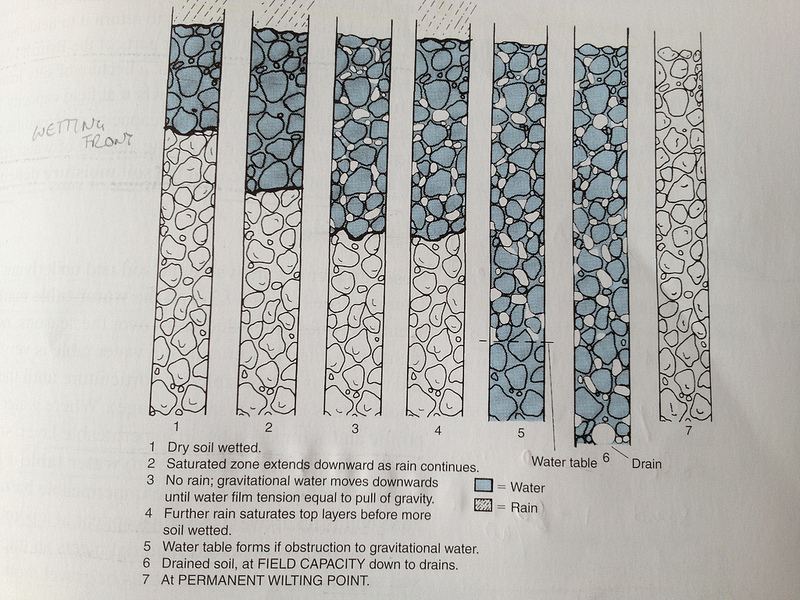
    The day starts with taking the min/max temperatures from all the houses and polytunnels, and checking that the mist unit and hot pipe are working. Then it’s watering of those plants that need it. I find this task quite daunting, as I am very conscious that overwatering can kill more than letting plants dry out. Roots cannot get oxygen from soil that is waterlogged, so they cannot perform respiration, they die and rot.

    In order to check that a plant needs watering I am looking at three things:

    • the surface of the soil is dry; that is not enough however, because the surface is what dries first and underneath the soil might still be wet;
    • probe to see if soil is wet underneath the surface, looking under those pots that have grids instead of bottoms or even opening those pots that can be unrolled (if in doubt);
    • weigh the pots: if the soil is dry they will be rather light compared to those with wet soil in.
    But it is really a skill to understand when a plant really needs watering. 

    What I know very well is that little and often is not the way to go with plants, so I give a good soak to the plants that need watering, going over them twice, waiting for the water to trickle out of the bottom in between the two sessions.

    I try not to wet the leaves to avoid possible diseases, but it is disputed whether that might be a problem in a well ventilated environment. Scorching on wet leaves in the sun might be more of a problem

    Watering took me most of the day, today, and I had just a little time left to help clean and cut back some plants that are ready to go out. My first day in the nursery flew by…

  • It’s raining on prom night (Week 12, Friday)

    Coming to work to Kew has made me want to sing, something I had not done for a long while. Since I am driving for a minimum of 1.5 hrs/day, that’s been a good opportunity to practice in an isolated space, where my out-of-shape, shaky voice, that could not reach up to high notes any longer, was not going to disgrace me in the eyes of anyone 🙂 After trying out a few CDs, I have stuck with Grease the musical pretty much throughout the three months, so I now know it all almost by heart, hence the idea for the title today.


    Not really to do with prom nights, but it is my last day on the South Canal beds (at least for a while), but it was raining today, which slowed me down considerably even though I was working under cover of some trees. As a result, I have not finished what I was planning to do, and, even though I did not end up with flu (as the song goes), I felt a bit like the ‘cruel force of nature’ was doing it on purpose to spoil my plans! Anyway, we desperately needed rain and it is highly likely I will come back to the South Canal beds after my stint in the nursery, so not much of a deal, really.

    Weeded out Cotoneaster

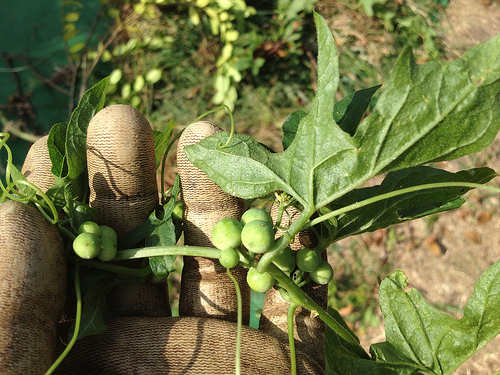
    It was mainly about clearing bindweed, the last of the garlic mustard from the other day, overgrown Rubus, and a couple of large bryony (Bryonia dioica) and bittersweet (Solanum dulcamara) plants. Oh, and the usual self-seeded Cotoneaster, grown to shrub size, unnoticed in a hidden spot.

    Here are some before and after pictures:

    Front, before

    Front, after

    Front, panorama (click to enlarge)

    Back, before
    Back, after
    Back (2), before
    Back (2), after

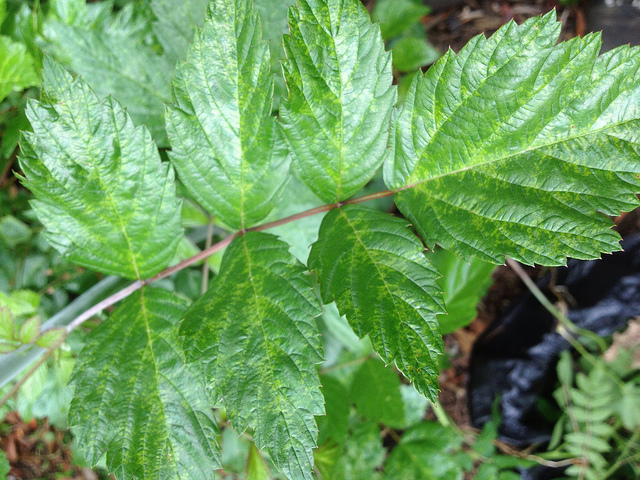
    I seem always to find something that fascinates me, when I work with plants, even in the more mundane of tasks, like weeding and cutting back. Today, I found this Spirea leaf, and then a few others like it. Something obviously went wrong when cells were dividing to make the leaf lobed and dented, which is obviously not a simple pattern, as any of you that are knitters know (casting on and slipping stitches…). The leaves (like a bad knitter might do) seem to have produced too much tissue, which got grafted in the required shape, with all excess just curled up underneath the leaf…